
Think, thoughtful reader, about something you use everyday, that everybody uses everyday. If you are Taylor Swift, the Pope, or Vladimir Putin, you use it. Got a PhD in Physics or just completed your training on the deep fryer at McDonalds and are finally moving up from the drive-thru window – you use it. The necessity for it may be the single-most universal human need beyond food, shelter, and clothing there is, uniting the Muslim fundamentalist in Syria, the Mexican World Cup fan (who has reason to be very happy this morning), and the Wall Street banker.
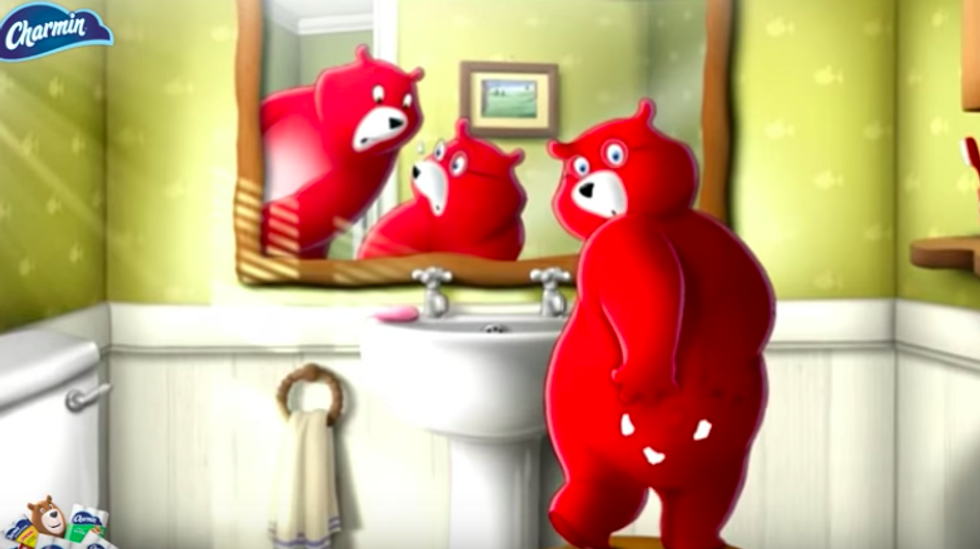
And with the exception of those creepy anthropomorphized Charmin bears whose family life seems centered around discussions of their bowel movements, nobody talks about it. I have touched on it before when this blog discussed the great “over or under” controversy, but on rereading that post I see that I was taking it for granted. Of course “it” is toilet paper, and because it is an item used to wipe your bottom after you’ve had a poo, well, it is not discussed.
We like to think we’ve progressed beyond the stifling sensibilities of the Victorian age, and in some ways we have when it comes to sex, nudity, and dinner table etiquette, although we’d do well to remember one must always pass the Port to the left, never set it down on the table between guests, and ask the person holding on to it too long if they know the Bishop of Norwich – and if they answer ‘no,’ one says, “He’s an excellent fellow, but he always forgets to pass the Port.” Passive-aggressive English manners!
But when it comes to bodily functions, well, it just seems beyond the pale. Like, I wanted to write about the history and evolution of toilet paper today, but I had to concoct this lengthy preamble to ease into it, because I didn’t want to come across as rude, or worse, crass. We just passed 300 words, so I think we can dive into it now.
Few inventions are as universally appreciated yet so rarely discussed as toilet paper. It is an everyday necessity for billions of people, but for most of human history it simply did not exist. People across civilizations improvised with whatever materials were readily available, leading to an astonishing variety of cleaning methods. The history of toilet paper is therefore not just the story of a household product – it is also a window into human ingenuity and changing standards of hygiene.
Long before manufactured paper became commonplace, ancient peoples relied on materials provided by their environment. In prehistoric societies, leaves, moss, grass, smooth stones, sticks, and even handfuls of snow likely served the purpose.
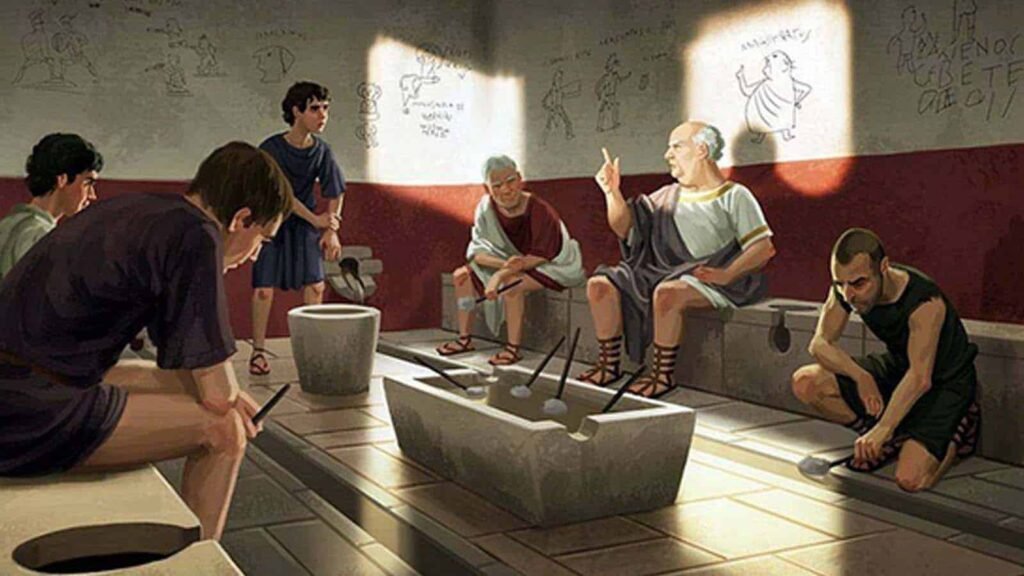
The Romans, renowned for their engineering and public baths, used a communal cleaning implement known as the tersorium – a sponge attached to a stick. The sponge was rinsed in saltwater or vinegar between uses. While ingenious for its time, modern microbiologists would probably not be happy with it today. And there’s no way I’m sharing a stick with you, so don’t even ask.
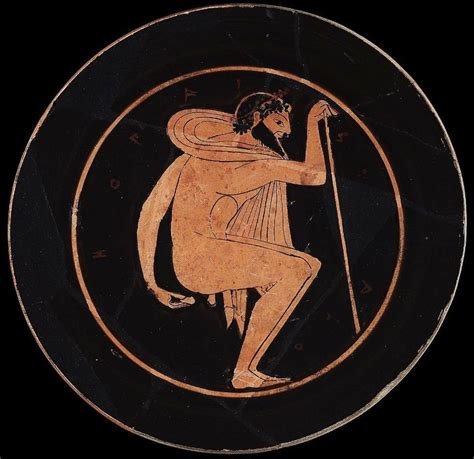
The ancient Greeks used small, rounded ceramic fragments called pessoi. These pottery shards were smoothed to reduce discomfort (well I should hope so!), although they were undoubtedly less than luxurious. Historical accounts also suggest that some Greek ostraca (broken pieces of pottery used for writing names during votes of exile) may have found a secondary use as a bottom wipe afterward. Thus, your enemies could suffer one final indignity as you, symbolically, shit on them.
Across Asia, various natural materials remained common for centuries. However, China would become the birthplace of true toilet paper. Since paper itself was invented in China during the Han Dynasty, it is perhaps unsurprising that someone eventually recognized its potential for personal hygiene.
The earliest written reference to paper being used in this manner dates to the 6th century CE. The scholar Yan Zhitui wrote that he would not use paper bearing quotations from the classics for toileting purposes, implying that less hoity-toity paper was already being used regularly. By the 14th century, production had expanded enormously. During the Ming Dynasty, imperial workshops manufactured millions of sheets annually, including specially perfumed varieties reserved for members of the imperial court. Everyone appreciates a touch of scent in the toilet.
Europe, meanwhile, lagged considerably behind. Throughout the Middle Ages and well into the early modern period, people typically used whatever was available. Depending on one’s location and social class, this might include hay, straw, wool, lace, hemp, old cloth, or handfuls of moss. Sailors often relied upon old rope fibers, while farmers simply made use of nearby vegetation.
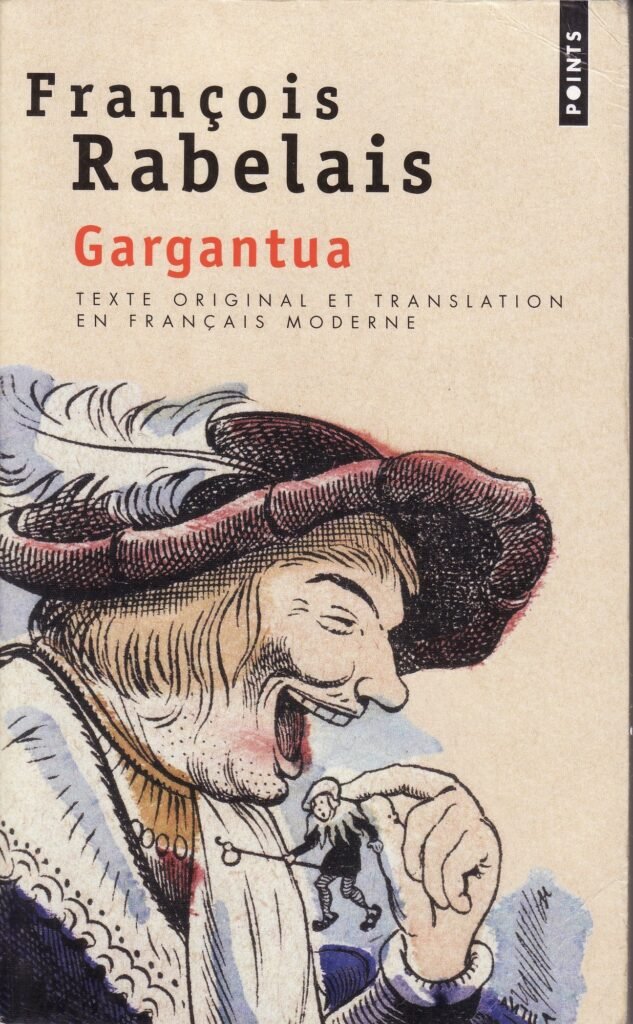
In 1534, the French Renaissance writer François Rabelais wrote the satirical novel Gargantua.
Rabelais begins Chapter 13 with a careful scientific investigation into how best to conclude a trip to the toilet and deal with your left-behinds; his main character, Gargantua, systematically “tests” hats, velvet, silk, cloth, hay, straw, wool, and cats, before arriving at his conclusion. In doing so, he is parodying scholarly reasoning and trying to exemplify the Renaissance spirit of questioning received wisdom.
And then:
But, to conclude, I say and maintain, that of all torcheculs, arsewisps, bummfodders, tail-napkins, bunghole cleansers, and wipe-breeches, there is none in the world comparable to the neck of a goose, that is well downed, if you hold her head betwixt your legs. And believe me therein upon mine honour, for you will thereby feel in your nockhole a most wonderful pleasure, both in regard of the softness of the said down and of the temperate heat of the goose, which is easily communicated to the bumm-gut and the rest of the inwards, in so far as to come even to the regions of the heart and brains. And think not that the felicity of the heroes and demigods in the Elysian Fields consisteth in their asphodel, ambrosia, or nectar, as these old wives here say; for the opinion I have is, that it consisteth in this, that they wipe their arses with the neck of a goose, and such is the opinion of Master John of Scotland.
From Thomas Urquhart’s 1653 translation of the original 16th century French
The passage was never intended as practical advice. Rather, it is classic Rabelaisian satire: outrageous, scholarly in tone, and gleefully devoted to treating an absurd subject with the seriousness of scientific inquiry. The image of someone chasing a goose around the farmyard in pursuit of improved sanitation and pleasure for their nockhole – well, let’s hope you’re laughing with me thoughtful reader and not at me!
The widespread use of printed newspapers after the invention of the printing press inadvertently created a new toilet accessory. By the 18th and 19th centuries, newspapers, pamphlets, and discarded catalog pages had become common substitutes throughout Europe and North America. In rural America, the Farmer’s Almanac became so commonly repurposed thus that editions were often printed with a hole near the corner, allowing them to be hung conveniently in an outhouse.
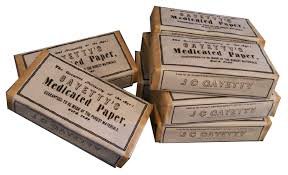
Commercial toilet paper finally emerged in the 19th century. In 1857, Joseph Gayetty introduced what is generally regarded as the first packaged toilet paper sold in the United States. His “Medicated Paper” consisted of flat sheets infused with aloe and marketed as a healthier alternative to newspapers.
The next great leap came in 1890, when the Scott Paper Company popularized toilet paper sold on rolls. Rolled paper proved far more convenient than loose sheets and gradually became the standard. Early advertisements, however, often avoided explicitly mentioning the product’s purpose because then, as now, toilet functions were considered too indelicate for polite conversation. Or blog posts?
Manufacturing quality also improved dramatically over time. Early toilet paper could contain wood splinters (ouch!) or other imperfections from the pulping process. Only in the 20th century did softer, smoother, and eventually multi-ply products become common. Innovations continued with embossed textures, perforated sheets, lotion-infused varieties, recycled fibers, and bamboo-based alternatives designed to reduce environmental impact. And let’s not forget the Charmin bears who tell us, “we all go, why not enjoy the go?” Yah, they still creep me out.
The COVID-19 pandemic unexpectedly elevated toilet paper to international status in 2020. Panic buying emptied supermarket shelves across much of the world. The phenomenon illustrated not merely the practical importance of the product but also its symbolic role in people’s sense of necessities. Economists and psychologists alike studied the shortage as an example of consumer behavior during crises.
Today, toilet paper is manufactured in countless varieties, from economical single-ply rolls to ultra-soft premium products boasting multiple layers and decorative embossing. Yet its history reminds us that this humble commodity is a remarkably recent luxury. For thousands of years, humans relied on creativity, convenience, and local resources to accomplish the same task. And when I was assigning this post’s meta-tags, those identifications down at the bottom next to the @ symbol used by search engines to find and organize content, I paused before adding “technology,” because we think of that as electronic; but what else would you call toilet paper and its fascinatingly rich history other than a story of technology for your bumm?
In the end (so to speak… see what I did there?), the history of toilet paper is a story of civilization itself: from leaves and stones to perfumed imperial paper, from communal Roman sponges to embossed luxury rolls. It demonstrates that progress is measured not only by grand inventions and towering monuments but sometimes by the small comforts that make everyday life just a little more pleasant.

And, thankfully, a great deal less dependent on poultry.
