
What are you up to now ?
When you are cured, your family and friends cheer; when you are dying, they offer their sympathies and mourn. But when you are simply maintaining, they are at a loss, as you are yourself. I am not a “survivor” in the way people who have conquered a disease use that word, nor am I in danger of dying anytime soon. I occupy a strange “in-between” state where the body remains fragile, treatment constant, and life does not so much move forward as stubbornly persist.
This liminal state is a distinctly contemporary byproduct of modern medical intervention. Since my life’s nadir in the winter of 2006, I’ve had pulmonary emboli (blood clots in my lungs), severe double pneumonia requiring hospitalization, and was diagnosed last summer with lung cancer. Any of those could be fatal, as the HIV to AIDS to PML progression of 2006 was diagnosed to be. But remarkable advances in pharmaceuticals, new treatment modalities, and perhaps a bit of luck mean that I’m sitting here today writing to you. Welcome to Act II.
Seneca, a Roman philosopher from the Stoic school of Ancient Greece, said, “Sometimes even to live is an act of courage.” The circumstances I find myself in are like a script, and I’ve always believed you have to act your part in the play – as written – giving life to your character. And this means facing daily challenges with clarity and integrity. I have a leading role, the leading role, in this play. Its second act contains an unexpected major plot twist.
An insensitive individual once said to me (in a ham-fisted effort to cheer me up, I think), “we all could die tomorrow, any one of us could step out in a crosswalk and get flattened by a bus.” True, but as I told him, the random tragedy of which he speaks is a hypothetical; for those of us living with chronic, fatal conditions, the theoretical bus is already idling in the driveway.
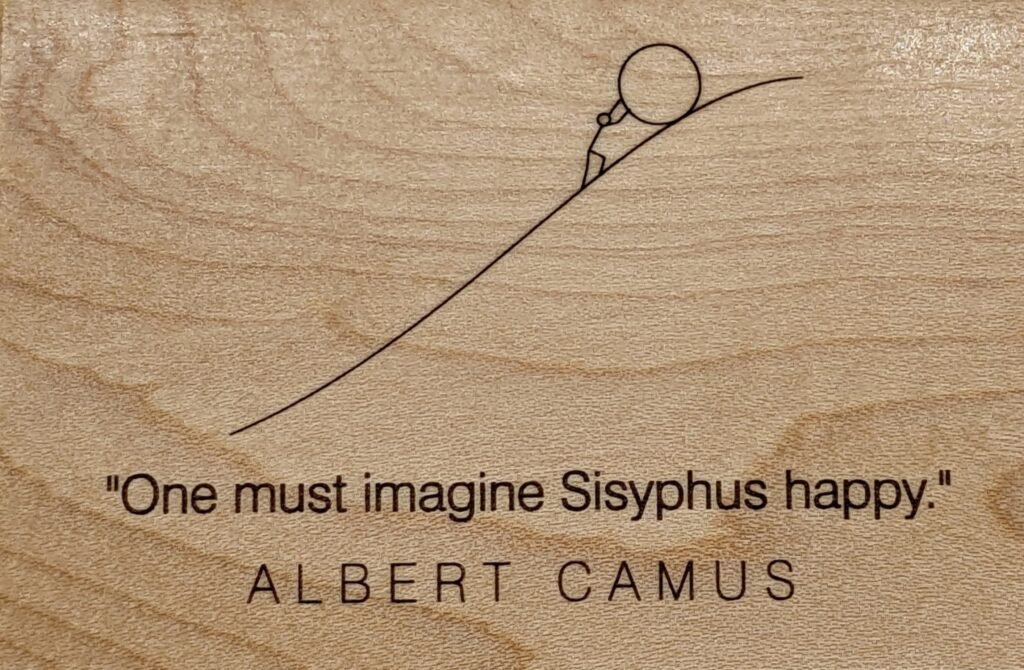
“One must imagine Sisyphus happy,” said Albert Camus, suggesting that Sisyphus in the Greek myth finds happiness in the act of rolling the boulder, rather than in the meaning of the task itself. And another Greek myth – that of the phoenix – gave me a context for moving forward, but Act II called for a scene change. I love Los Angeles. I still consider it the center of the universe. But like so many gay HIV+ men before me, I felt drawn to the desert. Perhaps the harshness of the landscape, beautiful in its own way, is a metaphor for our lives. Maybe the extremes in temperature mirror the emotions of being “sick” but well. And maybe it’s because in Palm Springs we find an oasis of tolerance. Whatever the reason, it is now home and the stage is set. Places everybody. Raise the curtain. Cue the orchestra. Enter stage left: my dog.
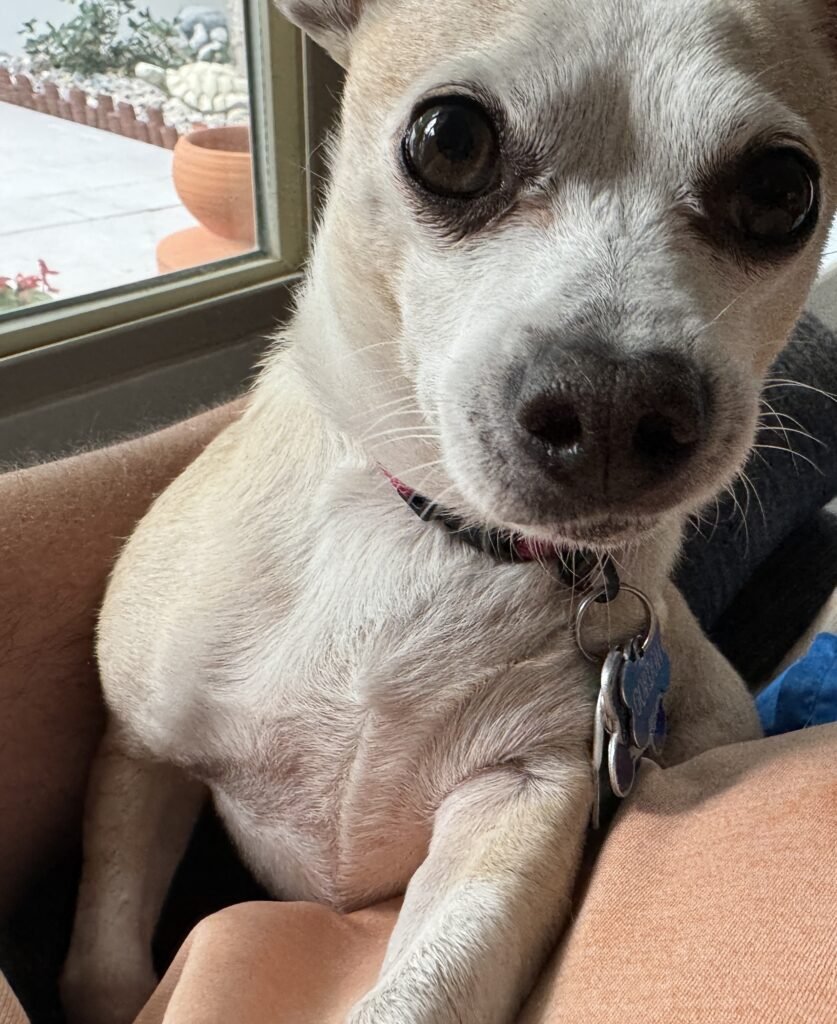
First there was Dennis, and now there is Gordon (at left), 11 pounds of pure love wrapped in the body of a blond, short-haired, deer head Chihuahua. But my dog is more than just a cold nose and a warm heart; he is a philosopher and a teacher that offers me insights into life and how to live, daily. My task is to learn how to listen.
Much has been written of late about the idea of mindfulness and “living in the moment.” But, one doesn’t have to follow Thomas Merton into the silence of a Trappist monastery or go to the trouble of reading a book by Eckhart Tolle to learn how to live hic et nunc – here and now. Your dog will happily show you how while wagging his tail with joyful abandon.
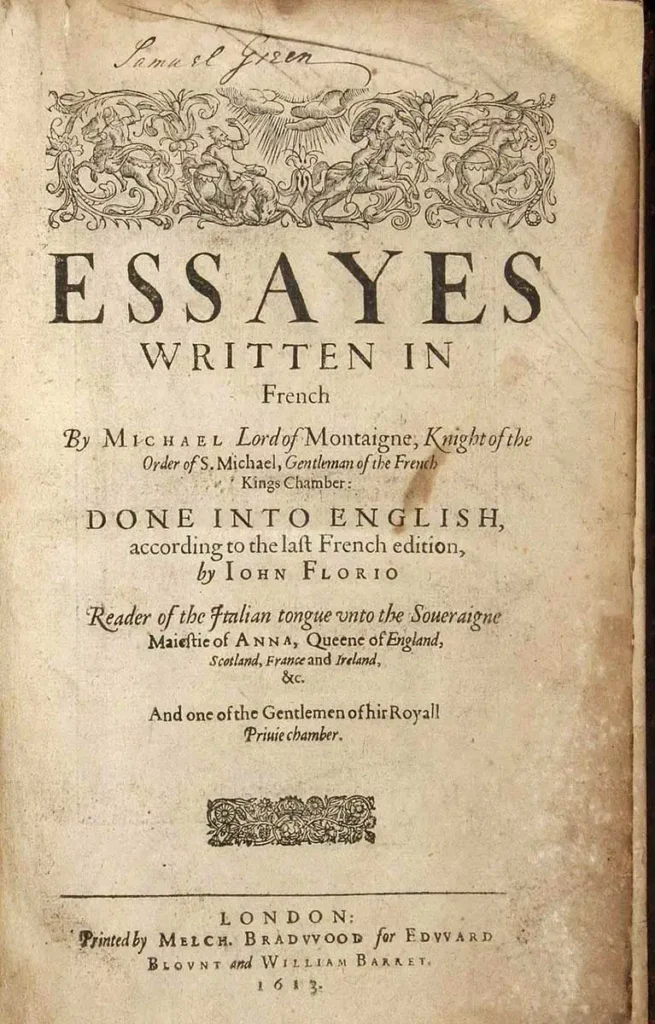
I created my first personal website in 1997 on GeoCities, a web hosting service that rose to prominence in the latter half of the 90s, and since that time my “site” has evolved and gone through many thematic and stylistic iterations. As a writer by avocation, though, my site has always been a repository for my writing, a way for me to explore what I do and do not know, to recall, record, and recount my experiences, and to reflect myself back to me to gain greater self-awareness. It is not unlike the 16th century collection of writings by Michel de Montaigne known as Essays.
As a genre (which he invented with this book), the essay gave Montaigne ample freedom to explore ideas. His essays tended to digress into anecdotes and personal ruminations, which was seen as a departure from “proper” style. But it was his declaration that “I am myself the matter of my book” that was viewed by his contemporaries as being a bit too self-indulgent.
Well, to that I say I am myself the matter of my website!
One thing that stands out about Montaigne was his practice of revising the essays over 22 years to better reflect his changing views. From 1570 until his death in 1592, as he gained more knowledge as well as experience, what collectively we might call wisdom, he would add many clarifying annotations to the texts. It is this constant annotating that demonstrates one of his most profound philosophical insights: our ideas and opinions on subjects, and our memories, change over the course of our lifetimes as we grow older and get on with the business of living. Seems obvious, yes? We are, quite literally, never “done” until we die.
In an essay entitled “On Repentance,” Montaigne discusses how difficult he finds it to describe himself, writing, “I can’t pin down my object. It is tumultuous, it flutters around.” And then, he illustrates with his writer’s quill what he believes is one of the fundamental characteristics of human existence: that we are on a journey…
I don’t paint the being. I paint the passage.
Every day is an “extra” one, like those minutes they tack on to the end of soccer games. But the simile ends there, for it is not penalty time. The days make up Act II. I am learning my lines and getting into character. There is no rehearsal; there are no retakes. Away we go. As I strut and fret my hour upon the stage, I face the final curtain expecting no encore, I am not interested in the critics’ reviews, and there is no sequel planned.