
It’s time for another of my “curiosity” posts. I have a confession to make: I really enjoy these. An esoteric question pops into my head, like why are there so many ways to say going to the toilet, or I come across some obscure fact like corn flakes were originally developed by John Harvey Kellogg at his late 19th and early 20th century sanitarium and health spa in Michigan to stop people from masturbating (along with yogurt enemas), and my reading is set for the next day or two as I research it. Which is fun. Then I get to tell you, thoughtful readers, what I found. Which is even more fun.
Today I’ve got a doozy for you. And I’d like to dedicate it to my friend Brian D. who has just left the desert with his partner for Canada, which is where he is from. Together, they are what we call here in Palm Springs “snowbirds.” Snowbirds spend the fall, winter, and spring here in the desert when our weather rivals Eden for the title of paradise and their home in Canada is under a thick blanket of snow and ice. But when summer arrives in the Coachella Valley, they have the good sense to fly off (thus they are called “birds”) to whence they came (the snowy north, which will have thawed out by then) leaving us year-rounders to melt like an ice cream in the summer heat.
Brian is one of the nicest people I have ever met. Of course he is! He’s Canadian, and if there’s one thing we know about Canada, it’s that everybody there or from there is nice. That used to sound quaint to me, but given the state of things in the US and the temperament of our dear orange leader, it now sounds as appealing as King Arthur’s Camelot or Kubla Khan’s Xanadu. We could use some nice. We need some nice.
And it’s to Canada we go for today’s “you’re not going to believe this” post.
History is full of legendary crimes. There was the theft of the Mona Lisa. There was the Great Train Robbery. There was that one time someone stole an entire beach in Jamaica (yep… that happened, sortof). Yet among these grand tales of criminal audacity stands a caper so gloriously Canadian and so absurd, that it sounds less like a real event and more like the rejected storyline of a Saturday Night Live sketch.
I am referring, of course, to The Great Canadian Maple Syrup Heist.

Now, if you’re unfamiliar with this remarkable escapade, you might assume that “maple syrup heist” is nice Canadian slang for stealing your neighbor’s pancake toppings while s/he was out at a hockey game. You would be wrong. This was an actual theft involving millions of dollars’ worth of maple syrup.
You heard me right. Not gold. Not diamonds. Not cryptocurrency. Syrup.
This immediately raises an important question: why does Canada possess enough maple syrup for a criminal mastermind to steal in industrial quantities?
The answer lies in the fact that Canada treats maple syrup with the seriousness usually accorded nuclear weapons. While other nations maintain strategic reserves of oil (kindof topical right now), grain, or precious metals, Canada, our nice, quiet neighbor to the north, maintains emergency reserves of concentrated tree juice.
Poodle point:
it’s easy to speak Canadian… just add “Eh?” with an upward inflection on to the end of every English sentence
Some countries ask, “What if there’s a fuel shortage?”
Canada asks, “What if someone wakes up and cannot adequately glaze a waffle, Eh?”
These are different priorities.
The syrup reserve itself sounds like something made up by someone whose been out in the cold too long. Hidden away in warehouses are vast stockpiles maintained by the government to stabilize the global maple syrup market. There’s a global maple syrup market? And it needs stabilizing? Now imagine explaining this to a visitor from another planet:
“Humans collect sweet liquid from trees.”
Interesting.
“We store millions of dollars’ worth in giant barrels.”
Fascinating.
“Then criminals occasionally steal it.”
Your species is not ready for interstellar contact.
The heist began when thieves managed to remove enormous quantities of syrup from a storage facility in Quebec. Their method was both ingenious and ridiculous. Rather than hauling away thousands of heavy barrels, whose absence would be noticed, they siphoned the syrup from them and then replaced much of it with water. Nothing missing here!
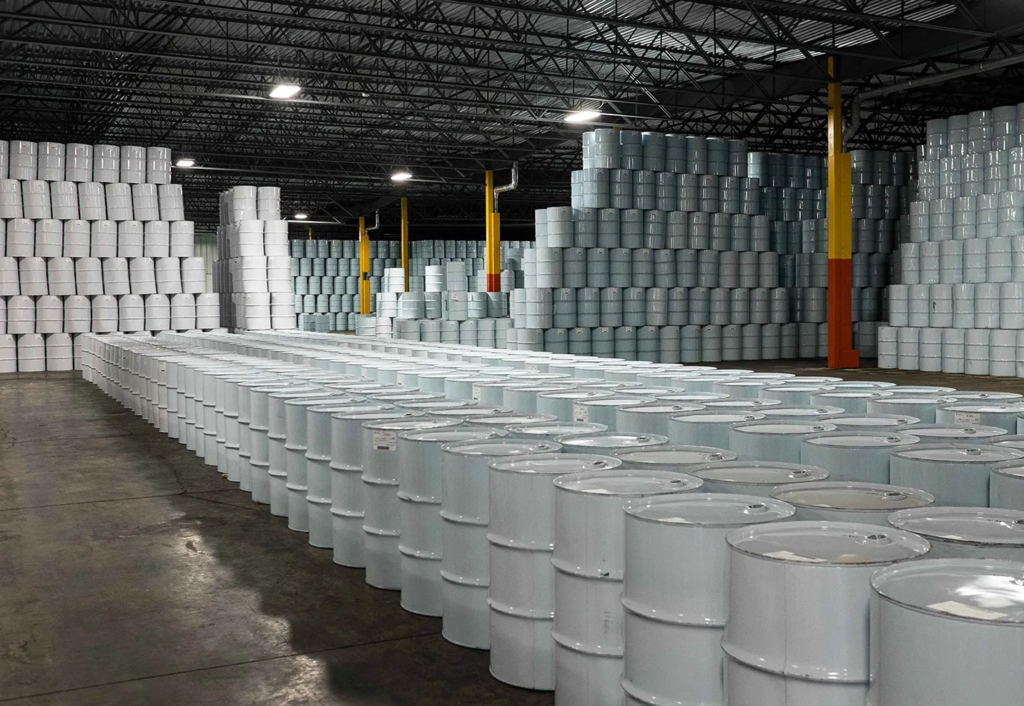
This demonstrates a remarkable level of confidence.
Most criminals worry about fingerprints, surveillance cameras, making a clean getaway, and forensic evidence. These thieves stood around saying things like, “Nobody will notice if we replace twenty million dollars of syrup with hose water, Eh?”
That is either criminal brilliance or the decision-making process of people who have consumed too much maple syrup in one sitting.
The discovery of the theft was equally Canadian.
Picture the scene. Some inspector walks through a warehouse filled with barrels. Everything appears normal. The barrels are present. The seals look intact. The paperwork is probably organized in three-ring binders of almost Matt-like neatness.
Then someone climbs onto a barrel. It falls over because it is mysteriously lighter than expected. Instead of syrup gushing out onto the floor, a puddle of water forms. At that moment, everyone present has a breathtaking realization:
“Looks like several million dollars worth of maple syrup appears to be missing, Eh?” Imagine being the police officer who received that report.
Syrup inspector: We have a major theft, Eh?
Officer: How much was taken, Eh?
Syrup inspector: About eighteen million dollars, Eh?
Officer: Oh My God, Eh?
Syrup inspector: In maple syrup, Eh?
Officer: …I’m sorry, could you repeat that, Eh?
Syrup inspector: Maple syrup, Eh?
Officer: The pancake stuff, Eh?
Syrup inspector: Affirmative, Eh?
Officer: I should have been a hockey goalie, Eh?
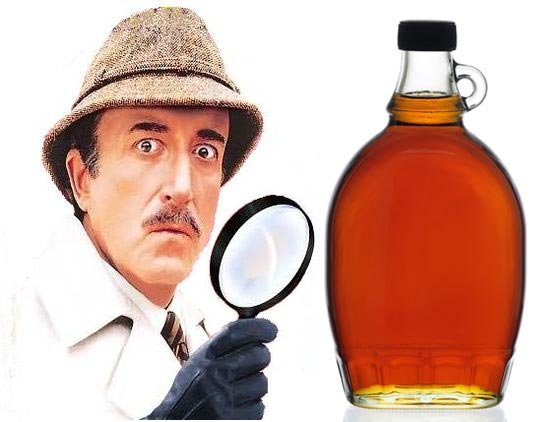
The investigation that followed revealed a criminal enterprise of astonishing scale. Thieves moved syrup through an operational network of distributors and buyers, creating what can only be described as an illegal underground maple economy. Most black markets involve dangerous substances or prohibited goods. Canada somehow developed a syrup cartel.
There is something quintessentially Canadian about the idea of hardened criminals gathering in secret warehouses to discuss tree sap. Instead of exchanging briefcases full of cash, they are probably debating viscosity. Instead of saying, “The shipment arrives at midnight, Eh?” they are saying, “The Grade A Amber is delayed, Eh?”
This is perhaps the least intimidating organized crime enterprise in history. Try to imagine a dramatic gangster movie based on these events…
A shadowy figure emerges from the darkness. “You got the goods, Eh?” The other man opens a barrel. Golden-brown syrup glistens under the glow of fluorescent lights. A violin soundtrack swells dramatically. Someone nearby is making pancakes.
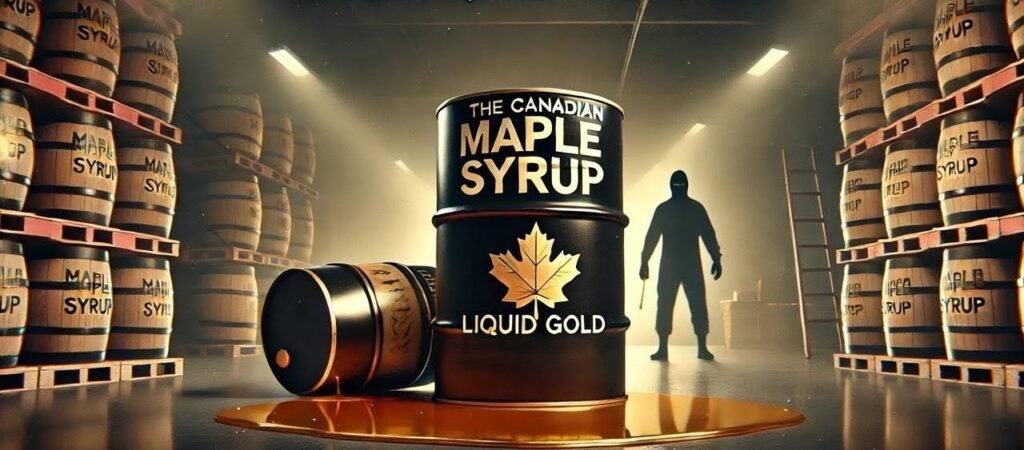
Hollywood is used to making blockbuster films like The Texas Chain Saw Massacre, loosely based on the real-life crimes of a man named Ed Gein. True crime stories are very popular. But I can just see a room full of studio execs with someone pitching them a story based on a “real Canadian crime” and them worrying they’ll end up with a movie called something likeThe Toronto Leaf Blower Kerfuffle.
Amazon Prime Video did, however, take a stab at telling a story based on the heist with an episodic comedy in 2024 called The Sticky (you can find it here) starring Margo Martindale and produced by none other than the man behind some of Hollywood’s biggest horror franchises, Jason Blum, and true Hollywood royalty, Jamie Lee Curtis, but the series was canceled after only one season in February of 2025.
The international reaction to the heist was much like yours right now thoughtful reader: WTF? Around the world, people learned that Canada not only possesses strategic syrup reserves but had also suffered a syrup theft large enough to attract global headlines. Many foreigners responded with disbelief. Some questioned whether Canada was a real country at all.
To be fair, if you came into this knowing little or nothing of Canada, it would sound suspicious. To start with, the national animal is a buck-toothed beaver, and the national stereotype involves excessive politeness. The country is obsessed with games played on ice, one with a stick, and the other with a broom. On top of all that, now you’re telling me there are large warehouses full of a breakfast condiment? At some point it begins to sound like something you would read at The Onion.

The greatest lesson of the heist may be that every nation has its own version of treasure. For some countries, treasure is gold. For others, oil. For Canada, treasure comes from drilling holes in trees and waiting patiently.
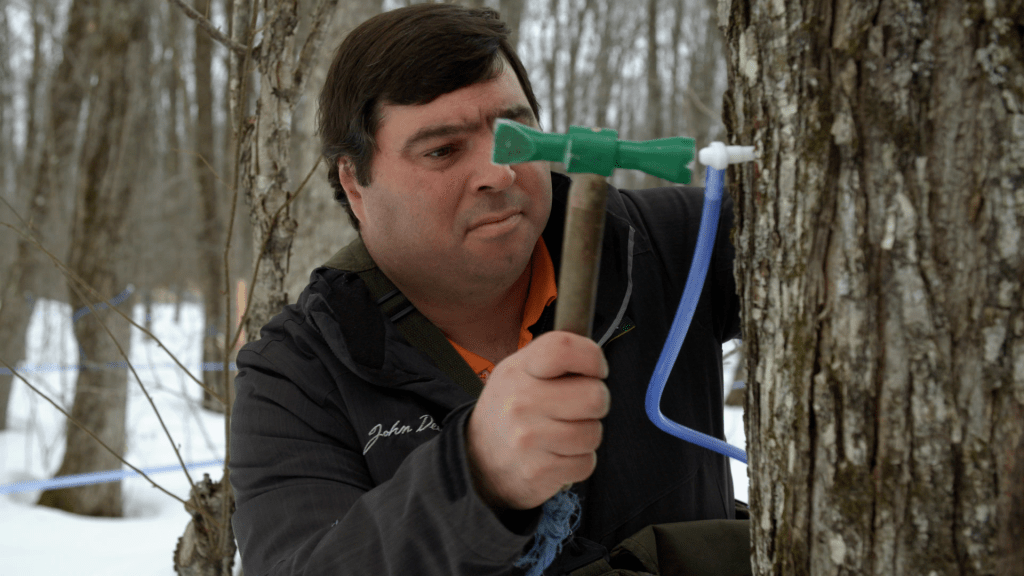
There is something admirable about that. Maple syrup represents everything Canadian stereotypes claim to value: patience, hard work, nature, and the ability to endure long winters while consuming unreasonable quantities of breakfast food (unless, like my friend Brian, they escape to Palm Springs).
Stealing it was not merely theft. It was an attack on the very essence of brunch, which, as I’m sure you know, is the closest thing the gay community has to church. But my tale has a happy ending! Much of the syrup (some 3,000 tonnes) was recovered, and the masterminds were caught and prosecuted. Justice prevailed. Pancakes remained adequately supplemented and civilization lived on. Brunch was saved!
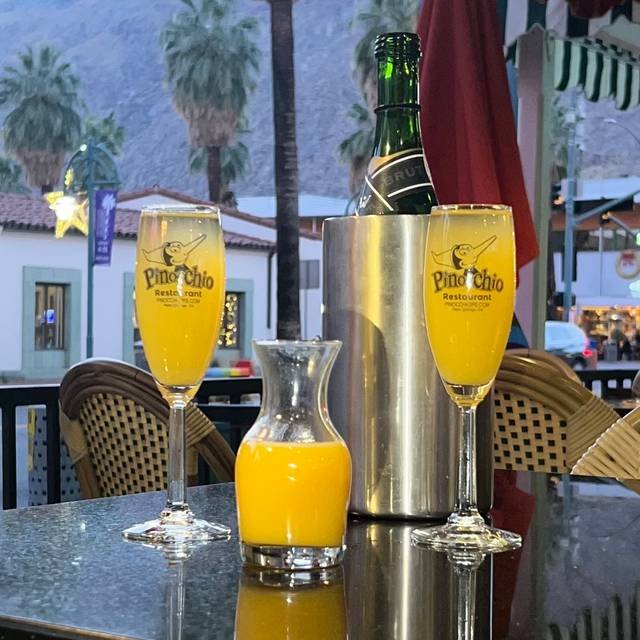
Pro Tip
when you’re deciding on a brunch spot, choose one like Pinocchio in the Desert on Tahquitz Canyon Way in Palm Springs that offers bottomless mimosas (actually, they do it right: it’s the champagne that is bottomless, you add a carafe of orange, cranberry, grapefruit, or pineapple juice for $4.50).
The Great Canadian Maple Syrup Heist occupies a unique place in the long story of human achievement. I should point out that it didn’t happen in some distant and less sophisticated time than our own – this took place between 2011 and 2012, just fifteen years ago . It demonstrates that no commodity is too strange to steal, no reserve too unusual to protect, and no criminal plan too ridiculous to succeed, temporarily.
Most importantly, it reminds us that reality is often far stranger than fiction. After all, let’s say a blogger who fancies himself a writer submits a manuscript about thieves infiltrating a strategic syrup reserve, siphoning millions of dollars of maple syrup, replacing it with water, and triggering an international investigation… I think most, if not all, editors would reject it as being the author’s mimosa-fueled flight of fancy.
Some Canadian thieves, however, looked at this scenario and said, “Yes, let’s give that a go, Eh?” Which may be the nicest, most Canadian thing of all. Eh?
