
There is nothing particularly controversial about naming an American aircraft carrier after a president. Provided, of course, that the president is no longer in office, has been dead for several years, and is therefore unable to object to the wording of the plaque. The difficulty arises when the president is still in office, is involved in the administration making the decision, and the proposed name happens to replace that of a decorated war hero. At that point, one begins to encounter what we might describe as a slight presentational difficulty.
The aircraft carrier in question is CVN-81, a Ford-class nuclear-powered carrier. In 2020, the Navy announced that it would be named the USS Doris Miller, after the Black enlisted sailor who distinguished himself during the attack on Pearl Harbor.
Miller was a mess attendant – essentially a Navy busboy – in a segregated Navy. When the Japanese attacked, he took control of a .50-calibre machine gun, despite having no formal training in its operation, and fired at Japanese aircraft. He also helped move the wounded captain of his ship to safety under heavy enemy fire.
For this, he received the Navy Cross, becoming the first African American to receive the decoration. He was later killed in combat. It is difficult to imagine a more worthy candidate, representing the best of us, for the name of an aircraft carrier. But, reports now indicate that the Navy has been considering changing the name.
To Donald Trump.
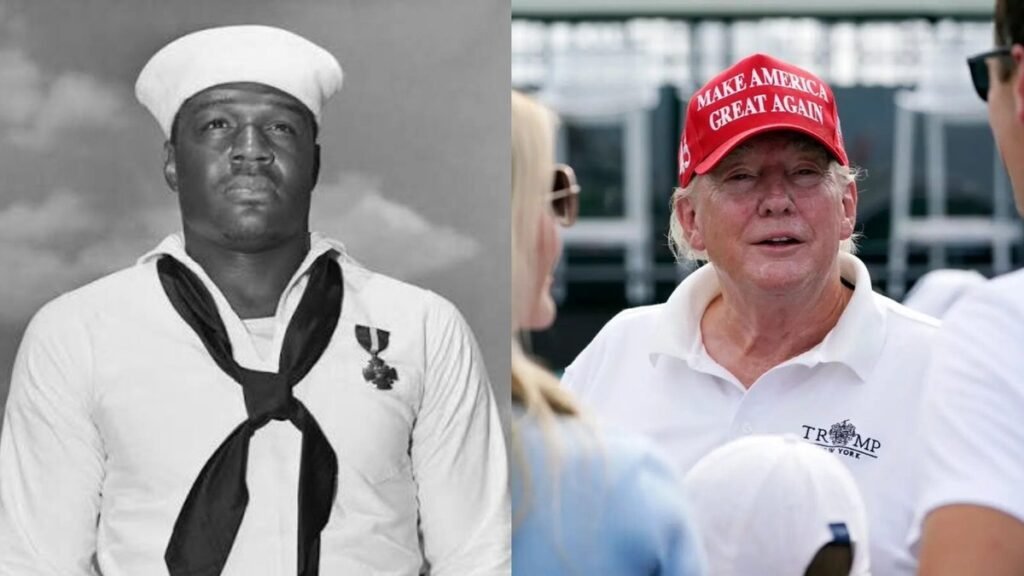
Yes, that Donald Trump, the draft-dodging, self-aggrandizing corruption monkey currently occupying the Oval Office.
One should perhaps begin by saying that this is not unprecedented in the broadest possible sense. American aircraft carriers have been named after presidents before. George Washington, Abraham Lincoln, John F. Kennedy, and Ronald Reagan have all achieved the distinction of having their names attached to very large machines that float and are capable of launching aircraft with weapons at other countries.
The difference is that they were generally dead, retired, or otherwise unavailable for comment when the decision was made. This is an important constitutional safeguard. It prevents the rather awkward situation in which the person being honored is also the person who might reasonably be expected to say, “Excellent idea.”
There is, after all, something reassuring about the time-tested principle that if a notable someone is to be commemorated, one should ideally wait until he or she has ceased to be notable (or notorious). Preferably permanently.
The Trump administration, however, appears to have discovered an efficiency improvement. Whatever happened to DOGE? You never hear about it anymore.
But why wait for history when the president is already available?
The White House could presumably issue a statement saying that the Navy has independently determined that the president deserves the honor, while the Navy could issue a statement explaining that the White House had nothing whatsoever to do with the Navy’s independent determination. Everyone could then agree that everything had been handled entirely according to procedure.
Do they think we’re idiots? Trump and his administration can insist that the decision is legitimate. Supporters can argue that Trump deserves the honor – presidents have had ships named after them before. And all of this may be perfectly true.
It does not alter the optics.
And the optics become particularly strange because the proposed change would not simply give Trump a new ship. It would take a ship away from Doris Miller.
That is where the whole affair acquires a rather malodorous stench.
Miller’s name was not selected because someone happened to like his politics. He did not have any politics of the sort that would make a modern television panel spend three hours discussing him. He was a sailor who performed an act of courage during one of the defining attacks in American history. He was the kind of nobody we teach children is somebody by virtue of their – I’m gonna use the C word – character.
Moreover, his story represents an important transformation in the American military.
A Black sailor in a segregated Navy was confined largely to menial duties. Yet when Pearl Harbor was attacked, the Navy discovered that its mess attendant was quite capable of defending the ship.
Naming the carrier after Miller would have preserved that story. Call me “woke” (I’ve been called worse), but that is a story worth preserving. And telling.
Removing his name would not erase him, of course. The Navy could name another ship after him. There have even been suggestions of further recognition for Miller – another ship, the Medal of Honor, the country’s highest military decoration for acts of valor, although the final award would need to be approved by Congress.
This is rather like assuring someone that although you have taken away their seat at the banquet, you have thoughtfully reserved them a chair in the corridor. The honor remains. Technically.
The question, then, is not whether Donald Trump should ever have a Navy ship named after him. He may. Indeed, if history ultimately decides that his presidency merits that distinction, there is no obvious reason why it should not happen. I may think he is absolutely the worst human on the planet, but others don’t. And I am not in charge of anything other than my own opinion. Thankfully.
The question is whether the decision should be made now, while he is president, by an administration he leads, and at the expense of an existing name chosen to honor a genuine military hero.
This is where a little old-fashioned bureaucracy might actually be useful.
Not the sort of bureaucracy that loses a form for six months.
The useful sort.
The sort that says:
“That is an excellent idea, Mr. President. We shall certainly consider it.”
“When?”
“After you have left office.”
“But why?”
“Historical perspective, Mr. President.”
“I have historical perspective.”
“Yes, Mr. President. But unfortunately it is the wrong kind.”
Because time has one enormous advantage over politics: it does not require anyone to win, or even be popular. Time helps us answer the question of significance.
A president leaves office. The arguments fade. Historians start disagreeing in more scholarly journals. Eventually somebody writes a biography with a title containing the words Legacy, Leadership, or American Destiny.
Then the Navy can decide.
If Trump has earned a carrier, give him one.
If he has not, don’t.
What seems unnecessarily difficult is deciding the matter while the president himself is still standing in the room.
It also creates an unfortunate precedent.
Once presidents discover that aircraft carriers can be named after themselves while they are in office, future administrations may reasonably expect the same courtesy.
The next president might want a carrier.
The president after that might want two.
Eventually the Navy could find itself with a fleet consisting of the USS Trump, USS Biden, USS Obama, and USS Whoever-Happens-to-Be-President-That-Week.
At which point the obvious solution would be to abandon names altogether and simply number the ships according to approval rating. The Navy could then issue a press release:
“The USS 43% has departed Norfolk.”
Very efficient. Very modern. And entirely unsuitable.
The American military is supposed to outlast its politicians. Its ships should therefore represent something more durable than the occupant of the White House.
Doris Miller represents courage. He represents military service. He represents the history of racial integration. And, rather inconveniently for everyone involved, he represents precisely the sort of American hero whom nobody needs to explain.
He did something brave. He served his country. He died in service. That is usually considered sufficient. And significant
Donald Trump may eventually deserve the same honor. But perhaps the Navy could adopt the traditional corporate solution to this sort of problem, which I learned well during my career:
Put the matter to a committee.
Ask for a report.
Commission a second report.
Circulate the second report for consultation.
Request comments from the relevant stakeholders.
Establish a working group.
Then, after several years of careful consideration, announce that the question will be revisited at an appropriate future date.
By then, Trump will no longer be president, Miller’s historical importance will remain intact, and everyone will have achieved the principal objective of good government: nobody will have to admit that anything was ever decided at all.
But for the record, I consider naming this ship after Trump to be like naming a crisis shelter for sexually abused children after Jared from the Subway ads.
