
Today, we describe someone as “in the hole” if they are in debt, upside down on their mortgage, or more generally in dire circumstances, but in medieval Germany that might literally be a description of your day in court. Imagine receiving a court summons that reads:
You are hereby ordered to appear before the court next Tuesday at sunrise. Please bring your witnesses, your courage, and, if you are the defendant, be prepared to spend the afternoon standing in a hole while someone tries to hit you with a rock tied inside a pillowcase.
This was, after all, the Holy Roman Empire, which is the historical foundation of western civilization, like it or not. The Grubenkampf, or “pit fight,” was a special form of judicial duel designed to settle legal disputes between a man and a woman. The man stood in a hole. The woman did not. It sounds like something out of Monty Python, but this was considered the fairest solution anyone could come up with.
Before laughing too hard, however, it helps to remember that medieval people viewed justice rather differently than we do. Rather. Differently. Today, if two people disagree in court, they present evidence. Lawyers argue. Witnesses testify. Judges deliberate. Occasionally someone dramatically produces a smoking gun or a crucial email.
In the Middle Ages, things were a bit more… let’s call them athletic.
If evidence was scarce or the testimony hopelessly conflicted, many people believed that God already knew who was telling the truth. Since God was both omniscient and perfectly just, surely he wouldn’t let the wrong person win a properly conducted fight. Handy, eh? Therefore, instead of endlessly debating who was right, the court sometimes invited the litigants to solve the matter with clubs.
This was known as a judicial duel. It wasn’t a sporting event or a tournament held for entertainment. It was an official legal proceeding. The winner won the lawsuit. The loser might lose property, honor, freedom, or, depending on the case, life itself. It was essentially litigation by way of blunt-force trauma.
The most bizarre version involved disputes between a man and a woman. Medieval lawmakers recognized an obvious problem: on average, men were physically stronger. Their solution was not to appoint a panel of judges or reconsider the wisdom of deciding lawsuits through violence.
No.
They dug a hole.
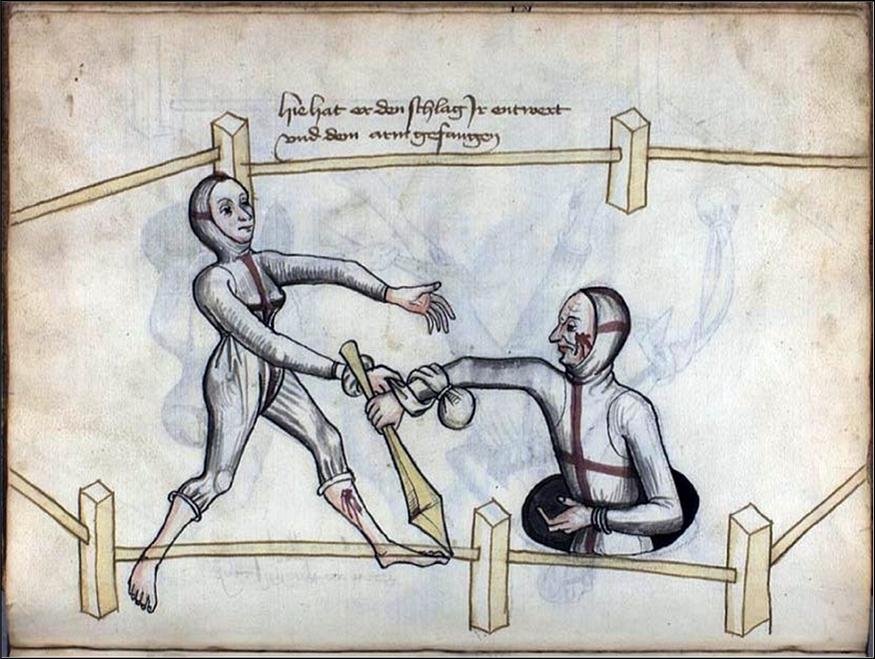
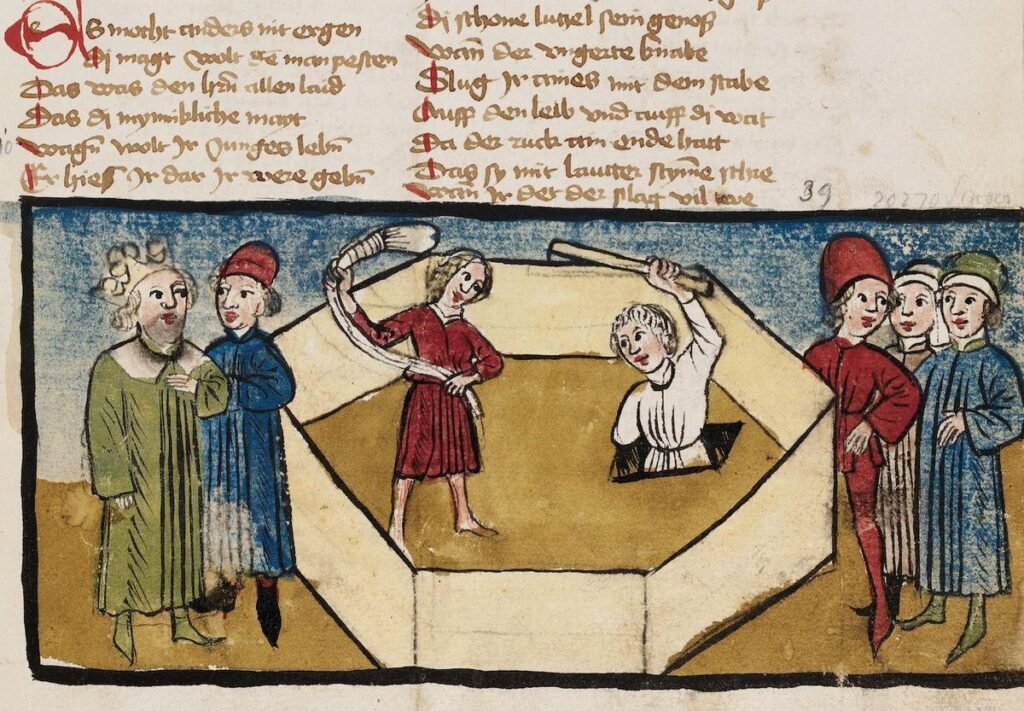
According to the 15th century fencing master Hans Talhoffer, whose wonderfully illustrated manuals (see above) preserve the rules of these contests, the man was placed in a pit roughly waist- or chest-deep. This prevented him from charging around the battlefield or using his legs effectively. In some versions, one of his hands was tied behind his back as well, because apparently standing in a hole wasn’t considered inconvenient enough.
Meanwhile, the woman remained outside the pit with complete freedom of movement. Her weapon was a heavy stone wrapped inside a cloth or veil, turning it into a remarkably unpleasant medieval flail. The man was not without weapons of his own: he received one or more wooden clubs.
If you’re thinking this sounds less like a courtroom and more like a deeply disturbing reality TV show, we’re on the same page.
Now of course, there were rules. Medieval Germans loved rules almost as much as they loved complicated hats. Neither combatant was supposed to grab the other’s weapon directly. Officials supervised the duel to ensure everything remained legal, orderly, and properly homicidal. After all, civilization must be maintained.
The duel continued until one contestant surrendered or could no longer continue. Depending on the circumstances, losing could mean execution. There were no appeals. There was certainly no request for a retrial on the grounds that your opponent had become unexpectedly proficient at swinging masonry.
Given our level of sophistication today, the whole affair seems spectacularly irrational. Yet medieval thinkers regarded it as a genuine attempt at fairness. The man’s superior strength was offset by his inability to move. The woman gained mobility but wielded a relatively awkward weapon. Once these disadvantages balanced each other – or at least balanced each other according to medieval logic – God would reveal the truth by deciding who walked away.
Curiously, actual records of these pit duels are quite rare. Judicial combat certainly occurred throughout the Holy Roman Empire, but historians continue to debate how often the man-in-the-hole variation was actually used. It may have been an accepted legal procedure that was seldom required, or perhaps it was already fading into obscurity by the time Talhoffer recorded it. Either way, the manuals leave little doubt that contemporaries regarded the idea as perfectly acceptable. And respectable.
Fortunately for everyone involved, European legal systems eventually evolved. During the Renaissance, courts increasingly relied on witnesses, documents, trained judges, and the revolutionary notion that determining the truth might not require hitting another litigant with a club. Trial by combat gradually disappeared, and lawsuits became considerably less hazardous to one’s skull.
Today, the Grubenkampf survives as one of history’s greatest reminders that the past was not simply different – it was gloriously, magnificently weird. Somewhere in 15th century Germany, a judge could sincerely believe that the most reliable path to justice involved one citizen standing in a hole while another swung a rock on a rope.
And somehow, everyone present probably nodded and thought, “Yes. This seems entirely reasonable.”
Perhaps the greatest lesson of all is that whenever someone complains about modern courts taking too long, it’s worth remembering the alternative. At least today’s judges don’t begin proceedings by asking whether anyone has finished digging the defendant’s hole.
