
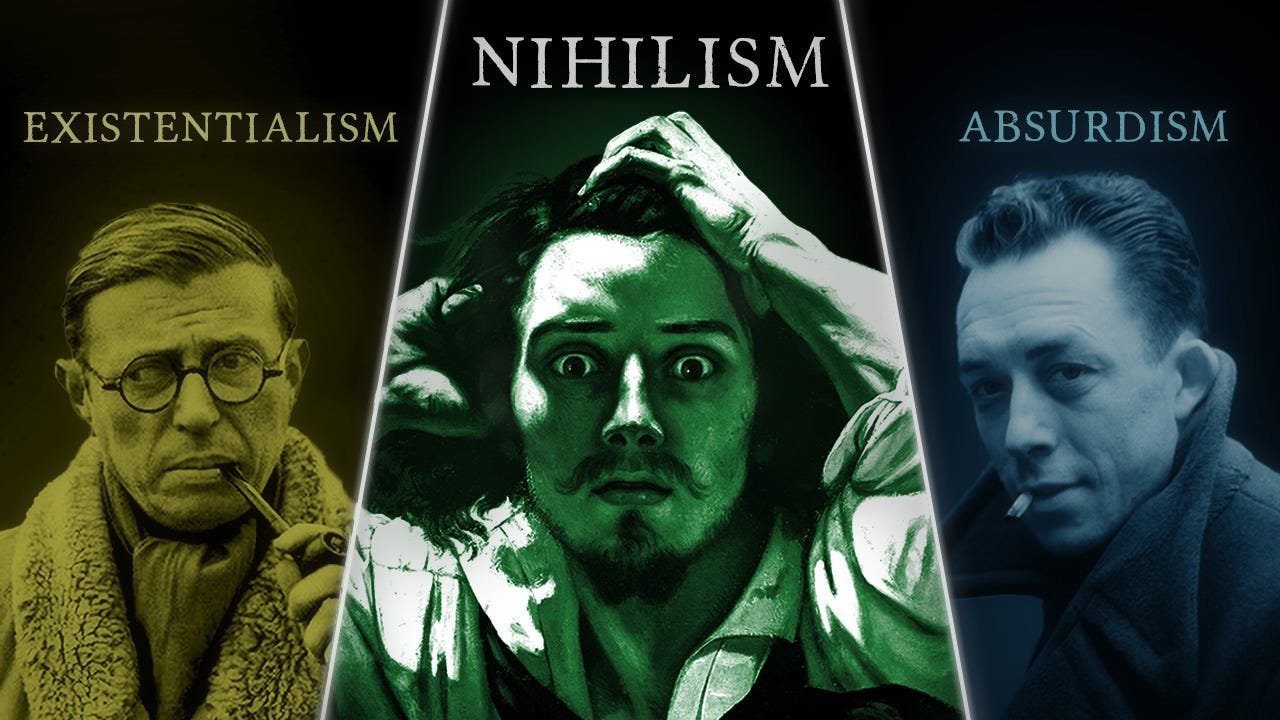
In the 19th and 20th centuries modernity came into its fullness, and with this maturation the religious worldview began to fall away leaving us with a crisis of meaning that we’ve come to call Nihilism. The emergence of Nihilism prompted philosophers to ponder anew that clichéd philosophical question – what is the meaning of life? Out of this renewed engagement with meaning, two philosophies emerged. There was the root problem: Nihilism, i.e., the realization that there is no objective meaning to our lives. And confronting this problem we have two responses: Existentialism and Absurdism.
For the religious person, life has an objective meaning. In the Judeo-Christian traditions the history of this world is bookended by God’s creation on one end and Judgement Day with Heaven and Hell on the other. For the Hindus and the Buddhists there is the story of karma and the endless cycle of birth and rebirth that it results in; the end point in this system is not a Heaven/Hell dichotomy but liberation known as “moksha” in Hinduism and “nirvana” in Buddhism. In these Western and Eastern systems of belief, humanity has a privileged place in reality.
But as the modernist worldview comes to full fruition, it casts off the residual holdovers from the religious mindset and this objective meaning dissolves. As we develop a better model of reality and no longer need to rely on gods to provide an explanation of the world, we begin to discard these gods and the supernatural beliefs associated with them.
In the 19th century modernity turned toward the secular with a number of explosive, revolutionary books. In the 1830s, David Friedrich Strauss published his Life of Jesus; this book became a controversial literary phenomenon that eroded belief in the Bible as a historical book. And then, 1841 saw the publishing of another book that called into question the received wisdom, Ludwig Feuerbach’s The Essence of Christianity, which explored the idea that God was a psychological projection of humanity.
Following Strauss and Feuerbach, the real stake in the heart of the religious narrative was the publication of Charles Darwin’s The Origin of Species in 1859. This cultural trend culminated at last in the catastrophic event that Nietzsche’s madman talks about in 1882’s The Gay Science. That title is not what you think, thoughtful reader. It was derived from a Provençal expression (gai saber) meaning the technical skill required for writing poetry. The book’s title was first translated into English as “The Joyful Wisdom,” but “The Gay Science” has become the common translation since Walter Kaufmann’s version in the 1960s; Kaufmann cites The Shorter Oxford English Dictionary (1955) that lists “The gay science (Provençal gai saber): the art of poetry.”
But I digress. Nietzsche’s madman lights a lantern in the bright morning and goes into the marketplace searching for God only to be mocked by the townsfolk, not fully appreciating the implications of their deicide. And then the madman gives his soliloquy: “Whither is God?” he cried…
I shall tell you. We have killed him, you and I. All of us are his murderers. But how have we done this? How were we able to drink up the sea? Who gave us the sponge to wipe away the entire horizon? What did we do when we unchained this earth from its sun? Whither is it moving now? Whither are we moving now? Away from all suns? Are we not plunging continually? Backward, sideward, forward, in all directions? Is there any up or down left? Are we not straying as through an infinite nothing? […] Do we not hear anything yet of the noise of the gravediggers who are burying God? Do we not smell anything yet of God’s decomposition? Gods too decompose. God is dead. God remains dead. And we have killed him. How shall we, the murderers of all murderers, comfort ourselves? What was holiest and most powerful of all that the world has yet owned has bled to death under our knives. Who will wipe this blood off us?

This passage from Nietzsche is the clarion call of Nihilism. It proclaims the undermining of objective values. Backward, sideward, forward, up, down – all these are the ways we orient ourselves in the external world. The death of God throws our entire relationship to reality – our life’s compass – into disarray.
To put it more philosophically, God was the foundation of external values and of objective meaning. Without God, without divinity, the external world lacks a telos, it lacks a purpose and a meaning by which we can orient ourselves. The objective grounding of morality and certainty of human purpose has been destroyed, and the resulting vacuum is disastrous.
And so this is the crisis that Nihilism describes. By fully accepting the implications of academic Biblical study and the scientific discoveries of Copernicus and Newton and later Darwin, reality is no longer geocentric and anthropocentric, and with the laws of the universe that Newton began to expose and the evolutionary story that Darwin uncovered there is no need for a god except maybe in the narrow logical role of Aristotle’s “uncaused cause.” The material explanations for the external world proved far more effective than the religious ones and so the stories of religion were rightly discarded as obsolete.
The trouble was that these religious explanations were attached to the grounding of human morality and meaning. The death of God plunged us into a meaning crisis. This Nihilism is the root problem out of which Existentialism and Absurdism grew.
Before we look at how Existentialism and Absurdism responded to the crisis of Nihilism, it’s worth addressing why there is so much confusion around the difference between them. The trouble lies with the usage of the term “existentialism” itself which, depending on the writer, can be narrowly or broadly defined.
For some, Camus and his philosophy of Absurdism are subordinate to and reliant upon Existentialism, whereas for others they are completely distinct. In addition, Existentialism often includes thinkers in the 19th century such as Kierkegaard and Nietzsche who predate the origination of the term in the mid-20th century. To make matters even more complicated, you have people who are often categorized as existentialists such as Heidegger and Camus who publicly declared that they were most certainly not existentialists. And so the exact definition of Existentialism is a bit difficult to nail down.
For my purposes here, Existentialism is going to mean specifically the philosophy of Jean-Paul Sartre. He is the philosopher most synonymous with Existentialism for a number of reasons. He not only defined the term “existentialist” and coined many of Existentialism’s key terms and phrases, but Sartre was also one of the few philosophers who self-identified as an existentialist.
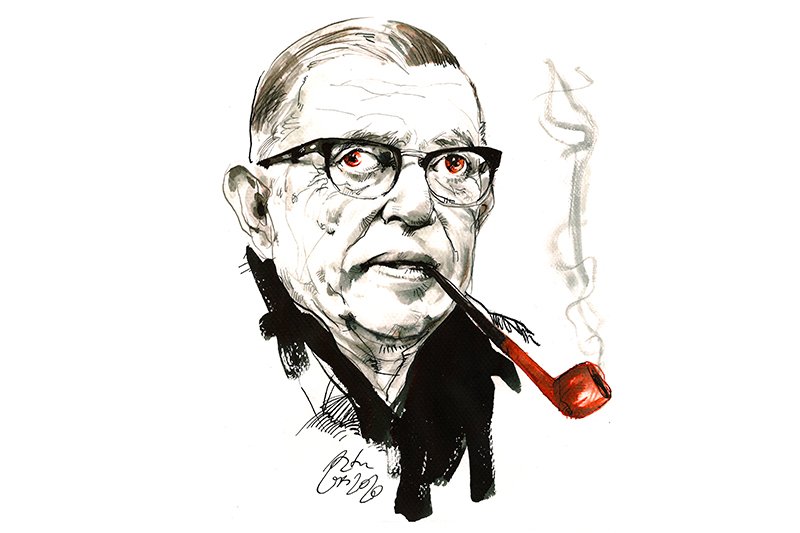
In tackling the problem of Nihilism and the absence of objective meaning, Sartre’s existentialist response was to first define what it is to be human. And this is where his famous phrase “existence precedes essence” comes into play.
Essence is a term that goes back to ancient Greek philosophy. For Aristotle the essence of a thing is its defining characteristic. This notion of essence is tied up with the related idea of telos which is the purpose of a thing; for example, the essence of a cup is to hold liquid. If a cup can’t hold liquid it’s not a cup since it is lacking the aspect that is essential to it. In the classical view of philosophy, the essence of a thing precedes its existence. Likewise, it would have been said that our essence (as human beings) precedes our existence (birth) until the figurative death of God upset the apple cart. Humans had a specific purpose – for Aristotle we existed to use the faculty of reason, for Christians we were a fallen people (separated from God) that must aspire to salvation (reunification with him). But with Nihilism the bottom fell out of these illusions and what was revealed is that there is no objective meaning, no purpose to it all. There is no quintessential human essence that predates our birth and applies universally to humanity. And so we are faced with a void of meaning.
We live in a meaningless universe and so how do we define what we are? What is the essence of being human? For Sartre, the essence is defined by our existence, what we essentially are is what we do, how we act in the world.
As he puts it in Existentialism is a Humanism:
man is nothing else but that which he makes of himself. […] there is no human nature since there is no God to conceive of it. Man is not only that which he conceives himself to be, but also that which he wills himself to be, and since he conceives of himself only after he exists, just as he wills himself to be after being thrown into existence, man is nothing other than what he makes of himself. This is the first principle of Existentialism.
So faced with the void of meaninglessness that Nihilism presents, the existentialist answer is that we must create our own meaning through our actions. There is no objective meaning and so we create our own by the way we live our lives. That is Existentialism’s answer to the problem of Nihilism.
The Absurd is an idea that we find as far back as Kierkegaard but isn’t fully developed into a philosophy until a fellow Frenchman and friend of Sartre, Albert Camus, came along in the 20th century. Looking more like a movie star than a philosopher (this assumes philosophers have “a look”), Camus developed Absurdism in response to the problem of Nihilism. He opens his essay, The Myth of Sisyphus, with one of the most iconic (and profound) lines in all of philosophy:

There is but one truly serious philosophical problem, and that is suicide. Judging whether life is or is not worth living amounts to answering the fundamental question of philosophy.
In facing into the problem of Nihilism, we are asking whether the lack of objective purpose means that life is not worth living. The Absurd is key to Camus’ framing of the question. The Absurd is the meeting between two things: the cold and meaningless objective reality on the one hand and humanity’s inherent drive for meaning on the other. The Absurd arises from the intersection of these two – it is the tension between the hunger for meaning and the impossibility of ever satisfying it.
We are all immersed in this absurd tension and according to Camus we have three alternatives for dealing with the problem: The first option is to commit suicide. If life has no meaning then why keep living? Camus finds this option unsatisfactory. He points out that there is no more meaning in death than there is in life and that it simply evades the problem. The second option is to take a leap of faith – to believe in some doctrine or ideology that tells us there is a meaning. This can be a religion like Christianity or an ideology like Marxism: we swallow the pablum these offer and in return we get a kindof salve that works like an analgesic masking the Absurd. Camus calls this option philosophical suicide.
Camus finds these two options insincere and so he proposes a third option – to embrace the insatiable tension, to embrace the Absurd, to lean into it. This third option is the philosophy of Absurdism.
Absurdism is a rebellion against meaninglessness. We do not escape from the Absurd through death or philosophical suicide. We meet the Absurd as it is without escape and with integrity and we maintain the tension of the Absurd in us without turning away. He incites us to a life without consolation: a life characterized by acute consciousness of and rebellion against its own mortality and its limits.
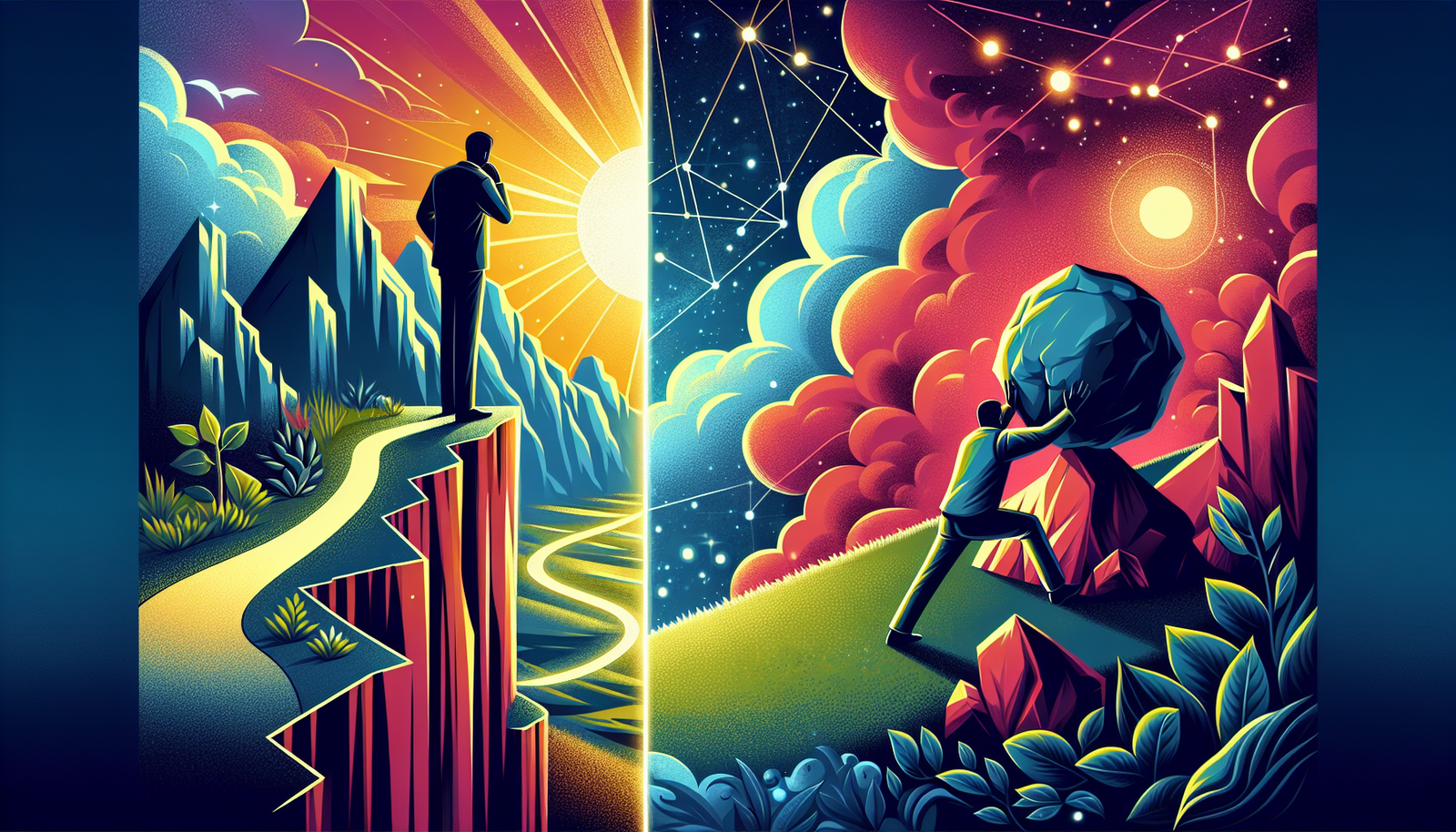
Camus looks at the existentialists and rejects what he ultimately sees as their escapism and irrationality. Absurdism means holding fast against the temptation to create meaning or to buy into some pre-packaged meaning. The absurdist rebels against the false satisfaction of our hunger for meaning proposed by the existentialists or offered by death, religion, or ideology.
Instead, Camus says that we must hold the tension within us and live in the space of absurd meaninglessness. As he puts it: “the only way to deal with an unfree world is to become so absolutely free that your very existence is an act of rebellion.”
Camus’s philosophy of Absurdism is best captured in an image: that of the Greek mythological figure Sisyphus. Sisyphus was the founder of the Greek city of Corinth. He was known to be the craftiest of all humans and was thought to be even craftier than Zeus himself. When he was sent to the Underworld in death he managed to trick his way out. In some stories he tricks Thanatos, in others Hades, and in other stories it is Persephone. Sisyphus returns to Earth and revels in the pleasures of the world.
But he is eventually returned to the Underworld where he is punished for his excursion by being condemned to roll a boulder up a hill and watch it roll back down at which point he must return to the bottom of the hill and repeat the process, quite literally, forever.
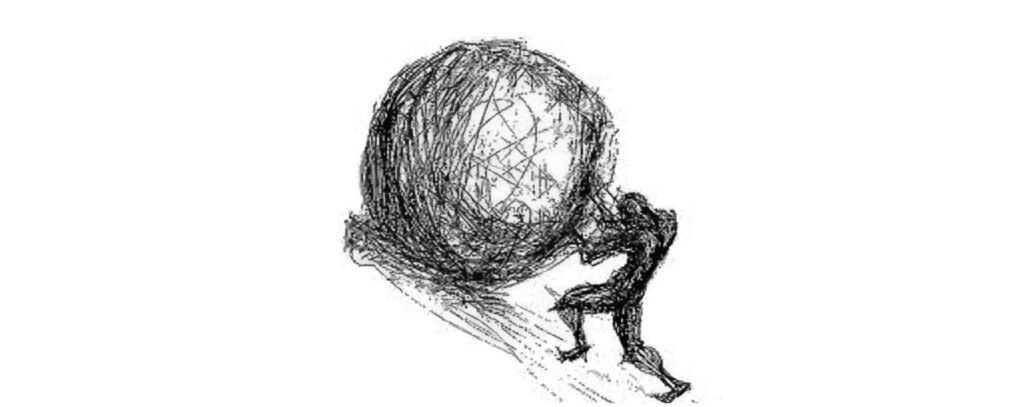
Absurdism can be summed up in one simple phrase taken from the last line of Camus’ essay:
I leave Sisyphus at the foot of the mountain! One always finds one’s burden again. But Sisyphus teaches the higher fidelity that negates the gods and raises rocks. He too concludes that all is well. This universe henceforth without a master seems to him neither sterile nor futile. Each atom of that stone, each mineral flake of that night-filled mountain, in itself forms a world. The struggle itself toward the heights is enough to fill a man’s heart. One must imagine Sisyphus happy.
Albert Camus, The Myth of Sisyphus
And so Absurdism is not about finding a meaning to life but about rebelling against the absurdity of life, it’s about standing aloof of the demand to find a meaning, rebelling against the absurd game itself and affirming life for what it is. It is to struggle with integrity because this struggle towards the heights is enough to fill a man’s heart.
Faced with the crisis of meaninglessness that Nihilism presents, the absurdist doesn’t throw a tantrum and kill him or herself, the absurdist doesn’t grab on to the nearest life raft and commit philosophical suicide by pledging themselves to a church or a cause. The absurdist affirms the struggle and enjoys life for what it is. A struggle without end. A struggle without purpose.
I’ll answer because I know I’ll be asked the question – am I Team Sartre or Team Camus? I favor Camus. But I am also deeply influenced by Epictetus, an ancient Greek philosopher of the Stoic school whose teachings have become some of the most influential works in Western philosophy. It always comes back to the Greeks, doesn’t it?! Although Epictetus wrote nothing himself, his ideas were recorded by his student Arrian in two works: the Discourses and the Enchiridion (“Handbook”).
Although separated by nearly two thousand years, the Stoicism of Epictetus and the Absurdism of Albert Camus speak to many of the same questions about the human condition. Both philosophers confront suffering, uncertainty, and mortality without sentimentality. Both reject the pursuit of wealth, fame, or pleasure as the foundation of a good life, and both argue that human freedom ultimately depends on our response to circumstances rather than on circumstances themselves. Yet beneath these striking similarities lies a profound disagreement. Epictetus believed that the universe is governed by providence, a rational and benevolent order, while Camus insisted that the universe is indifferent to human hopes and aspirations. Their contrasting views of reality lead them to different conclusions about meaning, virtue, and the proper response to suffering.
The common ground between them is an uncompromising commitment to reality. Neither philosopher encourages wishful thinking or escapism. Instead, both urge us to face life exactly as it is. But they have a profound disagreement as to how best we can respond to the ultimate nature of reality, with Epictetus seeking tranquility through trust in the universe’s fundamental reasonableness, and Camus seeking freedom through lucid confrontation with its silence.

Despite their disagreement, the practical advice offered by the two philosophers often appears surprisingly similar. This convergence is where I find myself living: a modern Stoic resembling Epictetus who like Camus has been stripped of metaphysical certainty. Ultimately, meaning depends less on the world we inhabit than on the spirit with which we inhabit it. “I am…” sang Neil Diamond, “I said, to no one there, and no one heard at all, not even the chair.”
