
I have had a resounding bit of good news with which to begin June and my summer. The burden that has weighed heavily on me these last few months (and even years) has been lifted. It is not hyperbole to say it feels like rebirth. “All shall be well, and all shall be well, and all manner of thing shall be well.”
These words, spoken by Julian of Norwich, have echoed across centuries. They live on in poetry and song, in sermons and in prayers, and in the quiet resolve of people facing uncertainty. They remain one of the most enduring and reassuring expressions of optimism ever written. Julian of Norwich was known in her lifetime as a trusted spiritual counselor and guide. Living as an anchorite during the Middle Ages, she devoted her life to prayer and contemplation while the world around her was shaken by profound suffering. She lived through the devastation of the Black Plague, social upheaval, and widespread fear. It was against this backdrop, not one of comfort and ease, that her optimism was formed.
She wrote Revelations of Divine Love, the earliest surviving book in the English language written by a woman. And while I might argue with her as to the source of our hope – she believed that divine love is the ultimate reality, holding all of creation together, even in the midst of suffering – I cannot deny that her simple words, “all shall be well,” were the first to pop into my head after my doctor’s appointment yesterday.
I believe that the stories we tell ourselves about events or about any given thing determine how we feel about that event or thing. It’s like the Stoic Epictetus said, “Men are disturbed not by things, but by the views which they take of things.” Never has that been more true than in my life these last several months, and I take from it a valuable lesson.
After reading the report on my most recent CT scan, I fixated on its finding of radiation fibrosis, a serious side-effect of radiotherapy (radiation) in the treatment of cancer. My research into that outcome, particularly regarding lungs, uncovered information that we might call the “worst case scenario.” But I am a lucky man.
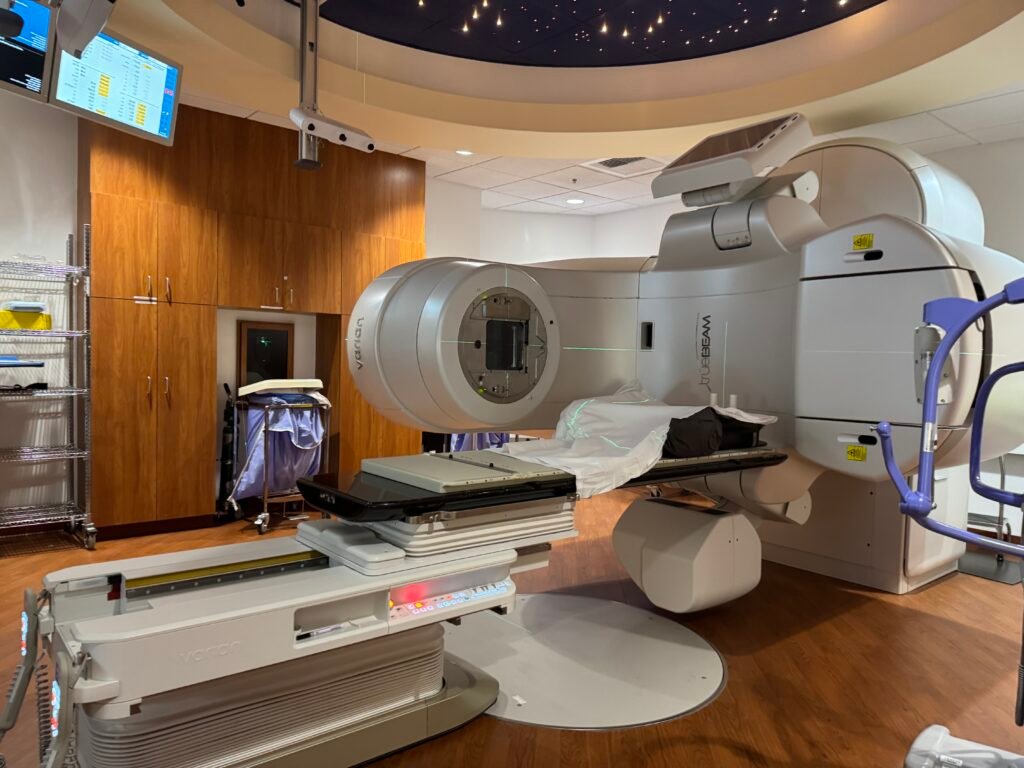
This is treatment room A (above) in the radiation oncology department (called Bighorn) at the Lucy Curci Cancer Center in Rancho Mirage, California. I underwent a two-week course of Stereotactic Body Radiotherapy, or SBRT, last September. SBRT delivers very high doses of radiation in a few sessions using precise image guidance. By using advanced imaging technology to track the movement of lung tumors in real time, the radiation oncologist can keep the radiation tightly concentrated around a patient’s tumor while steering clear of healthy tissue – this is the key. Because of the pinpoint accuracy of this method, offered at Lucy Curci because of their best-in-class equipment like the machine above, the damage to the non-cancerous parts of the lung (in my case) is limited. And in my case is very small.
Moreover, in focusing on the finding of radiation fibrosis, I overlooked the fact that my most recent scan had found no growth in the tumor on my lung in the last four months – meaning radiation had been successful. We are not “out of the woods yet” as they say, and I return in three months so my oncologist can keep tabs on the little bugger, making sure he’s not growing or spreading, but as he said when I met with him yesterday, “any scarring of the lung from radiation is a problem for Dr. Patel [pulmonologist] not me.” I’ve never been so glad to have someone pass the buck!
Spencer, the nurse practitioner who coordinates my care at Lucy Curci, will follow-up with Dr. Patel, who could not join us yesterday, to address the small amount of scarring on my lung, but my take-away from the last few days is: don’t look diagnoses up on the Internet! I went into yesterday’s meeting convinced I was in a dire situation because of my Internet sleuthing about radiation fibrosis over the weekend, and came out of it relieved because that was not the totality of my situation, which is impacted by the kind of radiotherapy I received, the success of that treatment, and even the technological capabilities of the place where I received it.
Aside…
the wife of one of the owner’s here at Stonewall Gardens was instrumental in raising the money – some $45 million dollars – to outfit that impressive looking treatment suite at Bighorn Radiation/Lucy Curci above. So you see thoughtful reader, every day and in every way Stonewall Gardens is making my life possible!
I know some of you reading this are here because cancer impacts you or someone you care about; you’ve told me as much in your emails, which I cherish and which I truly appreciate. So let me say this: radiation fibrosis is a serious matter not to be casually dismissed – discuss it with your doctor; don’t read my blog on the Internet and think it’s nothing to worry about because it turned out that way for me.

That said, my larger point is that fear, apprehension, dread, just pessimism in general, come from inside us, not outside. If we tell ourselves “this is it,” our attitude and emotions will take their cue from that. This is not to suggest Pollyannaism (a persistent irrational optimistic outlook, where a person maintains an excessively positive view of things, often ignoring negative aspects of situations); rather, get the facts from people who know, don’t leap to conclusions (as I mistakenly did the last couple of days), and hold out an educated hope that, as Julian said, “all shall be well.”
