
Like most things in life, cancer is not black and white. When last we spoke of it, I introduced you to the phenomenon of “scanxiety,” the emotional roller coaster of regularly scheduled CT scans to monitor cancer for spread or a tumor for growth, and I shared that during one such scan, the tumor on my lung had increased in size by .7 centimeters. That would be bad and indicate that the radiation treatment I underwent last summer was unsuccessful. A followup scan was ordered to confirm this, and I received the results yesterday.
I don’t want to bury the lede (“lede” or “lead” ??? pedants can find the answer here), so I’ll say up front I got the results of the secondary scan last night and it found the tumor HAD NOT increased in size. And while that is good news (actually, it’s a huge relief… I had been very worried), it’s not the whole story. Radiotherapy (radiation) caused scarring on my lung, called radiation fibrosis, and that is what they were beginning to see in that initial, distressing scan.
I was worried (“terrified” would be more accurate) that if the tumor was growing, I was going to have to have part of my lung removed (like Barry Manilow) or worse – that the cancer was metastasizing (spreading). You may think it’s silly, but my main concern was Gordon. A lobectomy (surgery to remove the cancerous part of a lung) would involve a lengthy hospitalization and probably a transitional stay in a skilled nursing facility, and while Gordon has lots of fans both here at Stonewall and elsewhere who would look after him if I was away for an extended period of time, he doesn’t even like it when I’m not here for a few hours! The staff tells me he sits in the window, looking … wondering … crying.
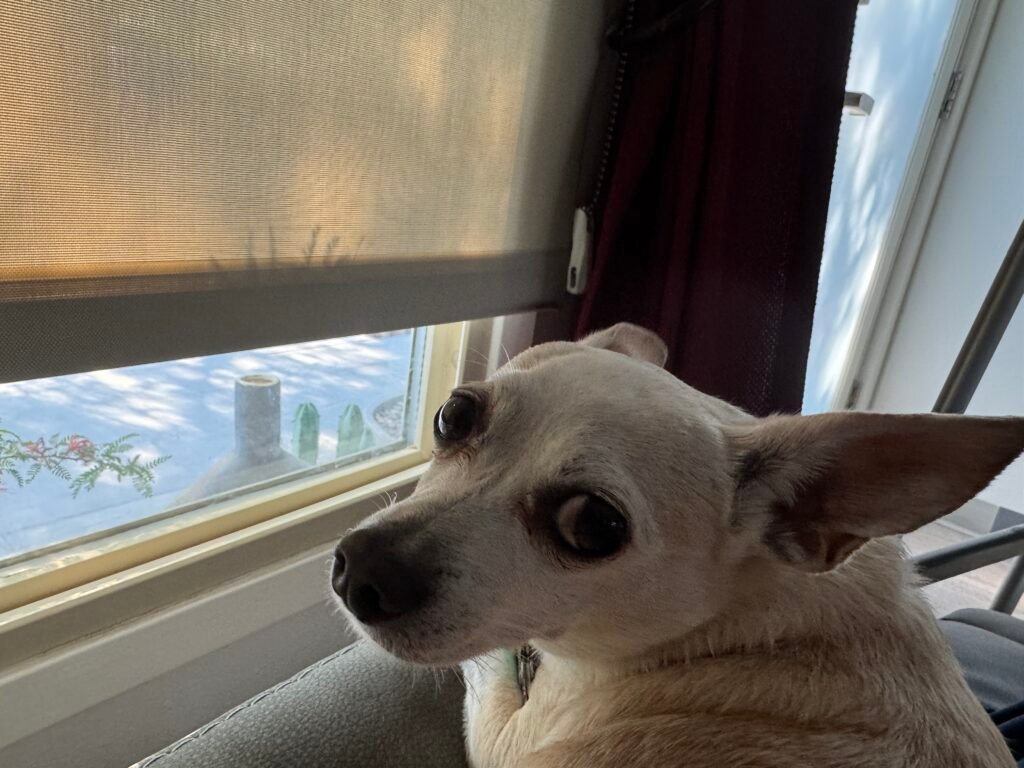
When I adopted him, I made him a promise, and that was he would never be abandoned again… ever! And I mean to make good on that promise. As a single man living alone, it can be easy to turn in on yourself and become selfish. Gordon reminds me, daily, there are other beings in the world; in his case, one who depends upon me entirely for his existence. And so I can’t only think of myself. But if I was hospitalized and in a nursing home for a time, while I am able to comprehend concepts like “treatment” and “recovery” (both of which would take place elsewhere), there is no way to explain to him the difference between “away” and “gone.” So I’m relieved to not be leaving him with the impression he’s been left behind. He probably does wonder why I’ve been hugging him a lot tighter these last couple of weeks.
Uh, but…
Radiation fibrosis of the lung is a chronic, late complication of radiation therapy to the chest. It results from progressive scarring and remodeling of lung tissue following radiation-induced injury. The condition most commonly develops months to years after treatment for cancers such as lung cancer, breast cancer, esophageal cancer, lymphoma, and mediastinal tumors. Here’s the science:
Radiation damages alveolar epithelial cells, vascular endothelial cells, and connective tissue within the irradiated field. The injury triggers an inflammatory response characterized by the release of cytokines, including transforming growth factor-beta (TGF-β), which promotes fibroblast activation and collagen deposition.
And here’s the bottom line:
Over time, normal lung architecture is replaced by dense fibrous tissue, leading to permanent structural changes and loss of lung function.
So, as I was saying, it’s not black and white, good or bad. It’s something new on my cancer journey. Radiation-induced lung injury typically occurs in two phases:
- Radiation pneumonitis (acute phase): develops within weeks to months after radiation exposure and is characterized by inflammation.
- Radiation fibrosis (chronic phase): develops 6–24 months or longer after treatment and represents irreversible scarring of the lung.
We seem to be at phase 2. I am not experiencing any symptoms yet, but depending on the extent of the fibrosis and the amount of lung involved, I can expect:
- Progressive shortness of breath
- Chronic dry cough
- Reduced exercise tolerance (well, I have NO tolerance for exercise already!)
- Chest discomfort
- Fatigue
Pulmonary function testing is employed to diagnose:
- Reduced total lung capacity (TLC)
- Reduced forced vital capacity (FVC)
- Decreased diffusing capacity for carbon monoxide (DLCO)
The degree of impairment generally correlates with the extent of fibrosis. Extensive fibrosis may contribute to respiratory insufficiency, pulmonary hypertension, or right-sided heart strain. Sounds like a hoot, right?!
Radiation fibrosis is irreversible, and the research I’ve done in the last 24 hours seems to suggest it’s an outcome radiation oncologists don’t discuss fully (if at all) with patients before radiotherapy; I can tell you it’s the first I’m hearing of it. And while I’m glad the tumor is not growing nor the cancer spreading, relieved at not having to leave Gordon alone and wondering where I am, and grateful to not be facing something truly horrible like chemotherapy, I am none too pleased about this.
I spent 15 days in a pulmonary ICU unable to breath back in 2013. It was awful. It was that experience that led me to make the decision to move to assisted living at the age of 47. The inability to breath is not “pain” – rather, it is existential. With each gasp for air, your brain tells you “yup… this is it…if you don’t fill your lungs now, it’s over… get ready to die,” followed by “ah… okay…good, we got some air… you’ll live,” and then “oh shit!… we’re out of air again… get some… what do you mean you’re trying?… well try harder or this is it.” And that little dialogue repeats over and over, every waking hour, every second of the day. It is relentless, emotional, and mentally exhausting. Pain would be preferable.
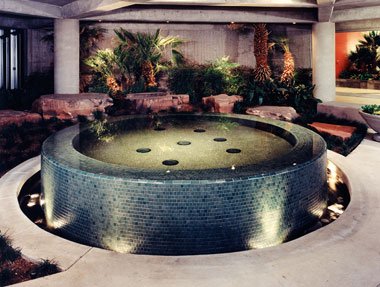
(main entrance foyer)
Now because radiation fibrosis is irreversible, treatment is limited to symptom management and preservation of lung function. Which means I’ll be at the Lucy Curci Cancer Center on Monday to discuss next steps with my team, which includes an oncologist (cancer doctor), a radiation oncologist (radiotherapy doctor), a pulmonologist (lung doctor), and Spencer (the nurse practitioner who acts as a kindof “care manager” coordinating all my needs).
I know I’ve said it before, and I won’t bang on about it now, but I am very fortunate to be a patient at Lucy Curci. They are the very apex of healthcare, and not just because of the Relaxation Garden below I love spending time in when I am there or the pianist playing a baby grand piano to greet you in the entrance foyer.
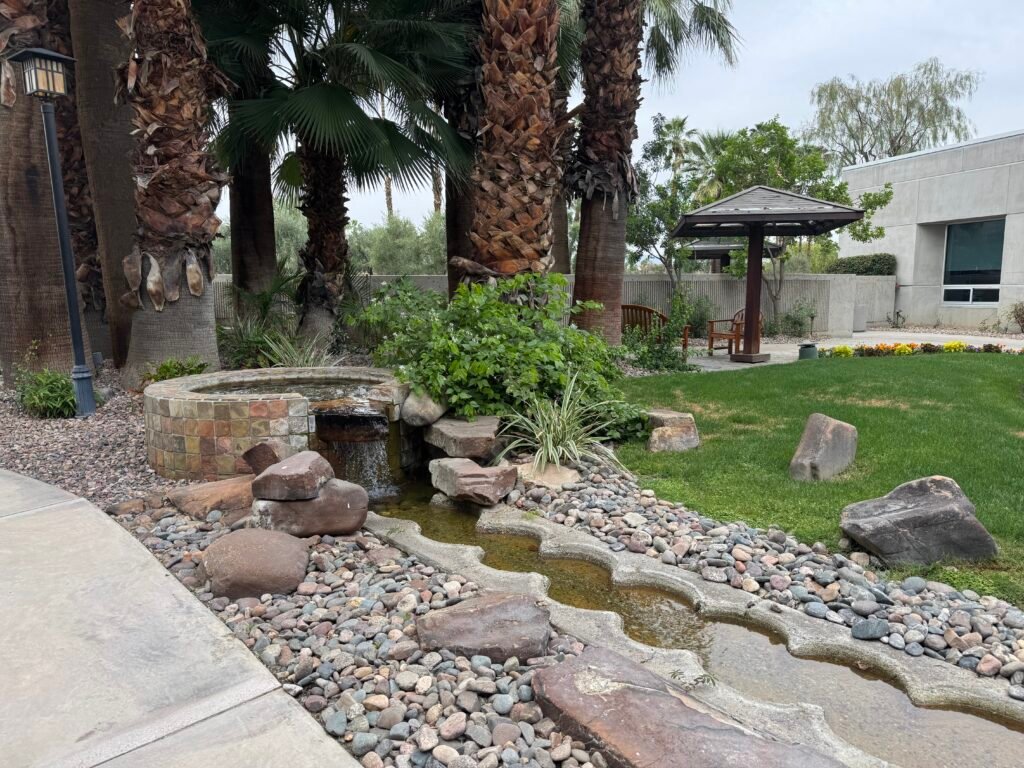
I like to park my wheelchair next to this little stream and just hang out – it is very tranquil
And Gordon and I are very fortunate to live at Stonewall Gardens Assisted Living. Just yesterday, we had a mariachi concert, margaritas, and a delicious Mexican dinner to commemorate and celebrate my ten years here. And on behalf of Gordon and myself, I want to say thank you: to the Kabakoff and Levy families for conceiving of the idea of a safe space for LGBTQ+ people to receive care and making it happen, to our management team (Brittany, Brian, Nisha, Regina, Jose) who work tirelessly behind the scenes to make it happen, to our dedicated med techs, caregivers, driver, housekeeper, cooks, gardeners, and handyman who are out there everyday making it happen, and to our selfless corps of volunteers from the surrounding Coachella Valley community who fill in the gaps. Echoing Dorothy in The Wizard of Oz…
there’s no place like Stonewall.

So you see, it’s not bad news but it’s not exactly good news. But I’m here and it’s now, and I truly believe that with Lucy Curci and Stonewall on my side, I’ll be fine.
