
We have already established that as a young boy I was rubbish at sports. It wasn’t for lack of trying. My father, may he rest in peace, had me “try out” for everything, but when it came to a ball, I was simply no good at kicking one down a lawn, hitting one with a cylindrical stick of wood, or propelling one into a basket suspended ten feet above the floor. I was on a swim team and swam competitively, but my career as the next Michael Phelps (probably would have aspired to be Mark Spitz at the time) was ended when a runaway, driverless car ran over me, crushing my left shoulder.
So Cotillion it was! We’d gather at 404 North Central Avenue in my hometown of Glendale, California. This historic Glendale site was home to the city’s Tuesday Afternoon Club, started in 1898, which had played a major role in the civic life of all Glendalians, including the founding of the Glendale Public Library. The building itself contained meeting rooms, offices, and a theater, in addition to a ballroom where we pre-teens gathered once a week for our cotillion to learn etiquette and manners.
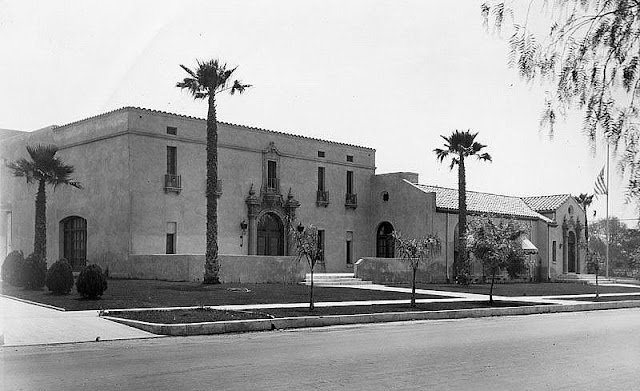
shows the theater entrance on the left, the ballroom off to the right
There were girls, so it was very important to make sure you were up-to-date on your cooties shots. Dressed in Black Tie (the girls in gowns), we learned how to behave at table, to dance (mainly the waltz), to promenade, and how to conduct oneself at formal occasions. Technically, it involved a ball – a ballroom that is – so it was kindof sports. I think the point was to learn how to be a gentleman, not physical prowess.
Beyond “which fork to use,” Mrs. Golatz, our “coach” if you will, taught us things, the usefulness of which seemed questionable then and seems downright ludicrous now. But I am determined this morning not to write about Trump, the war with Iran, or the World Cup (though I am quietly rooting for England to defeat Norway today and advance to the Semi-finals as a matter of pride in my national heritage), so I thought we might journey back to my childhood together, thoughtful reader, and learn the difference between French Service and Russian Service at table. Along with the need to solve the quadratic equation, or dissect a frog, it hasn’t come up that much or that often in my life, but that’s no excuse for being ignorant! Come on… it’ll be fun.

The way food is served reflects a society’s culture, wealth, and ideas about hospitality. It is one of those things most people take for granted, and yet there are differences; there is, of course, French Service (service à la française) and given the way people bang on and on about French cuisine you could be forgiven for thinking this style is somehow dominant. But that distinction belongs to Russian Service (service à la russe). Although both are associated with elegance and fine dining, they differ significantly in how food is presented and served to guests. Their origins also reveal the evolution of European dining customs from elaborate displays of abundance to the orderly, course-by-course meals that are much more familiar today.
French Service is the older of the two styles and traces its origins to the royal courts of 17th century France during the reign of King Louis XIV. At the lavish Palace of Versailles, meals were designed not only to satisfy hunger but also to demonstrate the wealth, power, and sophistication of the French monarchy. During these grand banquets, numerous dishes were arranged symmetrically across the table and presented to guests all at once. Rather than receiving individually plated meals, diners served themselves from platters and bowls placed within reach, or were assisted by servants in availing themselves of what was on offer. The impressive display of roasted meats, pastries, vegetables, and desserts created a visual spectacle that showcased the host’s generosity and social status.
In French Service, presentation is the centerpiece of the dining experience. Large silver platters and ornate serving dishes are brought directly to the table, allowing guests to choose what they would like and how much they wish to eat. Because many dishes are available simultaneously, guests enjoy the freedom to sample a variety of foods at their own pace. This leisurely style encourages conversation and creates a relaxed atmosphere during formal occasions.
Despite its elegance, French Service has several disadvantages. Since dishes remain on the table while guests help themselves, food can cool before everyone has been served. The style also requires a large dining table and an abundance of serving pieces to accommodate the many platters. Additionally, coordinating such an elaborate meal demands considerable preparation and staffing. For these reasons, traditional French Service is rarely seen today outside of state banquets, historic reenactments, or exceptionally formal occasions.
Russian Service emerged during the early 19th century thanks to the influence of Prince Alexander Kurakin, the Russian ambassador to France. Kurakin introduced a different approach to serving meals at diplomatic banquets in Paris, one that emphasized order, efficiency, and the enjoyment of food at its proper temperature. Instead of presenting all dishes at once, each course was brought to the table separately. Servers presented and/or prepared the food on elegant platters before carefully portioning it onto each guest’s plate from a side table or trolley rolled into place known as a guéridon. This method quickly gained popularity throughout Europe and eventually replaced French Service as the preferred style of dining.
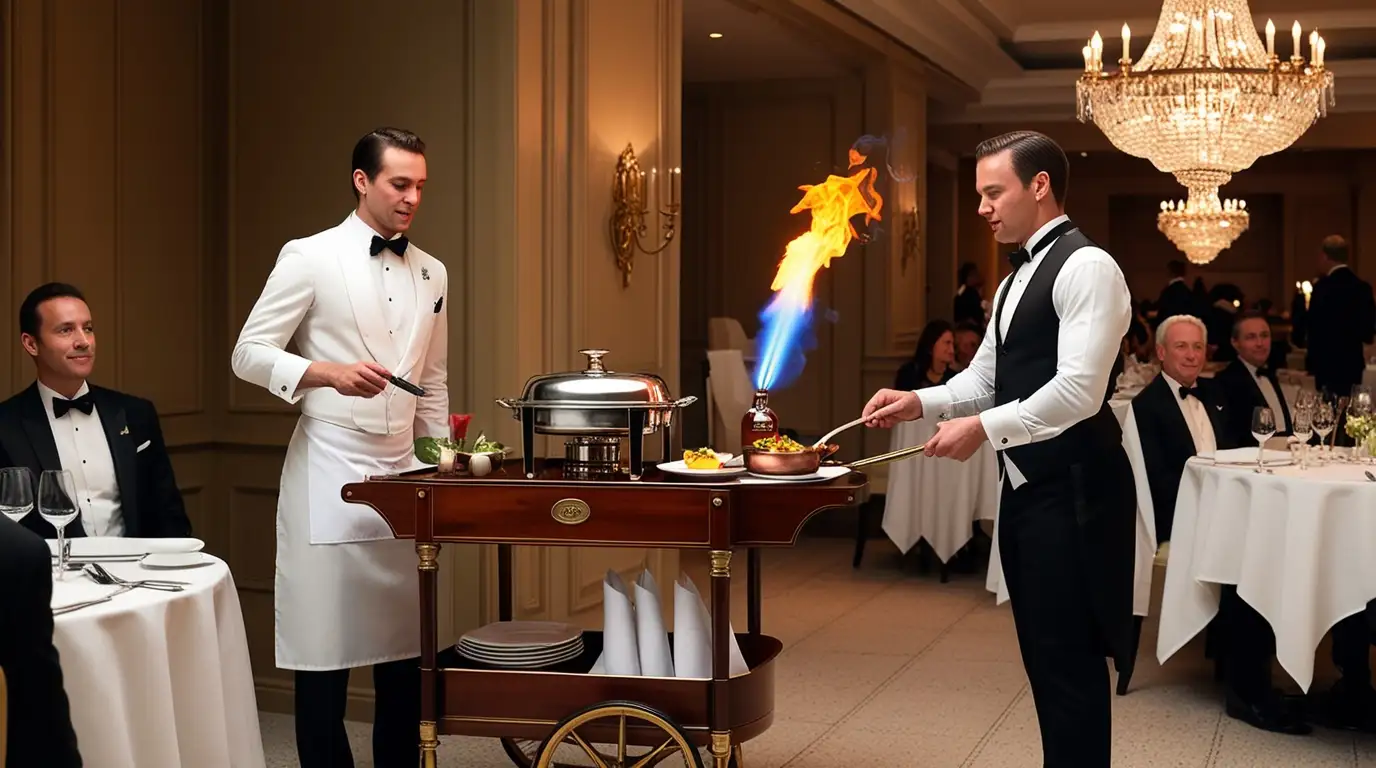
The defining characteristic of Russian Service is the role of the server. Rather than allowing guests to serve themselves, highly trained waitstaff portion each course with precision and consistency. Every guest receives the same carefully arranged presentation, ensuring both elegance and fairness. Courses are served sequentially – from appetizers and soups to the main course and then dessert – allowing diners to fully appreciate each dish before moving on to the next. Because food is served immediately after portioning and being plated, it remains hotter and fresher than it would under French Service.
Russian Service offers several advantages. It provides a refined and organized dining experience, maintains consistent portion sizes, and allows chefs greater control over the presentation of each course. Guests can focus on conversation without the need to pass platters or serve themselves. However, this style also requires highly skilled servers who are trained to portion and plate food gracefully and efficiently. As a result, Russian Service is more labor-intensive (except for diners) than other methods.
Today, Russian Service has had a far greater influence on modern dining than French Service. Most dining establishments now use plated or “American Service,” in which each dish is fully prepared away from diners in the kitchen before being brought directly to the guest. While this method differs from traditional Russian Service, it retains its emphasis on serving courses individually and presenting each plate with precision. French Service, by contrast, survives primarily in ceremonial settings where the grandeur of presenting numerous dishes at once remains part of the occasion.
French Service and Russian Service represent two distinct philosophies of hospitality. French Service emphasizes abundance, visual display, and guest participation, reflecting the grandeur of the French royal courts. Russian Service prioritizes organization, efficiency, and personalized attention through skilled table service, reflecting 19th century innovations in formal dining. Russian Service has left the more lasting legacy by shaping the course-by-course dining experience that remains the standard in dining around the world, whereas French Service is most often seen today, at least in America, in what might be called “family style.” Pass the potatoes.

Thanks Cotillion! As you can see, I may not know how to throw a ball, but I know how to throw a dinner party. And I know how to dance the box step. So all is not lost. Other than the fact that I don’t dance much these days confined as I am to a wheelchair.
