
Whether you are Christian, and particularly if you are not, the Christmas season is hard to miss. It generally runs from late November thru to early January. Ostensibly, it recalls and celebrates the birth of Jesus of Nazareth in the town of Bethlehem, thought by his followers to be the long-awaited messiah or savior, prophesied in the Hebrew scriptures and known as “Christ,” which is where we get the name.
But in today’s multicultural society, not everyone shares those religious beliefs, and yet Christmas endures – we talk of the “spirit of the season,” businesses implement holiday hours, and even atheists exchange presents. The “Christmas party” is as much a traditional observance this time of year as any religious liturgy with rituals all its own, like ill-advised drunken sexual liaisons and photocopying your bare ass and leaving it on your boss’ desk to find in the morning. I can speak from experience with regard to the former but not the latter. Ahem… enough said.
My question is ‘why?’. Why this holiday? The prevalence, hegemony actually, of the Christian religion in Western civilization for the last 2000 years is one answer. Even the central figure of the secular observance of Christmas, Santa Claus, has his origins in a 4th century Christian bishop of a town called Myra, in what is now Turkey, who is revered today as Saint Nicholas, renowned for his piety, kindness, and generosity. There are many legends surrounding his life that center on him being a benefactor of children and especially of the poor.
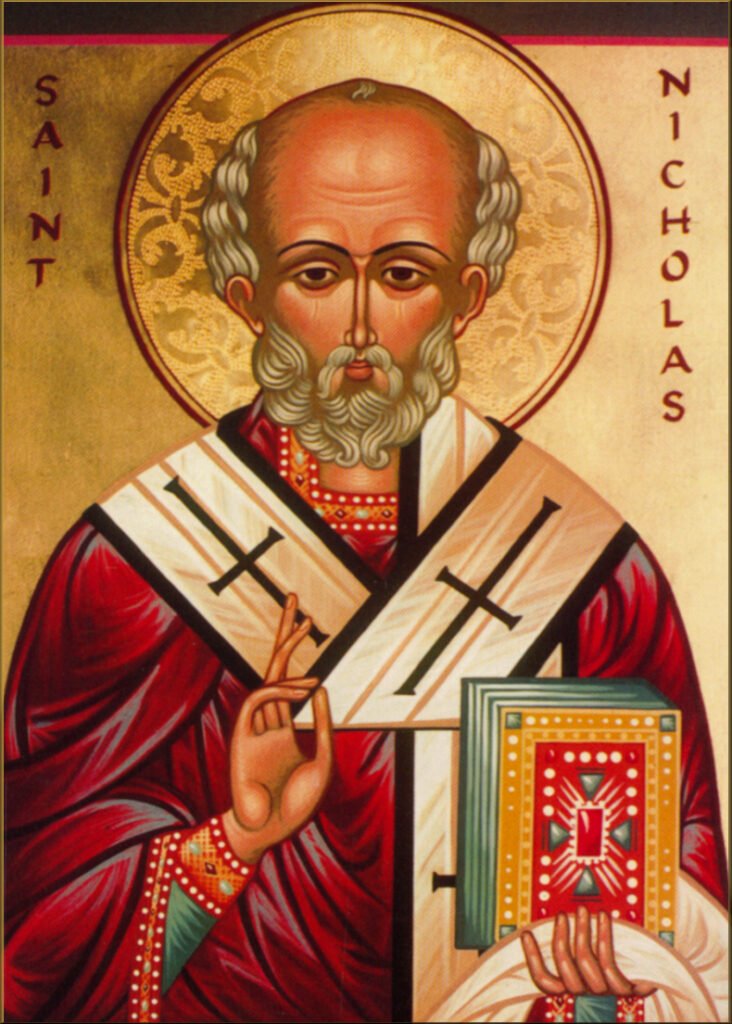
One of the most famous stories about Nicholas involves his coming to the aid of three sisters who were going to be sold into slavery by their father (doesn’t he sound nice?) because they had no money for dowries. According to the legend, Nicholas broke into their house one night and left gold for the sisters in their socks which had been washed and hung up by the fire overnight to dry. We forgive him the breaking and entering because of the charity, which not only earned him a reputation as a gift-giver but gave us the tradition of the Christmas stocking. And a stranger who secretly comes into your house at night leaving you presents.
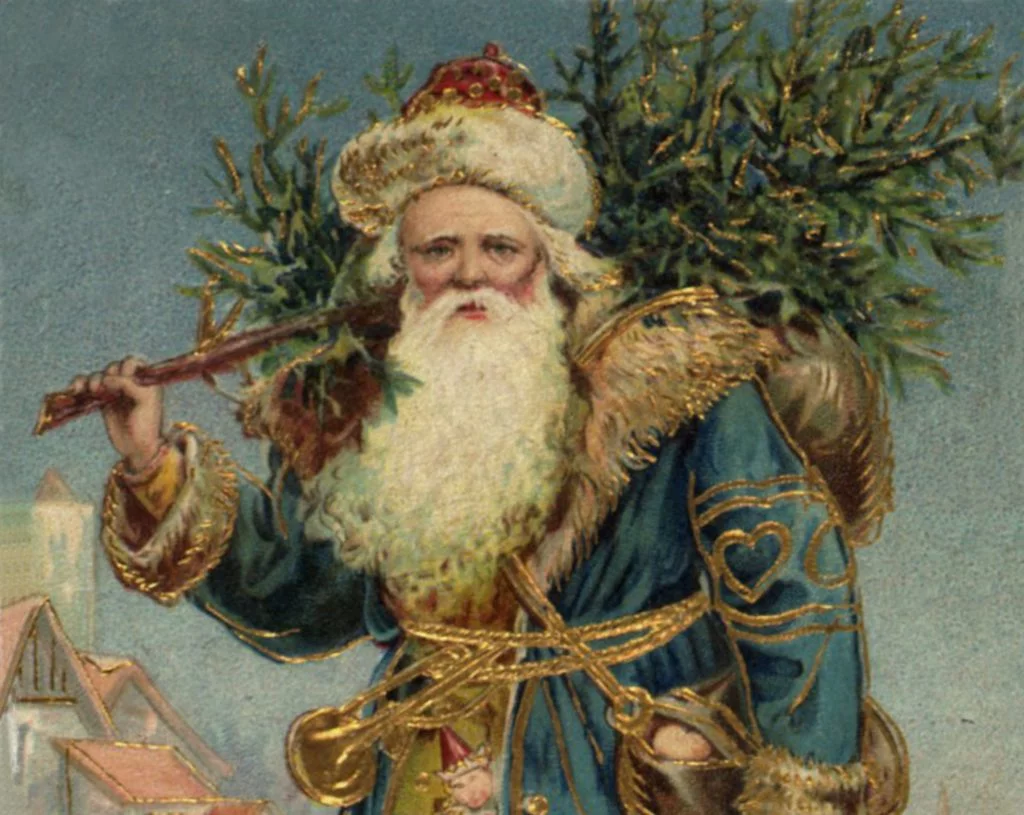
The legend of Saint Nicholas merged over the many centuries with local customs and traditions. In medieval England for example, Nicholas becomes Father Christmas – embodying the spirit of good cheer, feasting, and merriment – depicted as a kind woodsman in a warm, green overcoat.
In the Netherlands, Nicholas became known as Sinterklaas, a figure who arrived on the evening before the feast day of St. Nicholas, celebrated in the Catholic calendar on December 6th; the night of December 5th (Sinterklaasavond), Sinterklaas would leave gifts for children, and it was Dutch settlers (immigrants!) who brought the tradition of Sinterklaas to America in the 17th century, where it evolved even further.
The transformation of Sinterklaas into Santa Claus in America was influenced first by Washington Irving’s 1809 book A History of New York which satirically described a jolly Dutch figure, “Saint Nicholas,” who flew over rooftops in a wagon delivering presents. In 1823, the publication of the poem “A Visit from St. Nicholas,” commonly known as “The Night Before Christmas,” by Clement Clarke Moore further solidified Santa’s image in the American psyche – the poem introduced many elements that are now integral to the repertoire of Santa Claus: a sleigh pulled by flying reindeer, his ability to enter homes through chimneys, and his cheerful, plump (that’s code for ‘fat’) appearance.
By the 20th century, Santa Claus became a central figure in the commercialization of Christmas. Coca-Cola’s advertising campaign in the 1930s featuring a Santa Claus created by artist Haddon Sundblom played a significant role in solidifying the modern image we have of him. Sundblom’s Santa radiated warmth and reminded people of their grandfather — a friendly man who loved children and enjoyed life. To give his creation humanity, Sundblom used a friend of his as the model for the character, adding a white beard flowing down over a long red coat generously outlined with white fur (red and white being the colors associated with Coca-Cola’s logo, the selling of Coke being the whole point of the ad campaign), an enormous brass buckle fastening a broad leather belt, and large floppy boots. He is, again, fat!
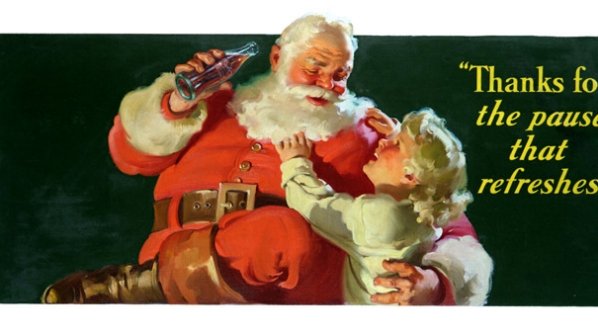
Sundblom’s Santa made his debut in 1931 and was an instant hit for Coca-Cola, offering a glimpse of hope and joy for people whose spirits had been brought down by the Great Depression; he continued to create Santa illustrations for Coke until his final version in 1964. These depictions became universally considered the official personification of the patron of Christmas.
Beyond this connection to Christian hagiography, medieval history, and American advertising, the customs associated with Christmas, and its central player in the guise of St. Nicholas (or St. Nick as he’s often called), Father Christmas, or Santa Claus, impart values and lessons relevant to us today. The blend of historical facts, folklore, literary contributions, commercial, and cultural adaptations are the “secret sauce” of Christmas and go a long way to explaining its wide, secular appeal. The act of gift-giving during the Christmas season reminds us of the need for generosity and compassion, and to be grateful for the many blessings in our lives. Gatherings, be they at the office or at home with family and friends, remind us of the importance of spending time with those we care about, giving us a sense of unity and belonging. Christmas carries with it a sense of hope and the promise of better things to come; it encourages us to look forward to tomorrow with optimism, just as children eagerly awaiting Santa’s arrival do as they go to bed the night before, confident he will visit.

From all this – the history, customs, and values associated with Christmas – we experience continuity, unity, and joy this time of year. I think it is these things that bridge the gap between generations and even very different peoples, serving as a source of comfort in our otherwise trying modern lives, and this is the true magic of Christmas. Santa’s journey through history and across cultures demonstrates the power that myth and tradition have on our lives, uniting and inspiring us.
Gordon and I would like to take this opportunity here to wish you and yours a very merry Christmas, as well as friendship and peace throughout the new year.
He’s just turned 8, I’m turning 60 in four months!