
Yesterday marked one month since my cancer diagnosis. In that time, I have had multiple consultations with doctors, quite a few tests, and I have been reading everything I can find on cancer and its treatment. When I was diagnosed with PML, I took quite a different approach; PML is a rare disease, so there isn’t a whole lot of information available on it, and there is no treatment for it (other than improving the body’s immune system function, the breakdown of which allows the disease to “activate” and spread). So with PML, I allowed my doctor (neurologist) to tell me what I needed to know and what I needed to do.
I have taken a much more active role in responding to the news that I have an 11-millimeter tumor on my right lung. Obviously, it needs to be gotten rid of. But the best way to do that is an open question encompassing things like the invasiveness of the procedure, any side effects, and time to recover. The nature (physical characteristics) of the tumor also factor into the discussion.
I first met with what we might call a “traditional” oncologist (cancer doctor). It was very brief. He more or less told me, “I’m the guy you’ll come back to see if other interventions don’t work or are ruled out for one reason or another.” He’s the chemo (chemotherapy) guy, with all the hair loss and nausea that entails. I decided early on I didn’t want to see him again!
Then there was the thoracic (chest) surgeon. He was the first person to help me visualize what I am facing. He described my lung as a bowl of chocolate chip ice cream, but with only one chocolate chip. And he described his job as going in to surgically remove the chocolate chip by cutting it out. This would be done laterally, through the side of my chest. Seems straightforward. I initially favored this option, but things like my PML diagnosis raised the risk level of surgery to “high,” and when he told me I’d probably spend 30 to 60 days in the hospital recovering I all but decided against it. I was away from Gordon for six days last August when I was hospitalized with pneumonia, and I have never been so sad or missed anyone that much in my life. And that was six days – less than a week! How would I manage to be separated from him for two months?
Which left radiation.
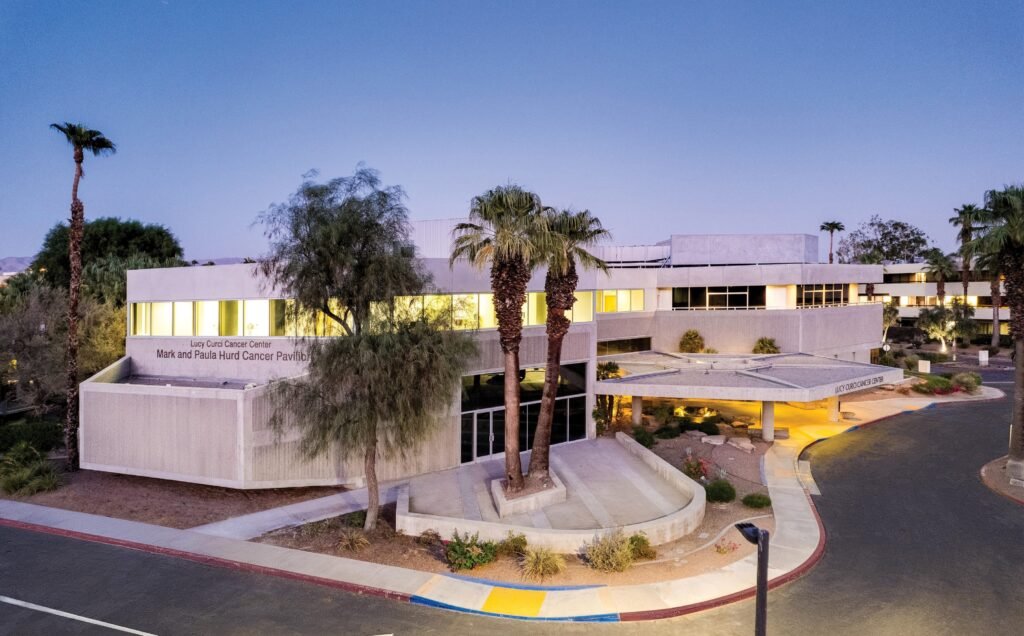
Throughout the last month, I have become a frequent visitor at the Lucy Curci Cancer Center (above) on the Eisenhower campus in Rancho Mirage. It is an amazing, truly remarkable place, and everyone that works there has been absolutely wonderful to me. They have created a calm, professional, beautiful setting where people dealing with the quality of their life and the very real possibility of its end can receive care and treatment.

The park in the middle (at left) has become one of my favorite spots to visit. But beyond that, the people are so nice. When I first became a patient there, they took my picture (for my file, they said).
Now, instead of some nurse hanging out a half open door and shouting out “Matthew” into a sterile waiting room like a carnival barker inviting spectators to “step right up,” a concierge walks over to wherever I am sitting and says, “Good afternoon Matthew, would you like to get started?” You would be surprised how much that little kindness puts you at ease.
After weighing all my options, and discussing them with my primary/HIV care physician and my neurologist and pulmonologist, I have decided to go forward with radiation treatment (radiotherapy). My radiation oncologist is Dr. Jeffrey Burkeen. We met yesterday to sketch out the plan. I will undergo five external beam radiation therapy (EBRT) treatments, each a day apart, over the course of two weeks. I will lie on a table while a machine, guided by computers fed coordinates from CAT scans and MRI images, “zaps” the tumor from different angles with highly focused X-rays to kill it. I will feel and see nothing. Each radiation treatment takes about 3 minutes, but requires 30 minutes of setup (positioning me, calibrating equipment, etc.). If all goes to plan, I’m told I can expect no discomfort or side effects, except extreme fatigue.

It sounds too good to be true. But Dr. Burkeen informs me that the location of the tumor – upper external surface of the right lung (see above) – is in my favor. It’s in an easily targeted place, and while he was realistic and discussed potential complications (including “missing” the tumor and frying the lung!), he said mishaps are rare, and this treatment for this kind of cancer almost always results in total remission and very little incidence of recurrence.
I’m moving forward with the radiation plan in the next week. Thank you to those of you who have taken the time to write and offer your support and encouragement. It means more than you’ll ever know.