
This is a cautionary tale.
History is full of inventors who changed the world. Thomas Edison gave us the light bulb. Alexander Graham Bell, the telephone. The Wright brothers taught humanity that flying was not just for the birds. Then we have Thomas Midgley Jr.: environmental historian JR McNeill said of him that he may have had a more adverse impact on Earth’s atmosphere than any other single organism in history. Think about that.
Now to be fair, Thomas Midgley was not some evil Bond villain plotting humanity’s downfall from a secret underground lair on a deserted island off the coast of India in the Bay of Bengal while menacingly stroking a cat. He was only trying to help.
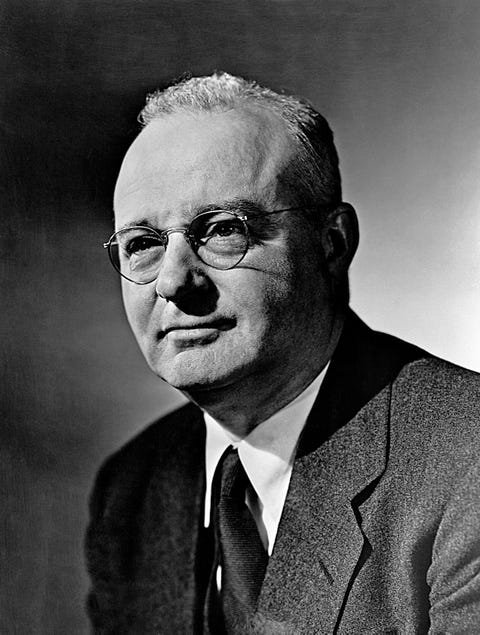
He was born in 1889, and studied engineering at Cornell University before joining General Motors, where he worked under the famous inventor Charles Kettering. His assignment sounded simple enough, almost mundane. He was given the task of figuring out why the car engines of his day sounded like giant mechanical coffee cans full of loose bolts. The knocking sound was not just annoying to the ear; it reduced engine performance. A solution would not just enhance the driving experience, it would make operating an automobile a more efficient enterprise.
He discovered by chance that iodine added to kerosene reduced the knocking, but only slightly, so Midgley approached the problem like any determined scientist, going one-by-one through the periodic table of the elements looking for something that when added to gasoline would eliminate the knocking completely. Eventually, he discovered that tetraethyl lead worked beautifully: just a tiny amount of lead added to gasoline had engines purring like a basket of kittens.
General Motors was thrilled. The automobile industry celebrated. Investors smiled. Everyone congratulated themselves on another giant leap forward for humanity thanks to the Industrial Revolution.
There was just one tiny problem. Lead is spectacularly poisonous.
Not mildly poisonous. Not “be careful when handling” poisonous. Lead has been disliked for thousands of years. The Romans had already figured out that too much lead made people sick; it’s always the Romans, isn’t it? The hubris of the 20th century looked at this ancient knowledge and said, “Sure, it sounds bad… but hey, what if we burned it by the billions of gallons?”
Workers manufacturing tetraethyl lead began experiencing hallucinations, insanity, convulsions, and death. One production facility became so dangerous that it was nicknamed the “House of Butterflies” because poisoned workers claimed insects were flying around them. Even Midgley himself did not escape these, let’s call them “adverse effects;” he developed lead poisoning during his research. Most people would have taken this as a sign that perhaps lead wasn’t the answer they were looking for; Midgley instead recovered and went back to promoting leaded gasoline. There is dogged determination, and then there is foolish, near-sighted stubbornness.
In a publicity stunt, he poured tetraethyl lead over his hands and even inhaled its vapors in front of reporters to demonstrate how safe it was, essentially the scientific equivalent of juggling chainsaws to prove workplace safety. His little “demonstration” succeeded because of scientific ignorance: not because the chemical was harmless, but because lead poisoning takes time to produce its worst effects.
For decades afterward, cars happily sprayed microscopic lead particles across cities, suburbs, farms, and playgrounds. Generations of children unknowingly absorbed the metal, while governments and scientists slowly realized that turning the atmosphere into a giant lead dispenser had perhaps not been humanity’s finest hour.
Most people would consider accidentally poisoning millions of people a career-defining mistake. Not Thomas Midgley. He was just getting warmed up!
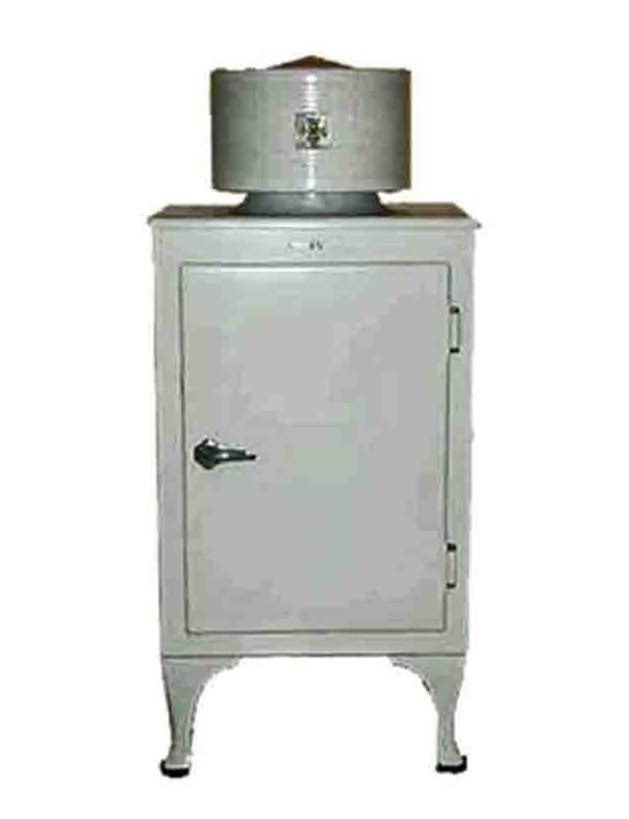
Warmed up, or cooled down as the case might happen to be. He next tackled the problem of refrigeration. Early refrigerators relied on chemicals like ammonia and sulfur dioxide to cool their contents. But these chemicals (it’s always the chemicals with this guy!) had the unfortunate habit of being toxic, explosive, or a combination of the two. Refrigerator leaks occasionally killed entire families, which your average consumer considered a design flaw.
Never fear… Thomas Midgley is here. He helped develop chlorofluorocarbons, better known as CFCs or Freon. These chemicals seemed almost too good to be true. They weren’t flammable. They weren’t especially toxic. They didn’t explode. Refrigerators became dramatically safer as a result, and air conditioning spread around the world.
Scientists congratulated themselves on another job well done.
Then, several decades later, researchers discovered an awkward problem.
Once released into the atmosphere, CFCs drifted upward until sunlight broke them apart, releasing chlorine atoms that enthusiastically destroyed Earth’s ozone layer. It turned out humanity had accidentally invented a chemical capable of dismantling the planet’s natural sunscreen one molecule at a time.
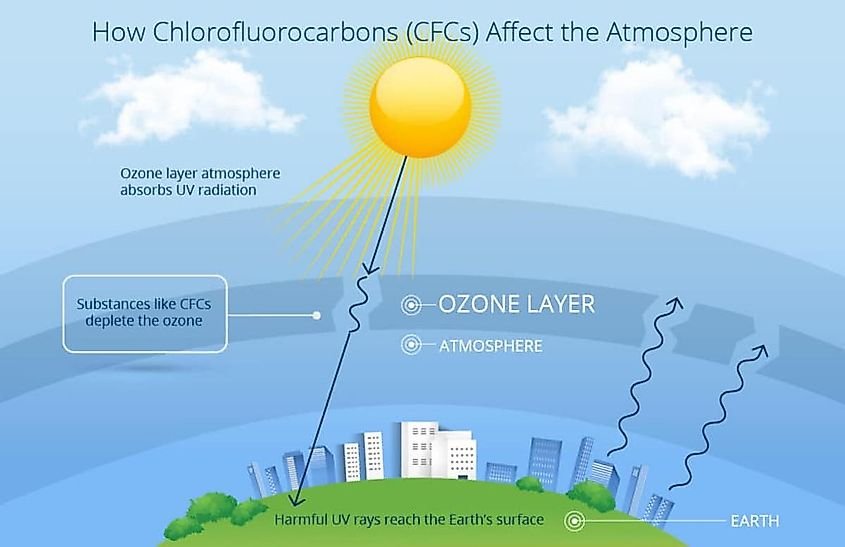
The ozone layer protects life from dangerous ultraviolet radiation. Without it, skin cancer rates increase, crops suffer damage, and ecosystems struggle. Discovering that one of your greatest inventions is quietly punching holes in the atmosphere is generally considered less than ideal.
Fortunately, unlike many environmental disasters, this one had a happy ending. Nations around the world signed the Montreal Protocol in 1987 and gradually eliminated most CFCs. The ozone layer has been recovering ever since, proving that humans can and occasionally do learn from their mistakes.
As for our boy, Thomas Midgley, he decided two chemistry strikes wasn’t enough so he developed a plan to cut out the middleman of dangerous chemicals and just kill babies with hammers.
I don’t believe in karma, but every once in a while, you come across something that makes you scratch your chin, furrow your brow, and say, “hmmm.” In 1940, Midgley contracted polio, leaving him with limited mobility. That is not the karma, that is just tragic. I have limited mobility, and I will tell you that even something as simple as getting out of bed becomes a major chore. Being an engineer, Midgley naturally decided to engineer his way out of the problem. He invented an elaborate system of ropes and pulleys that allowed him to lift himself in and out of bed independently.
But, one morning in 1944, the harness fastened around his body which the ropes lifted swung unexpectedly in an odd sort of way that left him inverted. I shouldn’t be laughing, but I am.
In the ensuing struggle to right himself he instead strangled himself to death on the ropes.
Let’s all say it together: hmmm.

The story of Thomas Midgley Jr. is one of unintended consequences. Every invention he created genuinely solved an important problem. Car engines became less annoying and more efficient. Refrigerators stopped blowing up in kitchens and killing people. Air conditioning became commonplace. Imagine a world without a reliable car, a safe refrigerator, or air conditioning – it was 106℉ yesterday in Palm Springs! Midgley’s intentions were good; his contemporaries viewed him as a brilliant engineer solving real-world problems and generally making life better for us all. The problem was that no one fully understood the long-term consequences of his inventions until decades later. What appeared to be engineering miracles slowly revealed themselves as environmental and public health disasters on a global scale.
His story remains surprisingly relevant today. As society races to develop AI, genetic engineering, weapons, and climate technologies, Midgley’s life reminds us that every breakthrough deserves careful scrutiny. We must not become intoxicated by success.
Solving today’s problem is wonderful. Accidentally creating tomorrow’s catastrophe in the process is considerably less impressive. Thomas Midgley Jr. never intended to poison the atmosphere, damage the ozone layer, or become one of history’s greatest examples of unintended consequences. He simply wanted engines to stop knocking and refrigerators to stop killing people.
He succeeded brilliantly. And then the bill arrived.
