
Last summer, when I was diagnosed with lung cancer, I promised to keep you, thoughtful reader, updated on my journey. In that regard, it’s all good. The tumor on the upper part of my right lung was 10 mm in size when first detected, grew to 14 mm before treatment began, and has now shrunk to 11 mm as a result of radiation. I had been under the impression that radiation was like the phasers on the starship USS Enterprise from Star Trek, where once they’d been trained on a target if they hit their mark the enemy was destroyed. Not so.
Radiation is the beginning of a process which will, if successful, shrink and eventually eradicate a tumor. So while I’d hoped to be able to say by the new year that I was “cancer free,” all I can say is things are going in the right direction – the tumor is shrinking. I’m due back at the Lucy Curci Cancer Center every three months for the foreseeable future for additional imaging and labwork to ensure that it keeps shrinking and does not spread. But the bottom line is radiation was successful even if the enemy wasn’t destroyed completely… yet. Stay tuned.

Of far more concern is this new diagnosis of Benign Prostatic Hyperplasia or “BPH.” Great! Another initialism to add to my collection – HIV, PML, and now BPH. As we’ve previously established, an acronym is pronounced as a word (like NASA), while an initialism is pronounced letter by letter (like FBI or NFL). Both are abbreviations formed from the first letters of a phrase, but the key difference is their pronunciation – for example, NASA is an acronym because it is said as a word, whereas FBI is an initialism because its letters are said individually. Drop that at your next cocktail party. You’re sure to be a hit with your fellow partygoers!
Everyone tells me (and by “everyone” I mean my doctor, friends, and the results of my own Internet sleuthing) that BPH is quite a common condition characterized by the enlargement of the prostate gland in men as they age. While it is rare in men under 40, it becomes increasingly prevalent with advancing age – by the age of 50, half of men (give or take) show evidence of prostate enlargement, and this percentage rises to nearly 90% by the age of 80. While it’s true not all men with an enlarged prostate experience symptoms, the likelihood of symptomatic BPH increases over time.
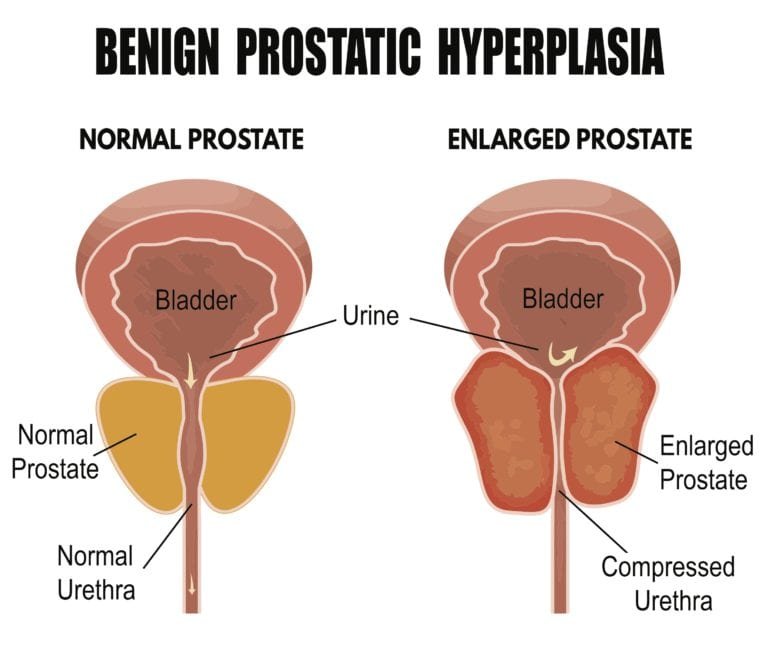
As the prostate enlarges, it can compress the urethra, leading to obstruction of urinary flow. Additionally, the bladder wall may thicken and become more irritable due to chronic resistance, contributing to urinary symptoms. These changes collectively result in the clinical manifestations of BPH. Although BPH is not life-threatening, it can significantly affect quality of life by causing troublesome urinary symptoms and complications if left untreated.
Symptoms of BPH are collectively referred to as lower urinary tract symptoms or “LUTS” (initialism or acronym? Answer at the bottom of this post.) and are generally divided into two categories: obstructive and irritative. The severity of symptoms does not always correlate with prostate size. Some men with significantly enlarged prostates may experience minimal symptoms, while others with modest enlargement may have severe urinary difficulties.
Various tests are utilized to diagnose BPH, such as uroflowmetry (which my doctor calls “urodynamics”), post-void residual urine measurement, ultrasound, and cystoscopy – all of which I’ve undergone in the last four months. So basically, I’m a full-time patient: if I’m not writing a blog post, working on this website, gardening, or playing with Gordon, I’m at a doctor’s office being poked, prodded, scanned, and a few things that are unmentionable in polite company. I’ll tell you one thing I’ve learned: growing old ain’t for sissies!
Still, it’s better than the alternative – not growing old.
Moderate symptoms warrant pharmacological intervention. The most commonly prescribed medications are alpha-adrenergic blockers, such as tamsulosin (which goes by the aptly-named “Flowmax”), which relax smooth muscle in the prostate and bladder neck, improving urine flow. These drugs act quickly but do not reduce prostate size.
Another class of medications, 5-alpha-reductase inhibitors (such as dutasteride), lead to gradual prostate shrinkage. I have been taking dutasteride, known by its brand name “Avodart,” for four months in an effort to stave off more invasive, surgical solutions, but my symptoms have persisted. I am reliably informed by my urologist that if left unresolved BPH can lead to severe complications such as acute urinary retention, a painful and urgent condition requiring catheterization, bladder dysfunction, recurrent urinary tract infections (which I am experiencing), bladder stones, hematuria, and, in severe cases, renal insufficiency due to back pressure on the kidneys.
So we’re at the point where surgical intervention is indicated. Transurethral resection of the prostate or “TURP” (initialism or acronym? Answer below.) has long been considered the gold standard, and was initially proposed by my doctor. But in the days since he has proposed an alternative, GreenLight Laser Therapy, which utilizes a laser beam to remove prostate tissue; the laser treatment is delivered through a thin and flexible fiber, which is inserted into the urethra through a cystoscope.
While still considered surgery, it is done on an outpatient basis (in my case at the Eisenhower Urology Specialty Clinic in the Hirschberg building on the main campus in Rancho Mirage). Compared to TURP, this procedure will result in:
- 50% less time with a post-op catheter (22 hours vs. 46.7 hours)
- 2x faster return to stable health (26 hours vs. 52.8 hours)
- lower incidence of complications (such as bleeding)
So I have green-lighted the GreenLight procedure. It is scheduled for February 9. My doctor wanted to get me in right away to get this done, but I said NO! I need some time to get my head around the fact that my plumbing is about to be roto-rootered!

And now let’s get some answers to our initialism or acronym quiz:
- LUTS – acronym: said as a word formed from the first letters of a phrase
- TURP – acronym: said as a word formed from the first letters of a phrase
How’d you do? Got two out of two? Look at you… not bad. Good on Ya! Now, let me get on with this. My next thing. I’m not happy about it, but needs must.
