
We have a gentleman (ahem!, and I use the term loosely) that works here at my residence who is very enamored with the color pink. I often taunt him about it. And he retaliates by assaulting me with the color any chance he gets. One December, I awoke to find that overnight he had filled my patio with ten artificial Christmas trees – all of them pink. Someone had donated them to the charity thrift store Revivals (benefiting Desert AIDS Project) where his husband works, and he thought “this is just what Stonewall Gardens needs,” so he brought them here and, after my patio, they became an annual feature of our holiday decorations.
In the last year or so they have disappeared. I say good riddance. But you do have to ask yourself “why would some company ever have made such a thing?” Then, “who would buy it?” And, “why pink?”

When I think of pink, and believe me I try not to, I see Barbie dolls, then the movie, then Ryan Gosling in the Barbie movie (at left), then Pepto-Bismol, and then Ryan Gosling naked and covered in nothing but Pepto-Bismol, although come to think of it that last one may have just been a particularly strange and yet oddly satisfying dream I had the night after I saw the Barbie movie.
But the history of pink tells a much more complex story.
The word pink only entered the English language when it was used as the name of a flower, the Pinks or what we would call Dianthus (or Carnation). We’ll come back to that. Prior to this, what we think of as pink was simply called light red.
Because of the frilled edge of the flowers, we have the verb in English “to pink” which dates from the 14th century and means “to decorate with a perforated or punched pattern”, as illustrated by the name of “pinking shears,” special scissors for cloth that create a zigzag or decorative edge that discourages fraying. Because of this, the color may be named after the flower, rather than the flower after the color.
It was Renaissance master Raphael’s Madonna of the Pinks (at right) in 1506 that gave pink its first significant meaning (beyond zigzaggy cloth edges).
At first glance, a naked Baby Jesus handing a sprig of Pinks (Carnations) to his mom may seem like no big deal, until you ask yourself where he got them.
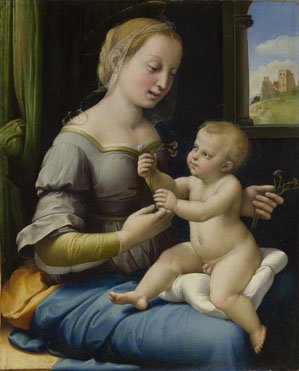
Obviously, he’s a baby, so it’s not likely he just popped down to one of Nazareth’s florists or even out to Mary and Joe’s own garden. But even if he did, we have what we call in television and film a “continuity problem,” because according to tradition, Dianthus (the Greek name for the Carnation plant, meaning “flower of Zeus” or “flower of god”) did not appear in the world until Mary wept at her son’s crucifixion 33 years later. So the Pinks take on a deeply theological/spiritual meaning; stained reddish with the future blood of the baby who hands them to her, they are a prophecy demonstrating how this child transcends the linear unfolding of time.
By the 18th century, pink was considered a strong, masculine color. Kings in royal European courts, like Louis XV of France, often wore pink suits. Pink symbolized wealth, elegance, and confidence. Why? Pink was linked to red through its Raphaelite connection to the blood Christ – often called the “King of Kings” – shed on the cross, and of course European kings ruled by something called “divine right” meaning it was thought they’d been chosen by God. Paler versions of red felt refined (read that “royal” as opposed to divine) but still bold. So pink emerges as a color of power, particularly since the majority of people at this time believed all earthly power derived from God.
Industrialization in the late 19th century made fabrics cheaper and dye production faster; to boost sales retailers started assigning colors to children’s clothes (which meant they were not interchangeable between daughters and sons; if you had one of each you’d need to buy two sets of clothes). An American magazine in 1918 suggested:
- Pink for boys: because it was “a stronger color.”
- Blue for girls: because it was “more delicate.”
But after World War II, it was marketing that reversed the roles. Pink became the color of femininity, softness, and domestic life due in large part to America’s first lady for seven years in the 1950s, Mamie Eisenhower. Pink was Mrs. Eisenhower’s favorite color, and Madison Avenue used the prominence she gave it to sell domestic tranquility to American housewives. The rise of Barbie in 1959 cemented pink as the ultimate girly hue.
A decade before, pink was pressed into service by none other than the Nazi regime during World War II; they used pink triangles sewn onto the prison garb of homosexual prisoners in concentration camps to out and shame them (as if arresting and imprisoning them wasn’t bad enough!).

But the rise of the gay rights movement saw LGBTQ+ activists reclaiming the symbol – during the AIDS crisis in particular to call attention to it but also more broadly as representative of pride. And that’s not pink’s only foray into politics and activism: in the 2000s, pink became the color of breast cancer awareness.
I begrudgingly have to admit that pink is a very versatile color; it sits somewhere between innocence and boldness. While baby pink feels soft and gentle, neon pink feels loud and rebellious. Psychologically, studies point to how pink can even calm aggression. In the 70s, some prisons painted their walls Baker–Miller Pink, also known as P-618, Schauss Pink, or Drunk-Tank Pink, to reduce inmate violence; the results were mixed, but it shows how seriously society takes the color.
In conclusion, the history of pink is anything but simple. It has been sacred, it has been masculine and then feminine, it has been political and it has been commercial. At the end of the day, I just think it’s ugly.
