
There was a time, when to hear the words “your test results came back positive for HIV” meant “you are going to die – soon.” In the western world, those days are part of the history of the AIDS pandemic, a history so recent that many of us alive today living with HIV can recall when the diagnosis was a death sentence. We either had friends who drew the short straw, or it was ourselves. Or both. I know for me I feared the diagnosis meant I was now going to be the one lying hopeless and emaciated in the bed while friends and loved ones gathered around, some of them thinking “thank god it’s him not me,” because I had thought just that as I watched friends die.
Unlike other diseases, AIDS was, and often still is, a two-front war. Of course, there is the disease itself, what it does to the body, and treatment which now includes many life-extending options. Then there are all the assumptions that get made surrounding the HIV+ person – they are gay, they are promiscuous, they are an IV drug user, any one or all three – and fighting HIV infection means also fighting prejudice and stigma.
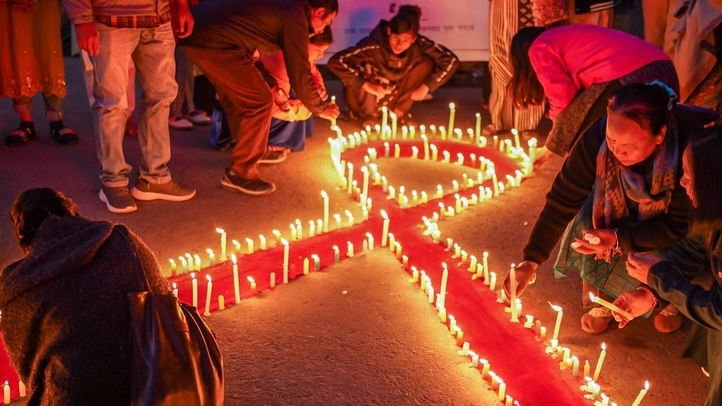
And it’s because of the need to do the latter, fight prejudice and stigma, that World AIDS Day was conceived, a day that looks back, mourning those who have died from the life-threatening disease, caused by HIV, and, importantly, raises awareness for the AIDS pandemic in the present, because while much has been done to combat the disease, on both fronts, much remains to be done.

And so, every December 1st, we hold those we’ve lost in our hearts, and we recommit to the science and the social progress that sees HIV/AIDS as a health crisis to be solved, not a political issue to be exploited. Despite its emergence on his watch and a rising death toll for Americans, President Ronald Reagan did not publicly acknowledge the disease until the 1985 illness and death of Rock Hudson, whom he knew from his days in Hollywood, from AIDS, and did not give an address on it until 1987. It was President Bill Clinton that was the first president to mark the day with a Presidential Proclamation in 1993. At this point, it’s unclear if Donald Trump plans to make a presidential proclamation for World AIDS Day tomorrow, but in a break with tradition that continues this administration’s all-out assault on any social progress made by marginalized groups over the last 50 years, the State Department will no longer commemorate World AIDS Day, ending a now decades-long tradition.
As if to pour salt on the wound, and to make clear that this is an intentional policy of the US government under Donald Trump’s leadership, an email seen and reported on by the New York Times last Wednesday makes explicit what “not commemorating World AIDS Day” means:
The U.S. government will not be commemorating World AIDS Day this year. To comply with this new directive, please note the following:
- USG funds should not be used for any World AIDS Day-related events or commemorative activities.
- Please refrain from publicly promoting World AIDS Day through any communication channels, including social media, media engagements, speeches, or other public-facing messaging.
This is, according to the Times, part of a new federal government policy put forward by the administration to “refrain from messaging on any commemorative days,” but The Guardian has a helpful list of twelve, that’s 12, presidential proclamations for awareness days – and awareness weeks and awareness months – that align more closely with Trump’s world view, including Leif Erikson day, to commemorate the Norse (read that “white”) explorer who is believed to have been the first European to land in North America, and this proclamation recognizing – and you can’t make this shit up – the 101st anniversary of United States border patrol; seriously!
Setting aside efforts to control, and end, the pandemic of AIDS, the loss of life alone warrants that we pause and remember.
According to Wikipedia, approximately 405,399 Americans died during World War II. And we have holidays and other observances to honor their memory. As well we should. Now, compare that to this number: 700,000.
It is estimated that as of 2018, about 700,000 people have died of HIV/AIDS in the United States since the beginning of the pandemic in 1981, and currently another 13,000 people in the United States with AIDS die each year – this according to “The HIV/AIDS Epidemic in the United States: The Basics” from KFF, a leading public health policy organization in the country. Based on the numbers, HIV/AIDS has been more deadly to Americans than a world at war – this demands our attention, but it is the work remaining to be done which makes this annual observance not only relevant, but necessary. “In 2021, at the United Nations General Assembly on HIV, member states committed to a set of global targets that would set countries on the path to achieve the Sustainable Development Goal (SDG) of ending AIDS as a public health threat by 2030.“
If you’re like me (and I hope to god you’re not), you find yourself wondering how it works in Trump’s White House; do they take it in turns to come up with something cruel and/or stupid each day? Is there a posted schedule? “John, it’s your turn today. What are you going to do to damage the lives of a large group of people? Mike, you’re on tomorrow.” Or maybe there’s a suggestion box just outside the gilded Oval Office and Trump draws from it each morning when he arrives for work. But as is typical for this administration, short-sightedness produces unintended consequences.
Consider this: Trump has set a refugee cap of 7,500 which limits the number of refugees allowed to enter the United States each year, while at the same time fast-tracked the resettlement of white South Africans who will be given priority; any guess what country has the highest number of people living with HIV/AIDS, with approximately 7.8 million people living with the virus as of 2024 and an adult HIV prevalence rate of 17.2%? I’ll give you a hint: it’s a country with two-words in its name, the first word starts with an ‘S’ and the second word starts with an ‘A’.
