
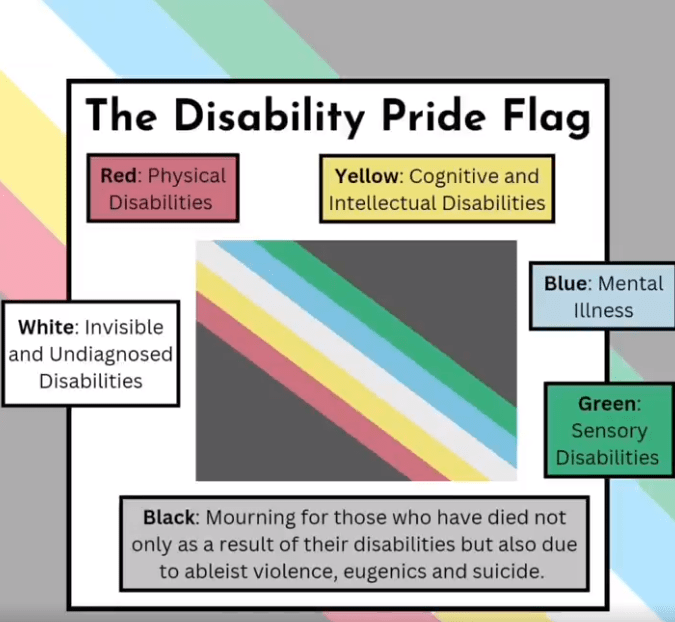
I have wanted to write a tribute to Ken for some time, and as we celebrate Disability Pride Month this July, now seemed like the right time. Longtime readers of my blog will recognize the name from my coming out story or from my retelling of when and how I first heard about HIV/AIDS. I am, of course, talking about Mr. Rodgers, a teacher of mine when I was in high school.

I attended a private, Catholic high school. One has to realize, first and foremost, the great personal risk he was taking in having a “positive” conversation about homosexuality with anyone at the school, let alone a student, because a teacher could be summarily fired for “going against” Church teaching, as happened just recently in the archdiocese of New Orleans when an obituary revealed the deceased was survived by his same-sex husband, a teacher in a Catholic school. A discussion of the hypocrisy of that when divorced and remarried teachers do not fall under the same scrutiny despite being equally in violation of Church teaching (cf: § 2384 Catechism of the Catholic Church) will be saved for another time as I do not want to get sidetracked.
This post is also not about the many ways Ken, and his partner at the time Tom, helped me first understand, then accept, and then celebrate my sexuality. “Coming out” for me was not the tortuous and arduous process I have heard others describe; without trivializing their difficulties, it was easy for me. And that is because I had happy, well-adjusted role models in Ken and Tom. In them I saw what could be for gay men and for a gay couple: a wonderful home life with each partner pursuing his own professional goals – Ken as a teacher, Tom as a production manager at Paramount Studios.
The greatest example, the greatest lesson Ken ever taught, happened years later. In the 90s, like so many gay men of that time, he contracted HIV. And like me, albeit years later, HIV had a devastating, life-altering effect on him. He went blind. He developed a disease called Progressive Outer Retinal Necrosis, characterized by a rapid progression of necrosis (death) of the outer retina in the eye occurring almost exclusively in patients with AIDS. Typical Ken: ask him how he lost his sight, and he’ll tell you with a wry smile, “I went blind from porn.” The first letter of the four-word name of the disease he suffers from spells out P-O-R-N.
And that attitude in the face of unbelievable loss and suffering sums up Ken. I can’t think of anything worse than losing your sight. I’ve seen many of the “opportunistic infections” which take advantage of the malfunctioning immune systems of HIV/AIDS patients. I think many people think that because we have pills now for HIV, it can’t be that bad – one look at me, who has been disabled and retired since the age of 41, should tell you otherwise. This disease not only kills people, but it alters the trajectory of the lives of those who suffer from it in devastating ways. Sometimes, when I get to feeling all sorry for myself because I can’t walk or drive a car, a hear Ken’s voice in my head: “Matt, I can’t see.”
Different people respond differently to a catastrophic, life-changing health crisis in their lives. For the first eight years, I sat in my recliner and watched tv. I didn’t even bother to groom (i.e., shower, shave, brush my teeth) unless I was meeting someone for lunch or a friend was coming over to visit.
Ken, who by this point had broken up with Tom, moved to Minnesota and enrolled in grad school – The Humphrey School of Public Affairs at the University of Minnesota. Using Braille textbooks, speech to text translators on his computer for writing papers, and a Seeing Eye dog, a beautiful German Shepherd named Sequoia, to get him around campus, he earned his Master’s degree in Public Administration, and became the Region 8 director of the Minnesota Department of Transportation (MnDOT) where he focused on implementing accommodation issues in public transportation mandated by the Americans with Disabilities Act, a job he got after suing the Department of Transportation for not having an ADA Transition Plan.

Disability did not stop him, it empowered him.
So Ken is still “teaching” me today. I haven’t headed off to grad school and I’m not running a state department, but I no longer sit around all day in a pool of my own filth and watch the ladies on The View, or reruns of Law & Order. Every time I start feeling sorry for myself or giving in to the inertia of my physical disability (“I’m never going to get better, so what’s the point of even trying to have a life?”) I think of Ken, who not only helped me accept myself as a homosexual, but sets an example of overcoming adversity with sheer determination and purpose.
As his student, I saw him pull into the faculty parking lot one day. I noticed he had one of those personalized license plates. It read IMINUBU. I couldn’t figure it out; I tried to parse it phonetically – eye-my-en-ooh-boo – but that made no sense! So I found him later that day and asked, “Mr. Rodgers, what does your license plate mean?” Turns out it was his personal philosophy, which I adopted and believe in to this day. Not only does it capture how each of us are unique and that we should honor and celebrate our differences, but it offers a simple, positive solution to the seemingly insurmountable things that divide us along the lines of ability, sexuality, gender and gender identity, national origin, ethnicity, religion, and politics (to name but a few).
It means: I AM I AND YOU BE YOU.
