
H. L. Mencken’s meditation on the “graveyard of dead gods” is characteristically provocative. Written in 1922 as “Memorial Service” and later included in A Mencken Chrestomathy, the piece begins with what appears to be a simple historical curiosity: Where are the gods who were once worshipped by the great civilizations of the past? Where are the temples, priests, believers, and mourners who once regarded these gods as eternal and all-powerful? Mencken’s question quickly becomes something much more unsettling. The forgotten gods of antiquity are not merely objects of historical interest; they are warnings about the nature of human certainty.
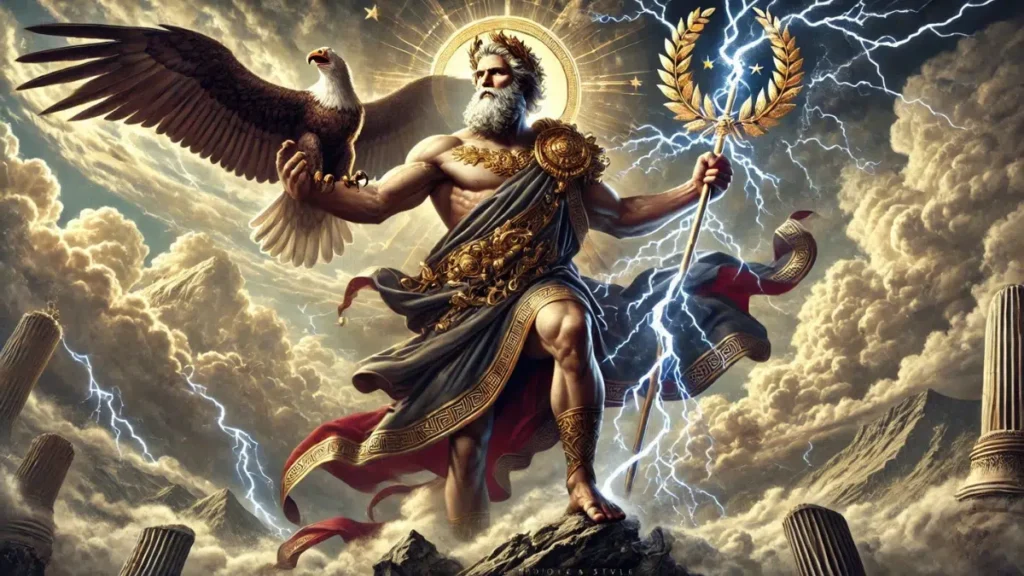
Mencken’s central observation is that human beings have repeatedly believed in gods with absolute confidence. The ancient worshipper of Jupiter did not regard Jupiter as an interesting hypothesis or one religious possibility among many. Jupiter was real. He was powerful. His existence was woven into the political, social, and moral structure of the civilization that worshipped him. Similar certainty surrounded countless other gods, from the deities of Egypt and the ancient Near East to those of Greece, Rome, and the civilizations of the Americas. People built temples to these gods, maintained priesthoods in their honor, sacrificed to them, invoked them in political affairs, and sometimes punished or killed those who rejected them.
Yet those gods are now, for the most part, dead – not in the sense that supernatural beings once lived and subsequently died, but in the sense that belief in them as living realities has disappeared. Jupiter, once the supreme god of Rome, is now principally a figure in mythology and classical literature. The religious world in which he was unquestionably real has become an archaeological and historical curiosity.
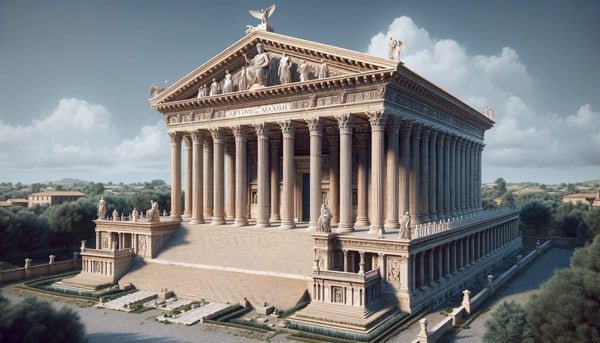
The Temple of Jupiter Capitolinus
In the 6th century BCE, the most important and grand religious building of Ancient Rome – the Temple of Jupiter Optimus Maximus – was built on the Capitoline Hill.
Mencken’s great rhetorical trick is to ask us to look at this transformation from the perspective of the believers who lived through it. They did not know that their gods were destined to become museum pieces. They could not see themselves as inhabitants of a vanished mythology. Their beliefs were simply reality. Their priests were not performing ancient rituals for the benefit of future historians; they were practicing what they believed to be necessary and sacred religion.
This creates the unsettling force of Mencken’s argument. If entire civilizations could be completely convinced of the reality of gods whom almost nobody worships today, what should we make of our own religious certainty?
The argument is not, strictly speaking, that the existence of Jupiter’s cult proves the nonexistence of the Christian God. That would be a logical non sequitur. A Christian could reasonably respond that the fact that human beings have invented or worshipped false gods does not establish that every god is false. The history of religious error demonstrates that people can be mistaken about supernatural matters, but it does not by itself establish that all religious claims are mistaken.
Mencken’s more interesting point lies elsewhere. He is not attacking belief itself, but the confidence with which belief is held. His argument might be expressed this way:
Human history is filled with people who were utterly certain about religious truths that later generations regarded as false. Therefore, people living today should be cautious about assuming that the intensity of their own conviction guarantees its truth.
The distinction is important. Mencken is not really arguing:
Jupiter is a dead god, therefore the Christian God is false.
He is arguing something closer to:
Jupiter was once believed in with the same kind of certainty with which people now believe in their own God. What makes us so certain that our certainty is fundamentally different?
That is a much more difficult question to answer.
One reason Mencken’s argument has psychological force is that religious belief does not exist in isolation. Imagine an ordinary person living in ancient Rome. His or her parents believe in Jupiter. Their neighbors believe in Jupiter. The state recognizes Jupiter. Priests explain Jupiter’s wishes. Public festivals celebrate Jupiter. Literature and political life assume the existence of the gods. Virtually the entire surrounding culture confirms the religious worldview.
Under those circumstances, belief in Jupiter does not feel like the acceptance of an unusual proposition. It feels like an acceptance of reality itself.
This is perhaps the deepest insight in Mencken’s meditation. Human beings tend to mistake cultural familiarity for objective certainty. A belief becomes so deeply embedded in the surrounding culture that it ceases to appear to be a belief. It becomes simply “the way things are.”
History, however, has a devastating ability to expose that illusion.
The Roman world eventually disappeared, and with it the ordinary assumptions that had sustained its gods. Jupiter did not have to be logically refuted in a philosophical debate before his worship collapsed. The social world that continuously reproduced belief in Jupiter disappeared. The temples ceased to function as centers of living worship. The priests disappeared. The rituals became historical artifacts. Eventually the god himself became something people studied rather than worshipped.
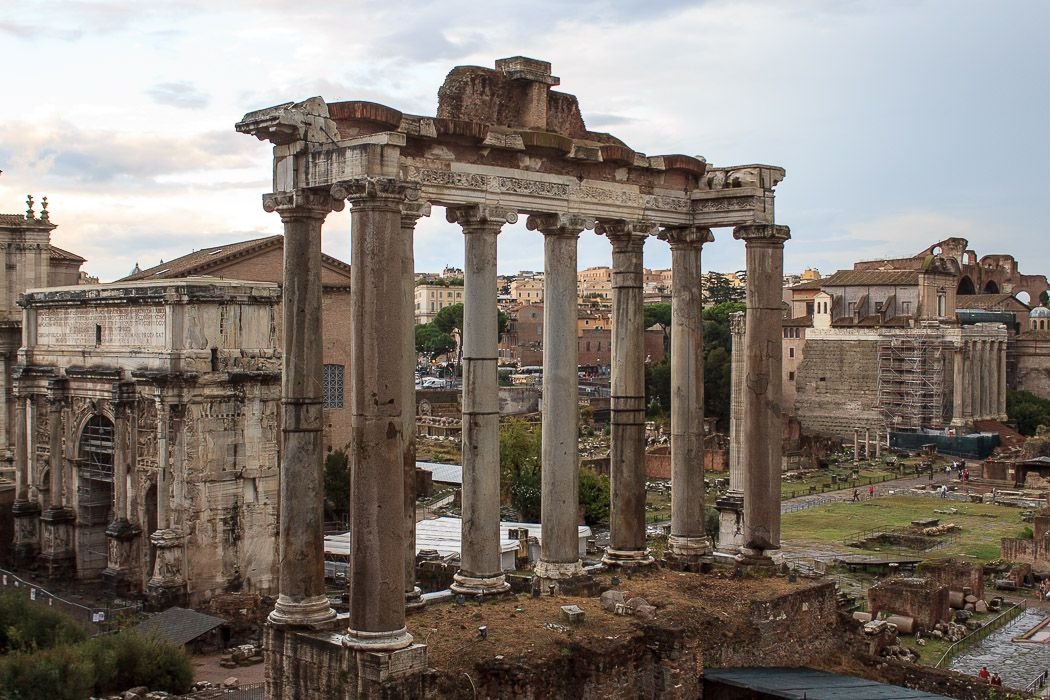
Mencken’s “graveyard” is therefore more than a collection of obsolete deities. It is a metaphor for the transience of human sacred worlds.
This places Mencken in interesting proximity to Nietzsche’s famous reflections on the “death of God.” Nietzsche’s concern was not simply that someone might demonstrate that God does not exist. He was interested in what happens to a civilization when its inherited metaphysical foundations cease to be believable. A society can spend centuries constructing its morality, institutions, customs, and conception of reality around a sacred framework and then discover that the framework has lost its authority.
Mencken approaches a related problem through historical satire. He asks us to imagine the sacred world of antiquity after its disappearance. What once seemed eternal has become mythology. What once demanded reverence now produces curiosity. What once governed the lives of millions becomes the subject of textbooks.
The unsettling possibility is that the same process could eventually happen to us.
Imagine a civilization thousands of years from now excavating the remains of a modern church. Archaeologists uncover crosses, Bibles, statues, cemeteries, theological texts, and the remains of enormous cathedrals. They reconstruct the beliefs of the people who once occupied these places. To them, Christianity might appear in much the same way that the religions of ancient Rome appear to us: a once-dominant religious system belonging to a vanished civilization.
The thought is powerful precisely because it forces us to adopt the perspective of historical distance. We normally experience our own civilization from the inside. We know our assumptions as assumptions only with difficulty. The ancient Romans, however, did not experience themselves as “ancient Romans.” They experienced themselves as contemporary people living in the real world. Likewise, people today do not generally experience themselves as future historical subjects. We experience ourselves as inhabitants of the present and therefore tend to assume that our institutions and convictions possess a permanence that history rarely grants.
Mencken’s humor makes this philosophical point more effective. Rather than presenting an elaborate treatise on epistemology, he creates the image of a cemetery filled with abandoned gods. The absurdity of an “immortal” god having a grave captures the paradox perfectly. The god does not literally die; belief in the god dies. A supernatural being who was once regarded as eternally present becomes culturally absent.
His famous conclusion – “And all are dead” – works because of the enormous distance between the majesty of the claims once made for these gods and their almost complete disappearance from ordinary life. The gods were supposed to be immortal, omnipotent, and eternal. Yet the human institutions through which their supposed immortality was expressed proved remarkably fragile.
There is an important limitation to Mencken’s argument. Historical disappearance does not establish metaphysical falsity. A belief can be unpopular and still be true; a belief can be universally accepted and still be false. The fact that Jupiter’s worship disappeared tells us something about religious history, but it does not logically determine the truth or falsity of Christianity, Judaism, Islam, or any other religion.
Mencken’s real target, therefore, is better understood as unexamined certainty.
He asks us to recognize that conviction is not evidence. A person can be completely sincere and completely mistaken. A civilization can be unanimous and still be wrong. An institution can be ancient and still be false. A belief can feel self-evident because an entire culture has taught people to experience it as self-evident.
That is why the graveyard of dead gods remains such a useful metaphor. It is not merely a place where obsolete religions are buried. It is a record of humanity’s repeated confidence in its own conclusions.
Every generation inherits a world that seems solid and permanent. It inherits political institutions, moral assumptions, religious beliefs, social conventions, and intellectual orthodoxies. Some of these survive. Others disappear. The difficulty is that while we are living inside them, it is extraordinarily difficult to know which is which.
Mencken’s challenge is consequently less an argument against religion than an argument against complacency. He wants us to look at the ruins of previous certainties and ask whether we are any less vulnerable to the same historical forces.
The ancient worshipper could not see Jupiter’s future grave.
Perhaps the most uncomfortable question Mencken leaves us with is whether we can see the graveyards being built around our own certainties.
Memorial Service
by H. L. Mencken
Where is the graveyard of dead gods? What lingering mourner waters their mounds? There was a time when Jupiter was the king of the gods, and any man who doubted his puissance was ipso facto a barbarian and an ignoramus. But where in all the world is there a man who worships Jupiter today? And who of Huitzilopochtli? In one year – and it is no more than five hundred years ago – 50,000 youths and maidens were slain in sacrifice to him. Today, if he is remembered at all, it is only by some vagrant savage in the depths of the Mexican forest. Huitzilopochtli, like many other gods, had no human father; his mother was a virtuous widow; he was born of an apparently innocent flirtation that she carried out with the sun. When he frowned, his father, the sun, stood still. When he roared with rage, earthquakes engulfed whole cities. When he thirsted he was watered with 10,000 gallons of human blood. But today Huitzilopochtli is as magnificently forgotten as Allen G. Thurman. Once the peer of Allah, Buddha and Wotan, he is now the peer of Richmond P. Hobson, Alton B. Parker, Adelina Patti, General Weyler and Tom Sharkey.
Speaking of Huitzilopochtli recalls his brother Tezcatilpoca. Tezcatilpoca was almost as powerful: he consumed 25,000 virgins a year. Lead me to his tomb: I would weep, and hang a couronne des perles. But who knows where it is? Or where the grave of Quitzalcoatl is? Or Xiehtecuthli? Or Centeotl, that sweet one? Or Tlazolteotl, the goddess of love? Or Mictlan? Or Xipe? Or all the host of Tzitzimitles? Where are their bones? Where is the willow on which they hung their harps? In what forlorn and unheard-of Hell do they await their resurrection morn? Who enjoys their residuary estates? Or that of Dis, whom Caesar found to be the chief god of the Celts? Or that of Tarves, the bull? Or that of Moccos, the pig? Or that of Epona, the mare? Or that of Mullo, the celestial jackass? There was a time when the Irish revered all these gods, but today even the drunkest Irishman laughs at them.
But they have company in oblivion: the Hell of dead gods is as crowded as the Presbyterian Hell for babies. Damona is there, and Esus, and Drunemeton, and Silvana, and Dervones, and Adsalluta, and Deva, and Belisima, and Uxellimus, and Borvo, and Grannos, and Mogons. All mighty gods in their day, worshipped by millions, full of demands and impositions, able to bind and loose – all gods of the first class. Men labored for generations to build vast temples to them – temples with stones as large as hay-wagons. The business of interpreting their whims occupied thousands of priests, bishops, archbishops. To doubt them was to die, usually at the stake. Armies took to the field to defend them against infidels: villages were burned, women and children butchered, cattle were driven off. Yet in the end they all withered and died, and today there is none so poor to do them reverence.
What has become of Sutekh, once the high god of the whole Nile Valley? What has become of:
- Resheph
- Baal
- Anath
- Astarte
- Ashtoreth
- Hadad
- Nebo
- Dagon
- Melek
- Yau
- Ahijah
- Amon-Re
- Isis
- Osiris
- Ptah
- Molech
All these were gods of the highest eminence. Many of them are mentioned with fear and trembling in the Old Testament. They ranked, five or six thousand years ago, with Yahweh Himself; the worst of them stood far higher than Thor. Yet they have all gone down the chute, and with them the following:
- Arianrod
- Nuada Argetlam
- Morrigu
- Tagd
- Govannon
- Goibniu
- Gunfled
- Odin
- Dagda
- Ogma
- Ogryvan
- Marzin
- Dea Dia
- Mara
- Iuno Lucina
- Diana of Ephesus
- Saturn
- Robigus
- Furrina
- Pluto
- Cronos
- Vesta
- Engurra
- Zer-panitu
- Belus
- Merodach
- Ubilulu
- Elum
- U-dimmer-an-kia
- Marduk
- U-sab-sib
- Nin
- U-Mersi
- Persephone
- Tammuz
- Istar
- Venus
- Lagas
- Beltis
- Nirig
- Nusku
- En-Mersi
- Aa
- Assur
- Sin
- Beltu
- Apsu
- Kuski-banda
- Elali
- Nin-azu
- Mami
- Qarradu
- Zaraqu
- Ueras
- Zagaga
Ask the rector to lend you any good book on comparative religion: you will find them all listed. They were gods of the highest dignity – gods of civilized peoples – worshipped and believed in by millions. All were omnipotent, omniscient and immortal. And all are dead.
