I had this idea for a post examining Trump, Trumpism, and the whole MAGA movement through the lens of another unlikely figure and phenomenon, Aimee Semple McPherson in 1920s Los Angeles. My premise was simple: she was and Donald Trump is a charlatan duping otherwise sane people for personal gain.
At this point, the post has grown into a 3300-word essay – what a news program might call an “in depth report,” what my news source of choice, The Guardian, calls a “long read” (yes, I’m a liberal, woke, pinko, guardianista… if you hadn’t figured that out by now, I’m afraid I can’t help you). And I mention this because I usually aim for about 1000 words in my blog posts; I like to plant a seed, fertilize the soil, and let you, thoughtful reader, run with it. To me, good writing is not a destination; it should try to be a launch pad, a springboard for your own ideas to take flight. If there is persuasion involved on my part, all I should do is help you develop then file your flight plan.
But I’m going to depart from my usual approach because Donald Trump is, without a doubt, the single-most destructive force in American history to the founding ideals of the country and, philosophically, the antithesis of democratic leadership. We dismiss him as merely a charlatan at our own peril. Who he is and what he has done and is doing must be understood. And defeated.
So brew a fresh cuppa, let the dog out to do his business, put your thinking cap on, and let’s get down to it. Turn off your outrage machine, and try to understand the dynamics of the dark cloud he has cast over our country. And with this little preamble, I have inadvertently added 300 words to this post!
From Aimee Semple McPherson to Donald Trump
“in depth” from Matt the TaxPoodle
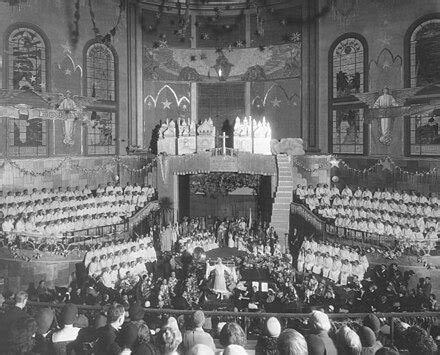
Aimee Semple McPherson is a revealing place to begin a blog post about charlatans. She was a Pentecostal evangelist, a pioneer of religious broadcasting, a celebrity, and one of the most famous women in America during the 1920s. She attracted enormous crowds, built Angelus Temple in Los Angeles, and used the newest technology of her time – radio – to carry her voice far beyond the people who could physically attend her services.
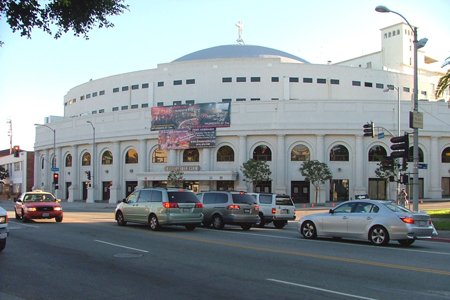
Considered the first “megachurch” in the US, it is affiliated with the Foursquare Christian denomination founded by Aimee Semple McPherson and attracts 9000 worshipers a week
But McPherson was more than a preacher. She was a performer.
Her sermons employed costumes, drama, music, spectacle, and publicity. She understood something fundamental about modern America: people did not merely want information. They wanted an experience. They wanted to feel that they were participating in something larger than themselves.
That insight connects McPherson to one of the central phenomena of contemporary American politics: the rise of Donald Trump and the MAGA movement.
The comparison does not mean that McPherson and Trump are identical, nor does it mean that every Trump supporter is foolish or deceived. Millions of Americans support Trump for reasons ranging from immigration and taxes to religion, foreign policy, cultural conservatism, and distrust of the political establishment. To dismiss all of those people as victims of a con would itself be a failure of understanding.
The more interesting question is this:
What happens when politics adopts the techniques of the revival meeting, the confidence man, the reality television show, and the celebrity spectacle?
Donald Trump may be the most successful practitioner of these – I’ll call them “dark arts” – in modern American history.
The traditional charlatan is a person who claims special knowledge, extraordinary powers, or unique abilities in order to obtain money, influence, or admiration. But the most successful charlatans are rarely successful merely because they lie.
They succeed because they understand their audience.
The 19th century medicine man understood that sick people wanted hope. The fortune teller understands that frightened people want certainty. The religious fraud understands that grieving people want to believe death is not final. The financial swindler understands that struggling people want prosperity. And the political showman understands that alienated people want someone to blame.
This does not mean that the problems themselves are imaginary. Illness is real. Poverty is real. Grief is real. Political corruption is real. Economic insecurity is real. The charlatan’s talent lies in taking a genuine problem and attaching it to a simple, emotionally satisfying explanation.
Donald Trump’s political genius is his ability to do precisely this.
For decades before he entered politics, Trump had built a public persona around wealth, success, aggression, and exceptionalism. His business career had produced both genuine accomplishments and highly public failures, but television simplified the story. On his “reality” show The Apprentice Trump became the decisive executive: the man who could instantly distinguish winners from losers.
The television character was more important than the complicated reality. When Trump entered politics, he brought that character with him. He was not merely running for president. He was auditioning to become the hero of a national drama.
I’ll begin with his MAGA slogan, which as I pointed out here can be traced back to Ronald Reagan’s 1980 presidential campaign. While certainly not original, the slogan’s genius lies in its ambiguity. Make America Great Again – when was it great?
For one supporter, the answer might be the 1950s, when industrial employment was strong and a single income could support many middle-class families.
For another, it might mean a time when Christianity had greater cultural authority.
For another, it might mean an America with lower levels of immigration.
For another, it might simply mean the period of that person’s own youth, when the world seemed more stable and understandable. Less frightening and uncertain. We all see the past through rose colored glasses – times were simpler then.
The slogan allows millions of people to imagine different lost worlds while believing they are participating in the same restoration. This is one of the oldest techniques in the book: do not define the dream too precisely. A vague promise can survive contact with reality because every believer can fill the promise with his or her own desires.
If America does not yet feel great again, there is always an explanation. The political establishment obstructed Trump. The Democrats obstructed Trump. The media obstructed Trump. The “deep state” obstructed Trump. Immigrants obstructed Trump. Globalists obstructed Trump. The election was stolen from Trump.
The promise therefore becomes difficult to falsify. Failure does not disprove the promise; failure becomes evidence that powerful enemies are preventing its fulfillment. This is where the political showman begins to resemble the classic charlatan. The miracle has not happened because someone interfered. The investment failed because the system was rigged. The prophecy was not fulfilled because believers misunderstood it. The promised restoration has not occurred because enemies are sabotaging the leader. The claim survives because it is protected from evidence.
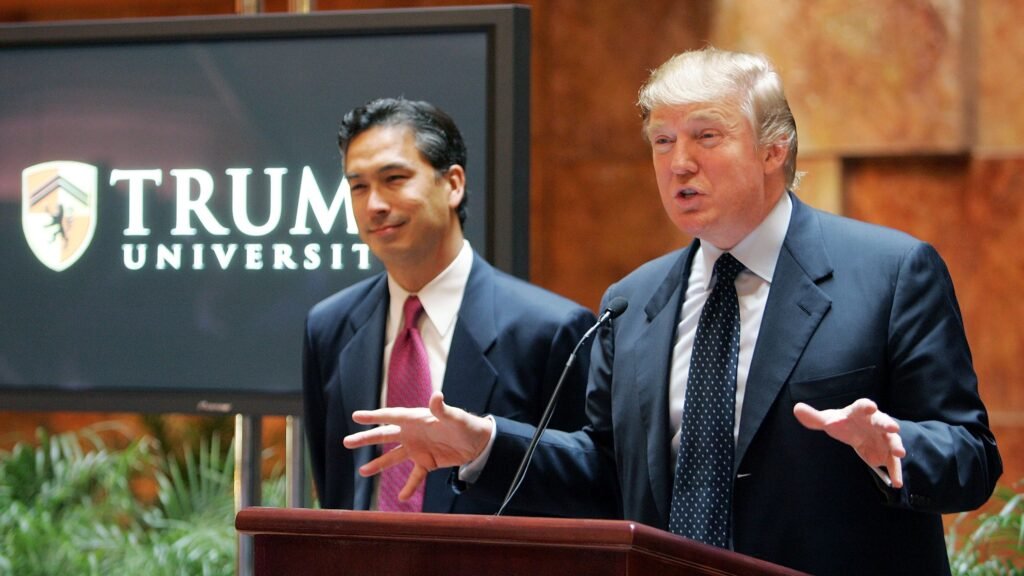
A clear example of Trump’s personal brand being transformed into a commodity was Trump University. The organization promised to teach students the secrets of Trump’s real estate success. The central product was not merely educational material. The product was access to the Trump method.
Students were encouraged to believe that Trump’s extraordinary success could be identified, packaged, and transferred to them. The program became the subject of lawsuits alleging deceptive practices, and Trump agreed in 2016 to pay $25 million dollars to settle litigation involving Trump University without admitting wrongdoing.
This episode matters because it demonstrates a recurring feature of Trump’s public career: the brand itself becomes the evidence. The argument is not necessarily:
Here are the independently verified facts demonstrating why this program will work.
Instead, the argument becomes:
Look at me.
Trump’s wealth, fame, buildings, television presence, and celebrity become part of the sales pitch. This is the logic of the confidence man. The apparent success of the performer is offered as proof that the audience should trust him.
McPherson understood a version of the same principle. Her enormous audiences demonstrated her importance. The size of the crowd became evidence of the power of the preacher.
Trump employs the same logic. The size of the rally becomes evidence of the movement’s strength. The size of the movement becomes evidence that the leader must be right. The leader’s popularity becomes evidence of his legitimacy. And criticism from powerful institutions becomes evidence that he threatens those institutions. The system feeds itself.
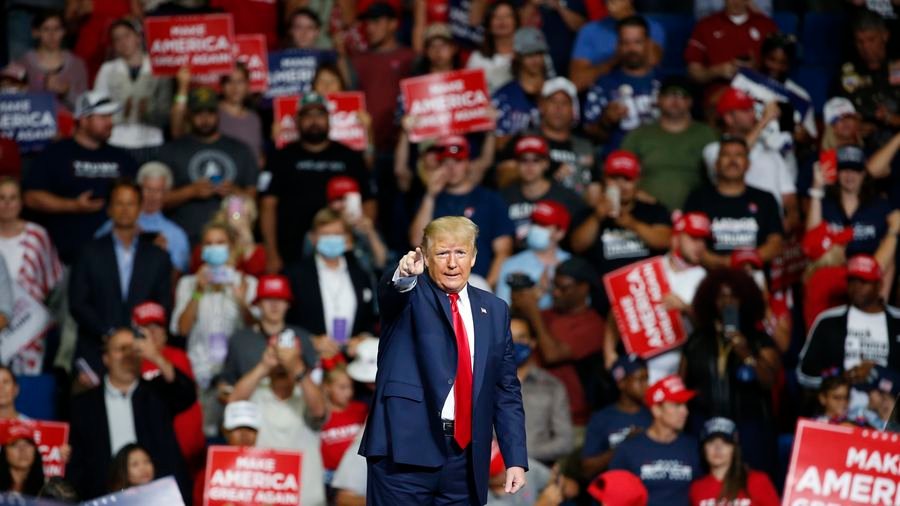
A conventional political speech is supposed to communicate ideas; its focus is the politician’s position on a given issue or topic. A MAGA rally does something different. It creates an atmosphere. The flags, the music (someone has got to explain his obsession with The Village People to me – has he just missed that they were meant to be a caricature of gay culture? Or is he… STOP! That thought is too revolting to even consider), the red hats, the chants, the insults, and the anticipation of Trump’s arrival transform the event into a collective experience. The crowd is not simply listening to Trump. The crowd is performing Trumpism. It’s an immersive experience.
The chant “USA!” is not a policy proposal. “Lock her up!” was not a legislative argument. “Stop the steal!” was not an investigation. These are declarations of collective identity.
This is where the comparison to Aimee Semple McPherson becomes particularly useful. The revival meeting creates a boundary between the believer and the outsider. The crowd experiences itself as a community. The emotional intensity confirms the importance of the event. The speaker and the audience reinforce one another. The preacher becomes powerful because the crowd believes. The crowd believes more deeply because it sees the power of the preacher.
Political rallies can operate according to a similar psychological logic.
The rally tells participants: You are not alone. You have been ignored. Your enemies are powerful. Your country has been taken from you. But there is someone who will fight for you.
That last proposition is essential. The charismatic leader does not merely offer policies. He offers himself.
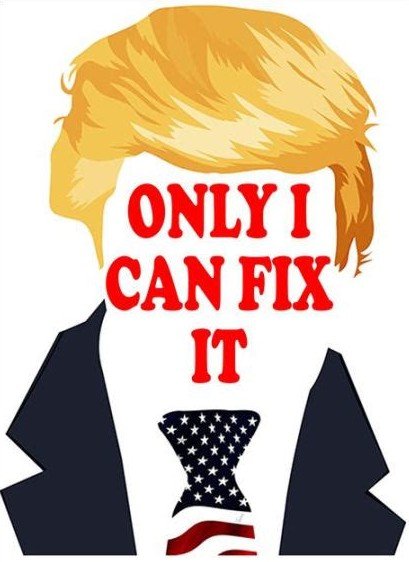
Trump made the logic unusually explicit during the 2016 Republican National Convention when he declared, “I alone can fix it.” The statement is remarkable because democratic politics is theoretically based on the opposite principle. No president alone can fix the country. Democracy requires institutions. It requires legislatures, courts, elections, civil servants, journalists, local governments, and citizens who disagree with one another.
The charismatic leader, however, thrives by presenting institutions as evidence of weakness. Congress cannot solve the problem. The bureaucracy cannot solve the problem. Traditional politicians cannot solve the problem. Experts cannot solve the problem. The media cannot be trusted. Only the leader can solve the problem.
This is one of the oldest patterns in authoritarian and populist politics: the transformation of a political movement into a personal relationship between the leader and “the people.” The institutions between them become suspicious. The leader says that he represents the people directly. Anyone who opposes him can therefore be portrayed as opposing the people themselves.

Trump’s critics are not merely people who disagree with him. They can become members of a corrupt establishment. They can become “fake news.” They can become enemies of the country. The political disagreement becomes moral warfare.
The strongest example of this process is Trump’s false claim that the 2020 presidential election was stolen from him.
At the risk of stating the obvious (and I shouldn’t have to), Trump lost the election to Joe Biden. Courts repeatedly rejected efforts to overturn the result, and investigations failed to establish the widespread fraud necessary to reverse the outcome. Yet the claim that the election was stolen continued to spread throughout a large portion of the Republican electorate. Reporting and investigations have documented how proponents of election-fraud theories continued promoting claims even after important pieces of supposed evidence had been discredited or seriously challenged.
This is where the psychology of belief becomes more important than the factual claim itself. If Trump is understood not merely as a politician but as the indispensable hero of a movement, then his defeat creates a problem. How can the hero lose?
There are only two possibilities:
- he lost
- the system cheated
For a deeply committed believer, the second explanation can be emotionally easier. The defeat is transformed into another chapter of the story. The hero has not failed. The hero has been betrayed. The promise has not collapsed. Enemies have interfered.
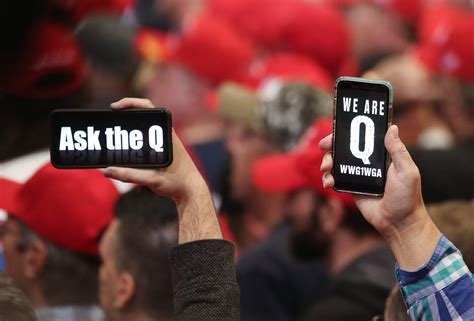
That story proved extraordinarily durable. It also merged with the tinfoil hat brigade, ahem… I mean conspiracy communities, like QAnon, whose followers incorporated Trump’s election loss into a much larger narrative involving a hidden “deep state” and an eventual triumph over corrupt elites. Government testimony submitted to the January 6 committee described how some QAnon believers treated Trump’s defeat as part of a larger imagined victory rather than accepting the election result.
The charlatan’s greatest protection is not simply the ability to convince people of something. It is the ability to make contrary evidence strengthen the belief.
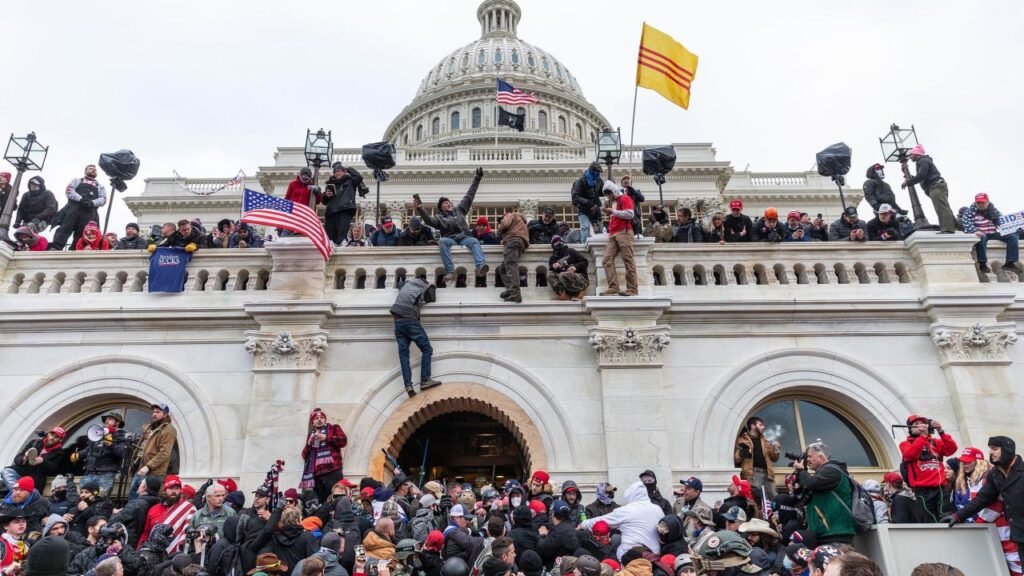
The events of January 6, 2021, demonstrated that political myths can have consequences beyond argument. Trump supporters and members of various right-wing groups disrupted the congressional certification of Biden’s victory, which is a nice way of saying they stormed the capitol in a naked act of insurrection. Public records, videos, and criminal cases established that the crowd included Trump supporters and adherents of conspiracy movements, including QAnon; false claims that the attack had been secretly organized by Antifa lacked supporting evidence.
January 6 revealed something important about the dangers of political storytelling. A story does not need to be true to produce real consequences. A person who believes a falsehood may act on it sincerely. This is why the distinction between the cynical propagandist and the sincere believer is sometimes less important than it appears.
The propagandist may know the story is false. The believer may sincerely accept it. But both can participate in the same political reality. The lie becomes an institution. It organizes behavior, determines loyalty, and ultimately influences elections.
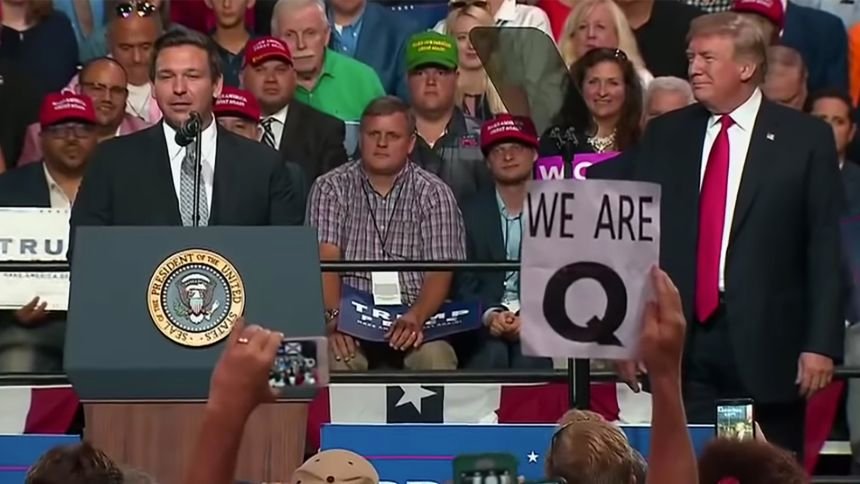
QAnon represented an extreme version of tendencies already present in charismatic politics. The conspiracy theory proposed that a secret cabal of powerful figures controlled the government and that Donald Trump was secretly fighting them. The theory gave believers a cosmic narrative in which ordinary political events became signs of an enormous hidden struggle. Trump was no longer simply a president. He became, for some followers, a figure of almost supernatural historical importance.
This is one of the dangers of personality politics. A leader becomes too important to fail. Every criticism becomes proof of persecution. Every defeat becomes evidence of conspiracy. Every apparent contradiction becomes part of a plan.
The leader is protected from ordinary standards of accountability because the leader is no longer considered ordinary. The most devoted followers do not merely support him. They interpret reality through him.
That is why the comparison with religion is useful – not because MAGA is literally a religion, but because political movements can develop forms of faith, ritual, heresy, prophecy, and apostasy. The slogan becomes a declaration – an article of faith. The rally becomes a ritual. The enemy becomes evil. The doubter becomes a traitor. And the leader becomes indispensable.
One of the most complicated aspects of Trump’s political coalition has been his support among white evangelical Christians. Trump’s personal life and public behavior seem dramatically different from the traditional moral image associated with evangelical Christianity. Married multiple times, famous for his crude public language, and he comes from the world of casinos, celebrity, and tabloid culture.
Yet many evangelical leaders and voters support him enthusiastically. This cannot be explained simply by saying that they were all deceived. Many supporters made a political calculation. Trump promised conservative judicial appointments. He opposed abortion rights. He supported religious conservatives in conflicts involving education, sexuality, and cultural values. He was willing to fight political battles that more conventional Republican politicians often approached cautiously.
The relationship was therefore partly transactional. But it was also emotional. For some believers, Trump became the instrument through which a threatened religious and cultural order might be restored. This is a time-honored, even scriptural pattern. The leader does not have to be morally pure. He only has to be useful to the cause.
The Bible itself contains rulers who are imperfect instruments of so-called divine purposes, and some religious supporters adopted similar language in explaining their support for Trump. The political danger arises when the leader’s usefulness gradually becomes indistinguishable from righteousness. Then criticism of Trump can begin to sound like criticism of Christianity itself. Politics absorbs religion. And religion becomes another form of political loyalty.
McPherson had radio. Trump has everything: television, cable news, talk radio, podcasts, social media, YouTube, Facebook, X, and his own direct channels (like “Truth Social”); these allow political messages to circulate at extraordinary speed.
The modern political charlatan does not need to own every newspaper. He just needs an ecosystem. One wonders (well I do anyway) if Trump would exist without Fox.
A story can begin at a rally, appear on social media, be discussed by a podcast host, repeated by an influencer, reach a television audience, and then return to social media as apparent confirmation. Each repetition creates familiarity. And familiarity can begin to feel like truth.
Research on the post-2020 election period found that prominent political podcasts played an important role in spreading misleading election narratives, including after courts and other processes had failed to substantiate claims of widespread fraud.
This is one of the great differences between McPherson’s America and Trump’s. McPherson broadcast from a platform. Trump’s movement exists inside an information environment. The audience can now become broadcasters.
A person does not merely hear the story. He shares it. She comments on it. They create videos about it. The believer becomes a participant in the production of the belief. This makes the modern political myth extraordinarily resilient.
The greatest mistake made by Trump’s opponents is often the same mistake made by people confronting any mass movement. They ask: how could anyone believe this?
The better question is: what does the belief provide?
For some people, MAGA provides community. For some, it provides an explanation for economic change. For some, it provides an outlet for anger. For some, it represents opposition to institutions that they genuinely believe have become arrogant and unaccountable. For some, it represents cultural or religious values they feel are disappearing. For some, it is simply a political preference.
And for some, undoubtedly, it has become something much more consuming: an identity through which nearly everything in their life is interpreted.
These distinctions matter. A democratic society cannot understand Trumpism if it treats every Trump voter as identical. But neither can it understand Trumpism if it refuses to acknowledge the extraordinary power of misinformation, conspiracy, celebrity, and emotional manipulation within the movement.
Two things can be true – people can have legitimate grievances, and a charismatic leader can exploit those grievances.
The grievances do not make the exploitation imaginary. The exploitation does not make the grievances any less real (or valid).
Aimee Semple McPherson understood the power of the new media of her time. Donald Trump understands the power of the media environment of his. McPherson transformed preaching into mass entertainment. Trump is transforming political campaigning into mass entertainment. McPherson cultivated a public personality larger than the ordinary institutions surrounding her. Trump has successfully transformed his own personality into the organizing principle of a political movement.
Both of them understood spectacle. Both understood publicity. Both understood that controversy could increase attention. And both understood something even more fundamental: people want to believe that someone possesses the answer.
This is where the history of charlatanism becomes the history of politics.
The traditional charlatan says:
I can cure you.
The financial charlatan says:
I can make you rich.
The religious charlatan says:
I can save you.
The political charlatan says:
I can restore your country.
There is a problem. The problem is frightening. The institutions have failed. The experts cannot be trusted. The enemies are powerful. But one extraordinary person understands the truth. Trust him. Follow him. And everything can be made right.
The promise changes. The structure remains.
The deepest danger is not that a charismatic leader tells a lie. Politicians have always lied. The deeper danger occurs when a movement reaches the point at which the leader’s truth becomes more important than reality itself. At that point, evidence becomes negotiable. Defeat becomes impossible. Criticism becomes persecution. Institutions become enemies. And loyalty becomes more important than truth.
If I have learned anything from this little project of mine, it is that the word “charlatan” must be used carefully. It should not become a substitute for analysis. Simply calling Donald Trump a charlatan does not explain why millions of Americans voted for him, why many remain devoted to him, or why his movement has survived scandals and contradictions that might have destroyed a more conventional politician. The answer lies partly in the same phenomenon that made Aimee Semple McPherson a national celebrity: America has always rewarded the extraordinary performer.
It rewards the person who can turn a complicated world into a simple story. It rewards confidence. It rewards spectacle. It rewards the person who appears to know exactly who is guilty and exactly what must be done.
Trump did not invent these desires. McPherson did not invent them. The medicine man did not invent them. The confidence man did not invent them.
They discovered them.
And then they learned how to perform them.
The ultimate lesson is therefore not merely about Donald Trump or the MAGA movement. It is about democracy itself. A democracy depends upon citizens who can tolerate uncertainty. It requires people who can accept that their side sometimes loses, that their leaders sometimes fail, that institutions can be imperfect without being illegitimate, and that a complicated problem may not have a simple solution.
The charlatan offers an escape from that uncertainty. He offers certainty. He offers enemies. He offers a story.
Most importantly, he offers himself (or herself).
And that is the oldest trick in the history of power: make people believe that they cannot save themselves – and then convince them that only you can save them.