
A “practical joke” is called practical because it is a joke carried out in the real world rather than merely told. The word practical here means something like “put into practice” or “involving action.” A practical joke therefore involves manipulating a situation so that another person experiences something unexpected, usually for comic effect.
“What do you call a boomerang that doesn’t come back?… A stick,” – taken from the comedy stylings of Matt Wilkinson, that is what we’d call a joke. I know! I’m hilarious. I really ought to do standup. But 54 Berners Street in London is the site of one of the most elaborate practical jokes in history.
Today, the original house at 54 Berners Street no longer exists. Its site is incorporated into the building occupied by the Sanderson Hotel. But in the early 19th century, the address belonged to a woman known to history as Mrs. Tottenham, a respectable widow living in a fashionable part of London. On the 27th of November, 1810, she would become the unwitting mark of an elaborate rouse.
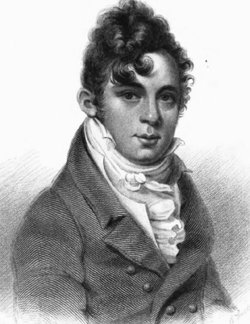
Our story begins with young Theodore Hook (left), a writer and composer. He was walking along Berners Street one morning with his friend, the architect and writer Samuel Beazley, when he pointed toward the house at number 54 and made an extraordinary claim: that he could make that otherwise ordinary house the most talked-about address in London.
Beazley was skeptical, so Hook backed-up his claim with a bet: a guinea (20 shillings or roughly £1.05).
For days, Hook prepared hundreds, probably thousands, of letters. They were written as though they came from Mrs. Tottenham herself and were sent to tradesmen, merchants, professionals, and prominent individuals throughout London. Each recipient was given some reason to visit or deliver something to 54 Berners Street on November 27th. The variety of requests was what made the scheme so brilliant.
The first visitors arrived at approximately 5 o’clock in the morning. A chimney sweep appeared at the house, expecting to be allowed inside to clean the chimneys. The household had no idea what he was talking about. Then another sweep arrived. Then another. Eventually, a succession of chimney sweeps gathered outside the house, all convinced that Mrs. Tottenham had summoned them.
But the chimney sweeps were only the beginning.
Soon coal wagons began arriving with coal to deliver. Bakers appeared with elaborate wedding cakes. Furniture dealers brought sofas and chairs. Several pianos were delivered. Butchers brought meat, cobblers brought boots, and tailors brought dresses, and it wasn’t limited to goods: doctors, lawyers, hairdressers, clergy, and even undertakers had been summoned, told that Mrs. Tottenham required their professional services. One particularly macabre request involved an undertaker arriving with a coffin. Other messages suggested that someone in the household was dying and required medical or religious attention.
The joke became even more spectacular when Hook’s letters drew important people into the trap. Invitations and urgent messages were sent to prominent figures including the Duke of Gloucester, the Lord Mayor of London, and the chairmen of the Bank of England and the East India Company, who all descended on 54 Berners Street the morning of the 27th of November.
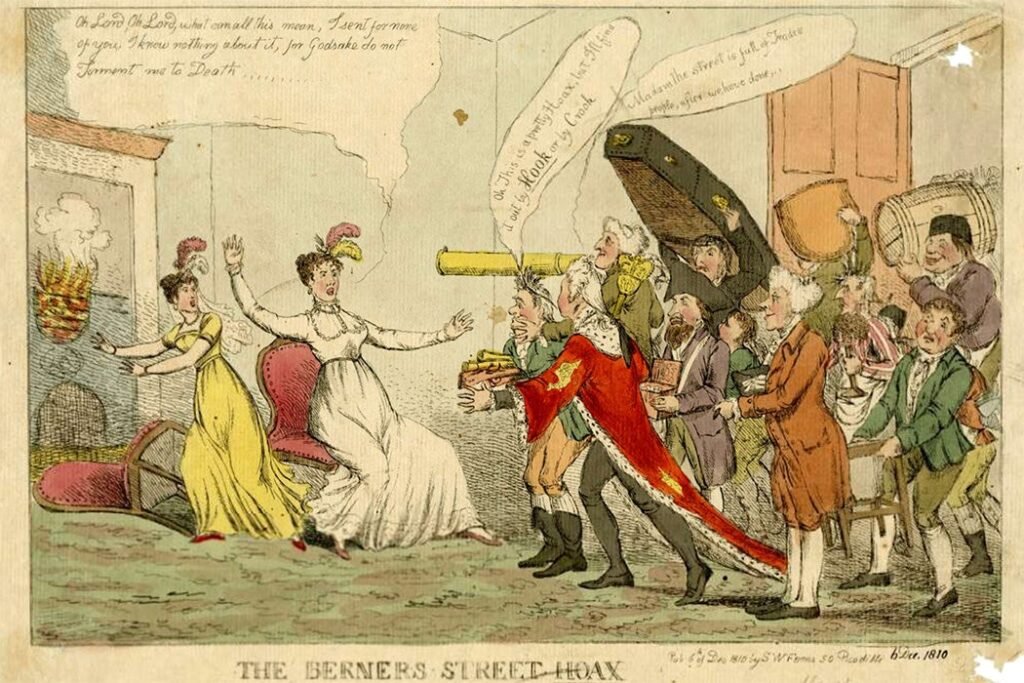
The result was chaos. The street became clogged with carts, tradesmen, servants, curious spectators, and frustrated deliverymen. The various visitors had no idea why so many other people had been summoned to the same house; to them, it looked as though Mrs. Tottenham had simultaneously decided to buy half of London, renovate her home, arrange a wedding, summon every conceivable professional, and prepare for a funeral.
And Hook was there to watch it happen; after all, he had a bet to collect on. He arranged rooms opposite number 54, where he and Beazley watched the spectacle unfold. Hook had essentially created a massive piece of street theater, recruited hundreds of unsuspecting Londoners as performers, and then sat back across the street with his buddy to enjoy the show.
You could even argue that it was an early version of the contemporary menace known as “swatting” – a fake call to 911 designed to bring Special Weapons and Tactics (SWAT) teams or heavily armed police, firemen, and paramedics, etc., to someone’s doorstep, despite a lack of any emergency.
The scope of Hook’s operation is one reason the story has survived to the present day. Accounts vary over the exact number of letters sent, with some sources suggesting around a thousand, while others put the number at four thousand; re-tellings sometimes embellish the cast of characters or the dignitaries involved. I left out the Archbishop of Canterbury above. Nevertheless, the event is well established.
What makes this episode especially fascinating is that it resembles something much more modern than a Georgian practical joke. Hook essentially exploited the information and communications systems of his age. He impersonated the householder, generated plausible requests, distributed them through London’s commercial networks, and allowed those networks to do the rest.
There was no need for Hook to personally persuade hundreds of people to participate. A baker who received a convincing letter did what a baker normally did when receiving a legitimate order: he prepared the goods and sent them to the address. A coal merchant did the same. A chimney sweep did the same. Each individual acted rationally, but the combined effect was ridiculous. In that sense, 54 Berners Street became an accidental demonstration of how a large society can be thrown into confusion when otherwise trustworthy systems are fed false information.
The authorities naturally wanted to know who was responsible. A reward was offered, and Hook prudently left London for a time. He was eventually suspected as the culprit, although that has has been questioned by some later commentators. Hook himself ultimately claimed responsibility in his semi-autobiographical novel Gilbert Gurney, published in the 1830s. Even then, another contemporary acquaintance later suggested that Hook may not have been responsible after all. The mystery has therefore never been completely solved.
There is also something wonderfully appropriate about the fact that the physical house has disappeared while the lore about the address has survived.
The original 54 Berners Street was eventually demolished. In the 20th century, the site became associated with Arthur Sanderson & Sons, the famous British wallpaper and textile company. A large building was constructed there in 1958 as Sanderson’s headquarters and showroom. That building was later transformed into the Sanderson Hotel, which occupies the site today.
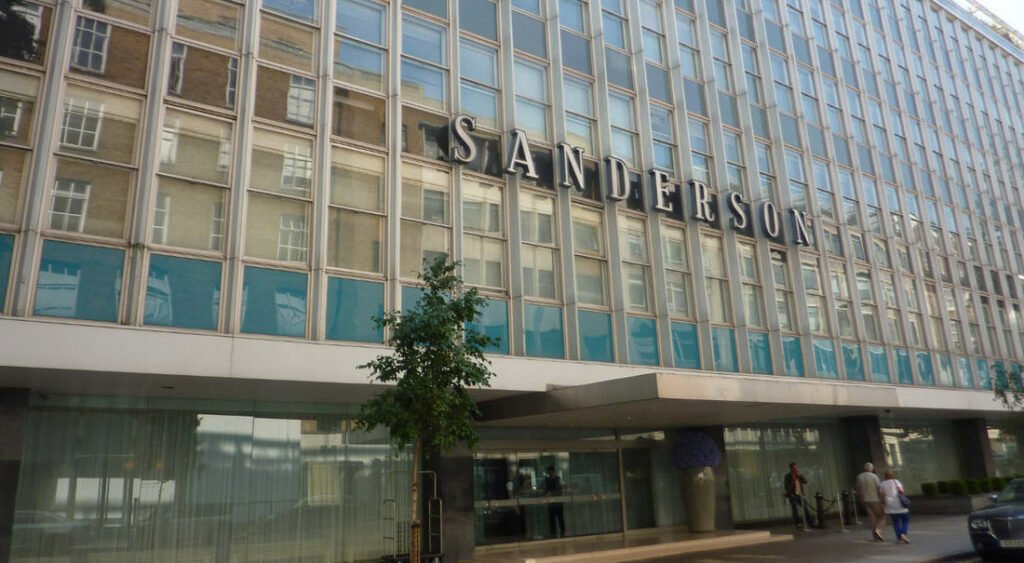
So the present-day visitor standing near the Sanderson Hotel is not looking at the house that witnessed the famous hoax. The original building is gone. Yet the location remains historically significant because of what happened there on a single November morning more than two centuries ago.
Remember Hook’s wager – to make 54 Berners Street the most talked-about address in London. He succeeded spectacularly. A bald, disabled, gay blogger in Palm Springs with a Chihuahua sleeping on his lap is up at 6:30 in the morning writing about it more than two hundred years later. You, thoughtful reader, are reading about it. The house is gone. Mrs. Tottenham is long dead. Hook and Beazley along with her. And yet, here we are: talking about the address.
