Few things are easier to ridicule than a regulation. Republicans have made a meal out of this since Ronald Reagan mockingly said, “The nine most terrifying words in the English language are: ‘I’m from the government, and I’m here to help.’”
Nobody wakes up in the morning excited about fire codes. No one tells friends over dinner how grateful they are for food handling inspections, health codes, or requirements that bridges remain attached to the riverbanks they span. And until recently, vaccines were considered a modern marvel – a blessing even!
Health and safety regulatory frameworks are, by their very nature, inconvenient. They demand paperwork, inspections, compliance, and occasionally the crushing disappointment of discovering that your ingenious plan to have your wife’s brother (who worked construction for a while after college) build an extension onto your family room for thousands less than a contractor would have charged is “not up to code.”
The benefits, meanwhile, are strangely elusive. That is because the greatest success of a regulation is often that nothing happens. No bridge collapses. No one dies from contaminated milk. No apartment building catches fire because someone thought insulation was an optional luxury. No airplane loses a wing because the manufacturer decided that bolts were an unnecessary expense. Success it would seem in these cases is spectacularly boring. And on the whole, human beings are not especially good at appreciating spectacularly boring.
We notice costs far more readily than we notice disasters that never occur. A restaurant owner complains about health inspections because they require time and money. Rarely does anyone celebrate the fact that thousands of customers did not spend the evening acquiring an intimate relationship with salmonella (or a case of “explosive diarrhea”). The inspection disappears into the background precisely because it worked. It is one of civilization’s greatest public relations problems.
Imagine a town that has enjoyed safe drinking water for fifty years. Eventually someone will ask why so much money is being spent testing the water. After all, nobody has gotten sick in decades.
Surely the testing is unnecessary.
No.
The testing is why nobody has gotten sick in decades.


Likewise, building codes become victims of their own success. A generation grows up without witnessing entire neighborhoods on fire because electrical wiring was installed by someone’s cousin who once watched an episode of Bob Vila’s This Old House. Since the catastrophe is absent from living memory, the regulations begin to look like bureaucracy rather than accumulated wisdom written in legal language.
History has an unfortunate habit of erasing the evidence for why many regulations exist. Every page of the modern rulebook is often stained with the memory of some forgotten catastrophe. Somewhere behind every aviation checklist lies an accident report. Somewhere behind every food safety law lies an outbreak. Somewhere behind every mining regulation, workplace standard, or chemical handling requirement is a story beginning with someone saying, “What’s the worst that could happen?”
History answered. The problem is that history tends to answer only once.

This is why GK Chesterton offered his famous principle about the fence. If you come across a fence in the middle of a field, your first instinct should not be to tear it down. Your first question should be why it was built. Perhaps it marks a property boundary. Perhaps it keeps livestock contained. Or perhaps it prevents people from wandering directly into a swamp. Until you know its purpose, leave it alone.
Regulations deserve similar treatment. Some are outdated. Some are contradictory. Some survive long after the problems they addressed have disappeared. Others become tools for protecting established interests rather than the public. There are regulations that deserve revision, simplification, or outright repeal.
But deciding which ones those are requires understanding what problem they solved in the first place. The alternative is remarkably consistent throughout history. Each generation, convinced it has discovered unnecessary restrictions imposed by timid ancestors, dismantles a few safeguards in the name of efficiency. Then reality arrives.
The bridge collapses.
The river catches fire.
The factory explodes.
The financial system implodes.
Suddenly, there is a federal commission, several thousand pages of investigative reports, a flurry of televised outrage, and, almost inevitably, a brand-new regulation that looks suspiciously like the one that had been discarded a few years earlier.
Civilization possesses an astonishing talent for relearning expensive lessons.
This is not an argument that governments should regulate everything. Rules carry costs. Excessive bureaucracy can stifle innovation, burden small businesses, and create opportunities for corruption. Regulations should be scrutinized, measured against evidence, and revised when circumstances change.
The mistake lies at either extreme.
One extreme imagines that every regulation is sacred simply because it exists. The other imagines that every regulation is an obstacle placed by meddling bureaucrats with too much free time. Reality refuses to cooperate with either worldview.
Most regulations are neither monuments to governmental wisdom nor monuments to governmental folly. They are imperfect attempts to solve real problems, drafted by imperfect people after events that someone wished had never happened.
Their greatest weakness is that they are visible. Their greatest strength is that the disasters they prevent are not.
Perhaps that is why successful regulation receives so little gratitude. Heroes who stop disasters before they happen rarely receive parades. Nobody erects statues to the engineer whose bridge did not collapse, the inspector whose diligence prevented an outbreak, or the accountant whose compliance checklist quietly kept a bank solvent.
They simply go home. Nothing happened today. And if they have done their job well, nothing remarkable will happen tomorrow either.
In the end, that may be the highest compliment civilization can pay itself. The quiet triumph of good regulation is not measured in headlines but in their absence. It is the invisible architecture of ordinary life – the countless precautions, standards, and safeguards that make modern society seem so safe and predictable that we forget they exist at all. Um, until an outbreak of cyclosporiasis that has sickened thousands since May, with 4,173 lab-confirmed domestic cases across 41 states and over 7,400 suspected cases under investigation as of July 22, 2026 – likely caused by contaminated produce. Or, 2,318 confirmed measles cases in 2026 as of July 23rd, with 93% of cases linked to outbreaks and most involving unvaccinated individuals, with the CDC noting this is the highest number of cases since 1991. Could this be the result of deregulation and an HHS secretary who is a vaccine skeptic?
Ironically, the better regulations work, the easier they are to mock. Their reward is anonymity, their success mistaken for inevitability. Yet beneath the calm surface of everyday life lies a simple truth: the world feels ordinary not because disasters are impossible, but because countless forgotten lessons are standing watch, hidden behind rules that most of us only notice when someone suggests getting rid of them.
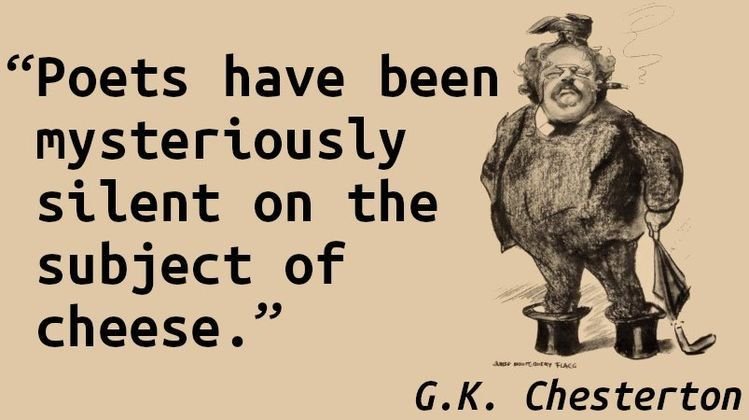
And before you think this Chesterton guy was some kind of genius, consider this: