
Philosophy, my field of study as an undergraduate, has fallen on hard times of late, and I don’t understand why, given that it is the foundation of every academic discipline; it is the ‘Ph’ in PhD (which stands for “doctor of philosophy”). So your professor with a doctorate in Chemistry actually is a “doctor of philosophy in Chemistry.” Same with Math, or Sociology, or some silly language like French. Philosophy is the discipline before the specialization: with logic it’s the precursor to things like Algebra and Geometry, with ethics it is the foundation for the social sciences, and semantics is just language without a country.
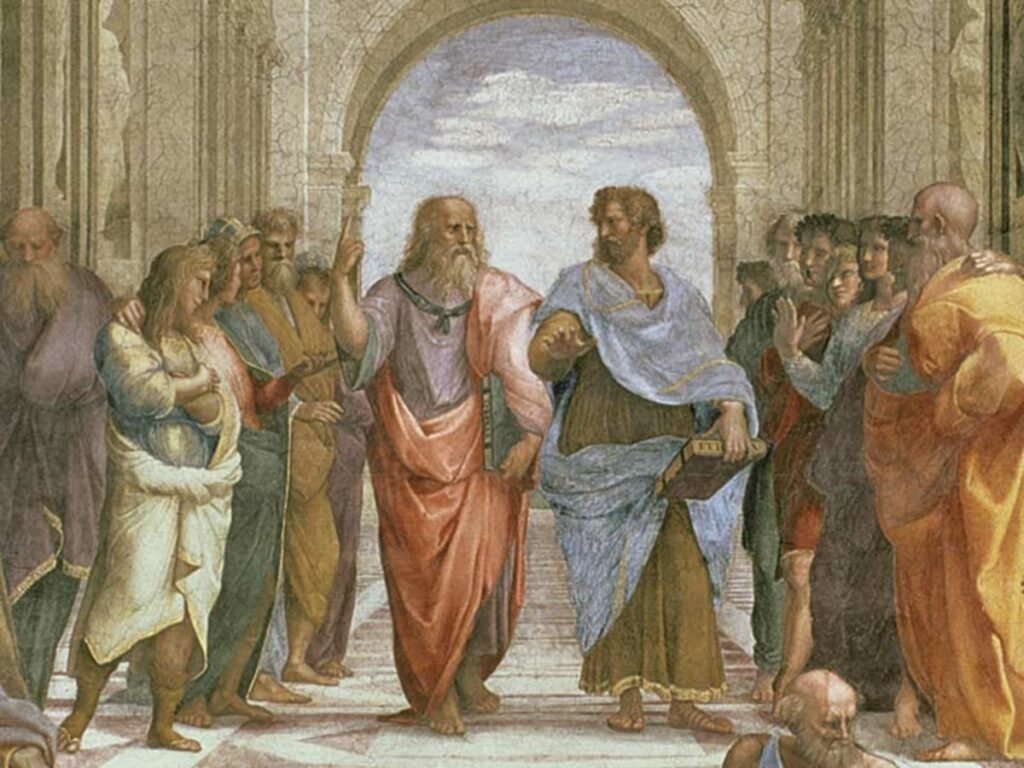
In Raphael’s “School of Athens” (above), perhaps the most famous painting in the world about philosophy (perhaps the only painting in the world about philosophy), Plato and Aristotle represent the two ways of thinking that anchor Western philosophy. Plato (on the left), holding the Timaeus, is pointing upward, toward the heavens, representing his belief that ultimate reality lies in abstract, eternal Forms (truth exists beyond the physical world). Philosophy, for Plato, is about transcending sensory experience to reach higher, ideal truths. Aristotle (on the right), holds the Nicomachean Ethics, and his hand is held flat and forward, toward the earth, representing his view that truth is found in the natural world, through observation, experience, and practical reasoning. Aristotle emphasizes empiricism, ethics, and how to live well in the real world in his philosophy. Rather than rivalry, they offer us two complementary approaches to knowledge: one looking upward to ideals, the other outward toward lived reality.
But philosophy never gets the respect it deserves. There’s that scene (one of my favorites in all of cinema) in Mel Brooks’ History of the World, Part I where Brooks plays an out-of-work philosopher in ancient Rome. He goes to the unemployment office to collect his unemployment check, and Bea Arthur is the clerk behind the counter; in a bored, civil servant, post office-esque tone she asks, “occupation?” Brooks replies, “stand up philosopher.” Arthur looks directly at him and says, “oh, a bullshit artist!… did you bullshit last week?… did you try to bullshit last week?”
Everyone has a philosophy of life, even if they don’t know it or call it that. Philosophies of life include three essential components: (1) a metaphysics, that is, an account of how the world works, (2) an ethics, that is, an account of how we should behave in the world and toward one another, and (3) a set of practices to help us live the ethics.
To use Christianity as an example, since it is the most common in the Western world, you’ve got your all-powerful, all-knowing god who created the world and everyone and everything in it while benevolently presiding over it (metaphysics), a well-documented behavioral framework from the teachings of Jesus based on the Ten Commandments (ethics), and activities like going to church, praying, tithing, receiving communion, and reading scripture (practices): everything you need for one helluva philosophy of life.
But there are others to be had, and they don’t all rely on religion. Mine, for example, is a carefully curated mixture of the stoicism of Epictetus, the pessimism of Schopenhauer, the absurdism of Camus (don’t call him an existentialist even though he is one, he hated Sartre!), and the sensibility of Seinfeld.
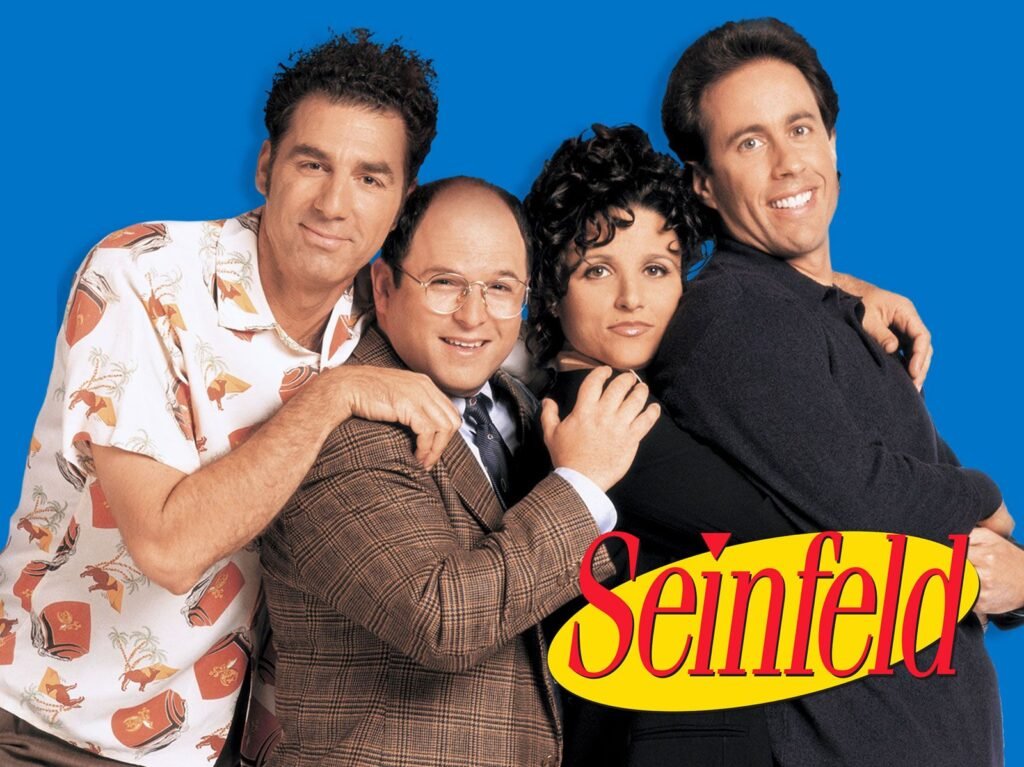
Yes, that Seinfeld, the sitcom from the 90s. Before Seinfeld, sitcoms were about lessons, growth, and heartwarming resolutions. Seinfeld threw all that formulaic woo out of the window and said ‘what if we just watch people be petty, selfish, and unchanged?’ That anti-moral stance was pretty radical at the time.
“The show about nothing” was the unfortunate way it was described; that’s actually a line from an episode where George and Jerry are trying to sell the script for a tv pilot they’ve written to the head of NBC in a brilliant bit of self-parodic comedy. But the phrase caught on, as did so many from the show, becoming a part of the lexicon of American life.
The show has been off the air now for almost three decades and we’re still using:
- “Yada yada yada” – skipping over boring or obvious details
- “Not that there’s anything wrong with that” – being defensive about homosexuality
- “Soup Nazi” – someone obsessively strict about the rules
- “Master of your domain” – exercising self-control over… you know… that!
- “No soup for you!” – rejection
- “Double-dipping” – committing a party crime
- “Close talker” – personal-space menace
- “Low talker / High talker” – as the name implies someone who whispers or shouts
- “Sponge-worthy” – evaluating someone suitable for a sexual liason
- “Anti-dentite” – someone who hates dentists, but used for any kind of bigotry
- “Breakup by answering machine” – cowardice
- “Festivus” – an alternative to Christmas for non-Christians or “the rest of us”
- “Serenity now!” – fake calm under extreme stress
- “George is getting upset!” – that rush of energy when you feel rage coming on
- “Shrinkage” – what happens to a man’s bait and tackle when he gets out of the pool
- “Re-gifter” – a social crime consisting of giving a gift first given to you as a gift
- “Sidler” – someone who sneaks up beside you without warning; I had a friend in high school named Sidler, but Bobby would never do such a thing… of course, he spelled his name with an ‘e’ (Seidler) and his family owned the Dodgers at the time
Seinfeld threw a spotlight on tiny, mundane, everyday annoyances – like waiting for a table in a restaurant and seeing people who arrived after you seated before you, or getting lost in a mall parking lot where all the rows (and the cars) start to look the same after awhile – and validated the idea that your dumbest, most trivial frustrations are actually universal.
Jerry, George, Elaine, and Kramer are deeply flawed and proudly self-interested, like most of humanity, adding another layer of universality to the show and making it a necessary ingredient in my philosophy of life. The role they play is not aspirational for me, but rather a good dose of what modern life is – it’s the how the world works (metaphysics). The show’s brutal honesty, set primarily in Jerry’s rather ordinary apartment and their booth at Monk’s coffee shop painted a much more realistic picture of the world for me than other shows I loved in my youth, like Dallas, Dynasty, and Blossom.
Yah, okay, Blossom… I thought the actor, Joey Lawrence (at right), who played Mayim Balik’s brother on the show was hot! I’m not above being shallow, and watching a show to satisfy my own prurient interests, meaning that I was definitely not the “master of my domain” on those nights, to borrow a phrase from Seinfeld.

I don’t base my personal philosophy in its entirety on Seinfeld, but it certainly plays a part. And I’ve noticed the strangest thing over the years: no matter what predicament, good or bad, I find myself in I can always think of a Seinfeld episode that dealt with exactly what I’m experiencing. Leading to one of my catchphrases I’m sure you’ve heard if you know me…
“There a Seinfeld for that.”
