It’s one of the most anticipated film releases of recent memory. At least for me. And no, I’m not talking about Michael, the Michael Jackson biopic that launched this weekend with a $97 million dollar opening in North American theaters and an unprecedented $217 million dollar worldwide box office – shattering the record for the biggest biopic opening of all time.
The film I’m talking about began its life in 2018 with a screenplay by Jon and Josh Silberman based on a 1997 book by American writer and humorist Ian Frazier, but was shelved in 2023 by Warner Bros. to obtain a tax write-off (remember, it’s called show business), but that decision was later reversed following public backlash.
Ketchup Entertainment acquired the rights in March 2025, and now we await the release of Coyote vs. Acme on August 28th of this year. Grab the popcorn!
I can’t wait! I’ve been a huge fan of Looney Tunes since childhood, and having just turned 60 there is some nostalgia here but mostly just excitement to revisit cherished characters. The premise is this: after every product made by the Acme Corporation has backfired on Wile E. Coyote in his pursuit of Road Runner, down-and-out human billboard attorney Kevin Avery represents Coyote in a lawsuit against Acme.
Confirmed characters that will be appearing include Wile E. Coyote and Road Runner of course, but also Miss Prissy, the spinster chicken who lived in the yard of Foghorn Leghorn, as a member of the jury, Porky Pig, Mrs. Cat as a flower shop vendor, Tweety, Daffy Duck, Foghorn Leghorn himself as an Acme Corporation representative, Bugs Bunny impersonating Deep Throat’s portrayal from All the President’s Men, Granny, Sylvester the Cat, Elmer Fudd, and Yosemite Sam. I haven’t been this excited since McDonald’s brought back the Shamrock Shake, which they do every March so at least I know I’m going to be excited once a year. Yes, as a newly minted senior citizen, I can now confirm it comes down to frozen dairy beverages and cartoons!
The Acme Corporation is one of the most recognizable fictional businesses in entertainment history, despite existing almost entirely as a running joke. Within the world of Looney Tunes, Acme functions as an all-purpose manufacturer of absurdly specific products, usually purchased by desperate, overconfident, or catastrophically unlucky characters. While it appears on the surface to be just a gag, Acme became one of the defining symbols of cartoon logic: a company capable of producing anything imaginable, often with disastrous results.
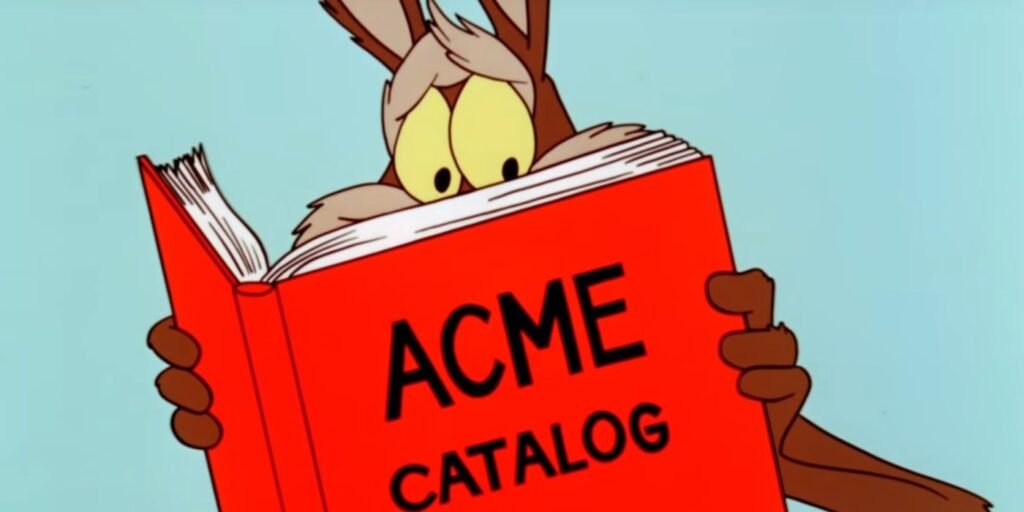
Acme’s most famous customer is of course Wile E. Coyote, whose endless pursuit of Road Runner depends almost entirely on Acme’s mail-order catalog. Rocket skates, giant slingshots, earthquake pills, portable holes, dehydrated boulders, spring-loaded shoes, and explosive tennis balls are just a few of the products he orders. These inventions are always theoretically brilliant but practically useless – or more accurately, they work perfectly until the exact moment they’re supposed to help Wile E. Coyote. Then they malfunction in the most spectacular way possible.
The genius of Acme lies in how it simplifies storytelling. Instead of explaining where a character got a giant magnet or an instant tornado kit, the writers simply slap the Acme label on it and move on. We immediately understand: the product exists because the joke requires it. Acme became shorthand for “cartoon technology,” where realism is irrelevant and comedic timing is everything.
The word “acme” itself is significant. In ordinary English, “acme” means the peak or highest point of achievement. That irony makes the company even funnier. Acme products promise excellence but usually deliver catastrophe. In the Looney Tunes universe, Acme is the supposed gold standard of invention, but its quality control is laughably inconsistent. The contrast between its name and its performance is central to the joke.
Although Wile E. Coyote is Acme’s most loyal and most victimized customer, he is not the only one. Other characters throughout Looney Tunes have used Acme products for traps, disguises, and pranks. Bugs Bunny occasionally uses Acme gadgets against his adversaries, while Daffy Duck and Sylvester the Cat have had run-ins of their own with Acme devices. Still, Wile E. Coyote defines the company’s identity.
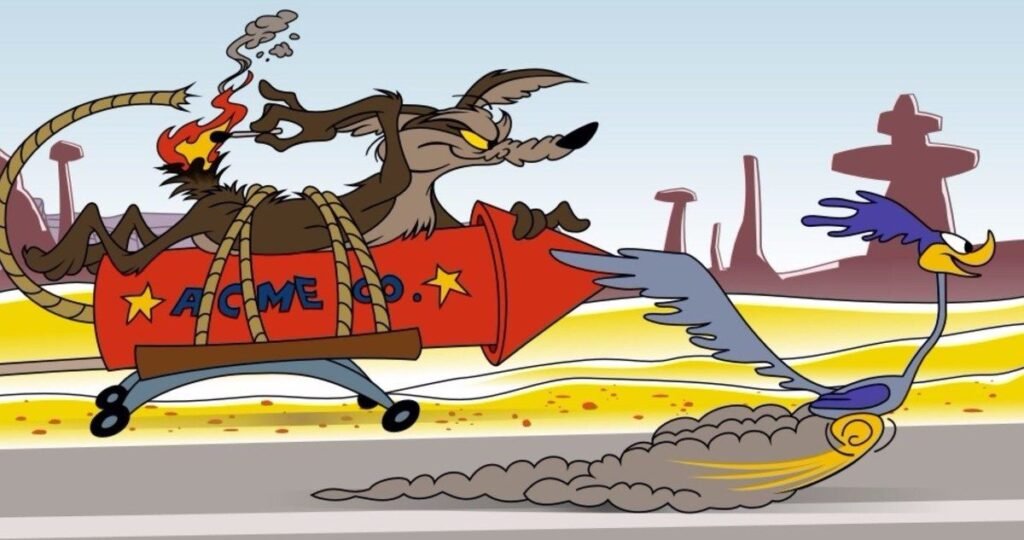
One fascinating aspect of Acme is that its products are rarely inherently defective. Often, they work exactly as intended. The failure usually comes from timing, physics, or fate turning against the user. A rocket may accelerate perfectly… straight into a cliff. A catapult may launch with flawless engineering… except the target moved. This nuance makes Acme funnier because it avoids making the company simply incompetent. Instead, it exists in a universe where bad luck and comic inevitability override engineering.
Acme also represents consumer optimism. Wile E. Coyote never learns. After every failed invention, he confidently orders another product, convinced this time will be different. This endless cycle mirrors real-world consumer culture in exaggerated form: the belief that the next purchase will solve all problems. In this sense, Acme is satire. It mocks advertising, innovation culture, and blind faith in technology.
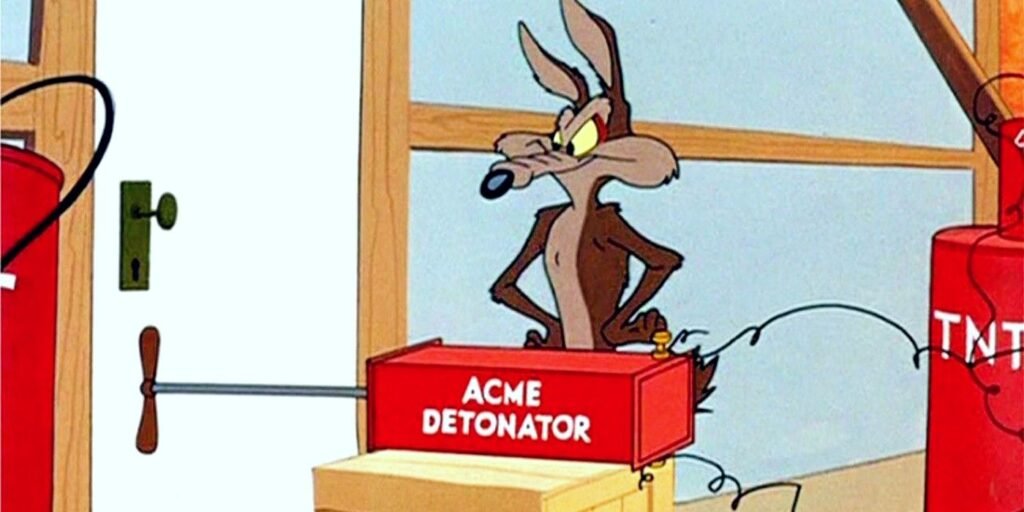
Visually, Acme branding is simple and iconic. The products almost always have “ACME” stamped in bold block letters, making them instantly recognizable. Whether it’s a bomb, an anvil, or a rocket-powered unicycle, the label serves as both a warning and a punchline. We see Acme and immediately anticipate chaos.
Acme symbolizes invention without wisdom. Wile E. Coyote is brilliant – arguably a scientific genius – but his intelligence is misapplied. Acme gives him tools, but not judgment. This dynamic creates a recurring theme: technology alone cannot guarantee success. In the world of Looney Tunes, cleverness often loses to instinct, speed, or improvisation, as demonstrated by Road Runner’s effortless escapes.
Acme’s staying power comes from its universality. Everyone understands the joke of buying a product that doesn’t solve your problem, or makes it worse. Looney Tunes exaggerated that frustration into absurdism. Instead of a disappointing kitchen appliance, Acme delivers rocket-powered roller skates that launch you into orbit.
Even decades after its creation, Acme remains one of the strongest fictional brands ever invented. It has transcended its original cartoons to become a symbol of unreliable innovation, comic inevitability, and the absurdity of problem-solving through gadgets alone. In many ways, Acme is the uncredited star of Looney Tunes. Without it, Wile E. Coyote would have far fewer plans, far fewer explosions, and far fewer encounters with gravity.
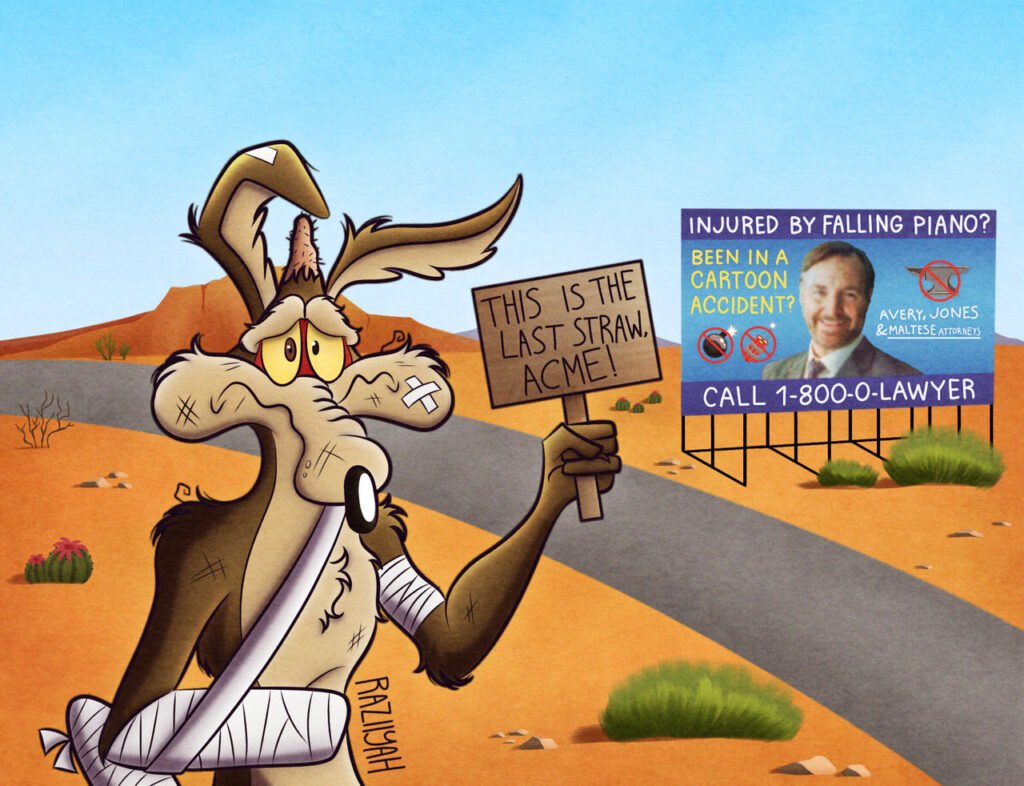
Ultimately, the Acme Corporation endures because it captures something essential about human nature: the cycle of hope, effort, failure, and repetition that defines life. Every Acme package carries the promise of success. We know it will fail. Wile E. Coyote never catches on, well at least until he decides to sue.
