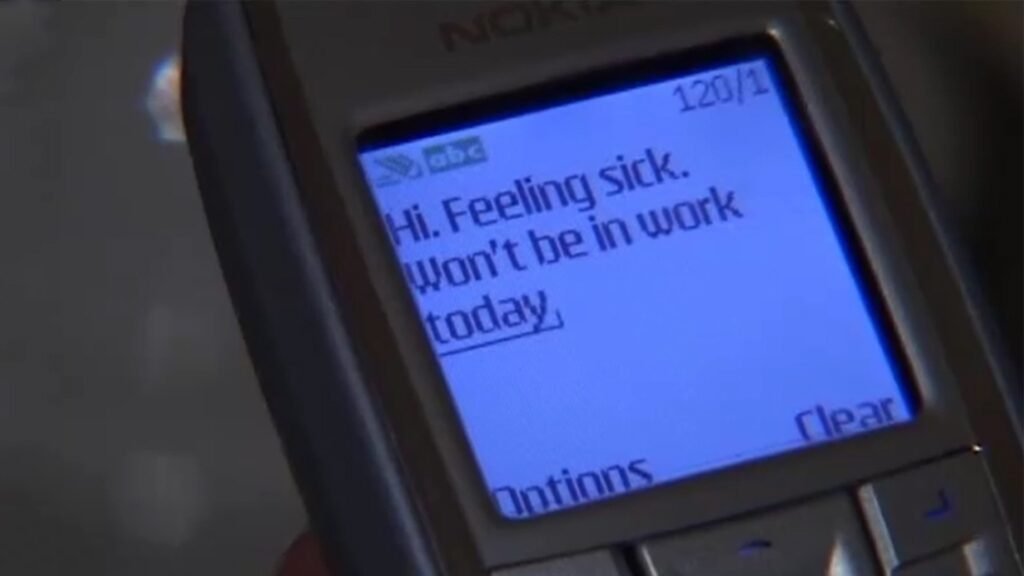
To begin, I think we need to agree on the term. We are describing the act of communicating with your boss, supervisor, manager, whatever-he-or-she-calls-him/herself that you cannot (or will not) perform the agreed upon labor you are employed to accomplish in return for financial remuneration for a period of time, which is usually unspecified but generally taken to mean over the next 24 hour period.
Some people refer to this as “calling in sick.” Some people refer to it as “calling out sick.” These people are what I like to call wrong. If you endeavor to utilize this methodology for shirking your duties, you should refer to it as “calling off sick.”
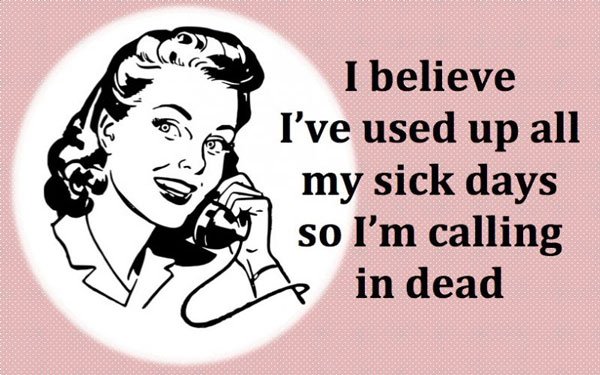
Calling off sick is one of life’s most delicate performances. It is theater. It is strategy. It is a one-person show entitled “I Am But a Fragile Human Being.” Whether you are genuinely ill or simply experiencing a powerful and debilitating case of “I cannot possibly deal with Steve today,” the art of calling off sick deserves respect.
Let’s begin with the moment of awakening. Your alarm goes off. It’s dark. It’s cold. Your body feels like it has been lightly marinated in regret. You perform the first diagnostic test: the throat swallow. Is it scratchy? Perhaps. Could you power through? Maybe. But then you remember that 9 am status meeting where Gary will use the phrase “circle back” at least seven times. Suddenly, your symptoms intensify. Your limbs feel heavier. Your spirit wilts like a Victorian child in a tuberculosis novel.
If you are genuinely sick, calling off is simple in theory but complicated in emotion. You feel bad – physically, yes, but also morally. You imagine your coworkers staring at your empty chair, whispering, “How could he [or she]?” You envision the printer jamming in protest. You picture your inbox swelling like a balloon full of air stretched so thin it is losing its color. Even with a fever, you feel compelled to write a novel-length apology explaining that you would absolutely be there if your body didn’t resemble one of those sweating purplish-orange 7-11 hot dogs that’s been out and rolling on the greasy metal thingy under a heat lamp since the Carter administration. Alas, my good and thoughtful readers, this is where a lot of amateurs make their first mistake.
The seasoned professional knows the proper sick call (or text) is brief. It is dignified. And above all, it is vague: “Hi, I’m not feeling well this morning and will be out today. I’ll respond to urgent matters as I’m able.”
Then there’s the fake sick day. Ah yes. The mental health day disguised as gastrointestinal drama. You wake up, perfectly healthy, and simply cannot face society. Your soul needs a duvet. Your brain requires pancakes and silence. This is when your acting skills come into play.
- Step one – timing: Calling off sick at 8:59 am for a 9:00 shift is suspicious. It suggests either chaos or cowardice. You want to strike at 6:47 am – early enough to imply that you’ve been awake, suffering nobly, perhaps pacing near a bathroom. This shows commitment.
- Step two – symptom selection: You must choose wisely. A cold is respectable but risky; people might expect you back tomorrow. A migraine is strong – mysterious and unprovable. Food poisoning is dramatic but overused. The gold standard is “stomach bug.” It is vivid, it is unpleasant, and no one asks follow-up questions because they do not want the answers.
- Step three – choose direct voice or text: For obvious reasons, texting is always preferable; it avoids having to channel your inner Suzanne Pleshette or Bea Arthur (i.e., sounding like you just smoked a carton of Marlboros). But texting comes with the awkward waiting period after you send the message; this is the most psychologically complex stage. You stare at your phone. Did they see it? Are they typing? Why are those three dots appearing and disappearing?
One way or the other, when your supervisor responds: “Feel better!” you are overcome with guilt, and if you’re not you are a horrible person. You almost confess. “Actually, I’m fine, I just need to reorganize my sock drawer and reevaluate my life.” But you resist. You are committed now. You must stay indoors like a fugitive.
The fake sick day has rules:
- You cannot post on social media.
- You cannot be seen in public.
- You cannot, under any circumstances, run into a coworker at Starbucks while purchasing a bagel and a latte at 10:30 am.
Of course, the irony is that calling off sick is often the healthiest thing you can do. Modern work culture has convinced us that attendance is a moral virtue. We drag ourselves in coughing like factory workers during the Industrial Revolution because we do not want to seem weak. Meanwhile, Brenda in accounting is quietly building immunity to fourteen new viruses she’s been exposed to in the office.
If you actually are sick, staying home is not laziness. It is thoughtfulness. It is a public service to be applauded. There should be a trophy or at least a certificate. How come we don’t get gold stars now for doing something good like we did in kindergarten? (Note to self: post topic for another day)
There is also the uniquely modern drama of calling off sick when you work remotely. Technically, you are already home. You are steps away from your laptop. Your boss knows this. You know this. So when you say you’re too sick to work, you must imply a level of suffering that makes sitting upright impossible. You are not “a little tired.” You are a wilted houseplant. You are a fallen warrior. You are typing this message from beneath three blankets while your nose secretes mucousy fluid on your keyboard. As a general rule of thumb, the involvement of bodily fluids lends credibility.
And yet, some managers respond with,“No worries! Just log on if you feel up to it later.” This is not comforting. This is a trap. “If you feel up to it” suggests that at any moment you could rally, like a plucky protagonist in the third act. But you are committed to your narrative. You are not logging on. You can’t! You are drinking tea. You hate tea.
Then there’s the return-to-work performance. If you were truly sick, you shuffle in looking pale and brave. You say things like, “I’m a little out of it,” and accept sympathy granola bars. If you faked it, you must calibrate your energy. Too cheerful, and suspicion arises. Too miserable, and people think you’re still contagious. Aim for something in the middle – “fragile but functional.” Speak softly. Mention soup.
Occasionally, there’s the coworker who never calls off sick. They arrive no matter what, coughing potentially biohazardous spittle on everyone around them. They say things like, “I never take sick days.” This is how plagues begin. We do not applaud this behavior. We smile and think unkind thoughts that involve the use of weaponry.
The truth is, calling off sick exposes our strange relationship with productivity. We equate presence with worth. We fear being perceived as unreliable. But humans are not machines. Machines do not get the flu. Machines do not experience existential dread on Tuesdays. Machines do not need to lie in bed contemplating their life choices while eating toast.
Sometimes a sick day is about physical recovery. Sometimes it is about preserving your sanity before you send an email that begins with “Per my last message” and ends with unemployment. Taking a day to reset can prevent burnout. It can remind you that your job is something you do, not something you are. Few people have jobs that define who they are – those that do are either clowns or cops. Or accountants.
Of course, moderation is key. If you are calling off sick every Friday with metronomic regularity, people will notice. Patterns are the enemy of deception. Illness should be random, like weather or plot twists. Alternate days, avoid Fridays and Mondays.
In the end, calling off sick is a small rebellion against the relentless march of obligation. It is you saying, “Today, my body and/or spirit has vetoed this nonsense.” Whether you are genuinely feverish or simply allergic to spreadsheets, the act requires courage, timing, and a well-crafted phone or text message.
So the next time you wake up feeling the technicolor yawn coming on or just profoundly uninterested in capitalism for 24 hours, remember these three rules if you remember anything: keep it short, keep it vague, and for the love of all things sacred, stay off Facebook.