I am actually a very shy person. If you find that easy to believe, good; I’ve done what I’m supposed to do. I may be outwardly shy and non-confrontational but sometimes, inside, I well up with megalomaniacal self-belief. In my head I act out little vignettes where I not only get my point across but bask in the glow of the recognition and the approving accolades that follow. It’s pathetic and I really wish I didn’t do that. I’m trying to stop.
Sometimes my confidence does collapse and I’m forced to “make up” an imagined scenario in which I shine. But then I’ll do something and my brain is telling me, “There you go again, Mr. Amazing!” When something I’ve done has gone well, I want everyone to know and I scheme to get the knowledge of it into everybody’s heads. But I know that it is not permitted for me simply to tell them – because, and this may sound old-fashioned, I wasn’t brought up that way.
There seem to be two universal lessons from childhood that stay with us as adults: no one likes a tattletale, and no one likes a bragger.

We overcame the first after 9/11, when the Department of Homeland Security taught the nation “If You See Something, Say Something.® ” And yes, the phrase is a registered trademark of DHS who primarily want us to be on the lookout for terrorists, even though it’s been adopted for use in a variety of situations, such as here at my very own residence where a poster bearing that exact phrase urges residents to be on the lookout for wrongdoing and raise issues of concern with the county’s long-term care ombudsman.
We’re whittling away at the second through social media. Try this little thought experiment out: next time you read a friend’s Facebook update, X post, or any of the others (Tik Tok, Instagram, whatever), imagine that person walking down your street shouting whatever they’ve shared on social media. Imagine someone, even a friend or relative, standing outside your front door yelling:
“I’m going to the movies… 3D rocks!”
-or-
“Just back from Disneyland… waited in line 3 hours to get on the Matterhorn.”
You wouldn’t have it. Yet that is precisely what the majority of social media is: self-promotion, or to call it by its uglier, more common name: bragging.

I boarded this particular train of thought because an author and columnist I read regularly mentioned the book Brag Better by Meredith Fineman. It asserts not merely that it’s okay to talk about yourself, but that you ought to. I looked into it. She writes, “There is a place for self-deprecation, but it needs to be used sparingly. If you rely on it as a mechanism it can undercut you. I would rather you took that out and try to cut it in half, because it’s not really serving you.”
There’s a lot to unpack there, but to my way of thinking (and the way I was brought up) self-deprecation is not a mechanism, it is manners. It’s not supposed to “serve you,” it’s an acknowledgment that it is impolite to praise yourself or bang on about yourself with no end in sight. I’m not saying that you shouldn’t give a good account of yourself in certain situations, like a job interview or an interaction with a potential landlord. There’s a time and a place for everything, including what might otherwise be considered bragging.
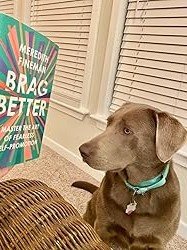
At its core, Brag Better reframes “bragging” as strategic, truthful self-promotion rather than arrogance. Fineman argues that many talented people, particularly those she calls the “Qualified Quiet” – individuals who do outstanding work but struggle to talk about it because to do so would mean talking about themselves – are overlooked because they don’t make a case for their personal value based on what they have achieved. Which is all well and fine, if it stopped there.
But when you drill down on the key principles Fineman explores, ostensibly related to a work environment, the emphasis on promoting your own value sounds an awful lot like the Human Potential Movement that emerged in the 1960s strongly influenced by Abraham Maslow’s theory of self-actualization. Fineman suggests that you:
- Reframe Self-Promotion
Bragging is not about boasting; it’s about stating facts about your achievements in a clear, confident way that benefits you and helps others understand your value. - Craft a Personal Narrative
Learning to describe your skills and accomplishments in a compelling way helps others remember you and your value. - Be Proud, Be Loud, Be Strategic
This three-part mindset teaches you to embrace your achievements (proud), share them consistently in the right contexts (loud), and plan how and when to communicate them (strategic). - Overcome Fear & Imposter Syndrome
The book discusses common internal barriers like feeling “icky” about self-promotion and offers tools to push past that discomfort.
Fineman writes in her book: “For too long we have paid attention to the wrong people because of their volume and showmanship.” This is one of those catch 22s because if we follow her advice we’d all be increasing our volume and showmanship – we’d become the wrong people. En masse! It’s like members of the gun lobby who say you can reduce shootings by giving more people guns.
I guess I’m just old-fashioned and would rather live in a society where we erred on the side of modesty and decorum, where blowing your own trumpet was frowned upon. I’ve always tried to live by a “show me don’t tell me” rule, one where the “the proof is in the pudding.”