
Dogs are among the most socially connected animals we interact with on a daily basis. Their behavior reflects the deep bond they form with us, particularly when it comes to moments of separation. Yesterday, in the midst of a game of Rummikub during our “Games with Chuck” activity in which I finally beat Betsy at something, I got into an argument with one of our volunteers and fellow dog lovers about what our precious fur babies are thinking when we go away. I say “argument” – it was more a friendly difference of opinion. It wasn’t as though we challenged each other to a duel at 20 paces! We’re not drama queens. Well, he’s not.
He has often asked me where I get my ideas for blog posts, and because I know he will be reading this, today he will get a straight answer (well, as straight as an answer from me can be!). Now, for my part, I thought that when you leave (say, to go to work, or to that new place downtown in La Plaza for brunch – Hunny’s) dogs think you are gone for good, and their extreme excitement upon your return (Gordon’s whole body shakes and he makes a high-pitched squeal that can be heard on the moon) is not just because you’re back, but because of the realization you had not abandoned them. Chuck, the eponymous host of our Thursday afternoons of games, disagreed. And I got it in my head to go and figure out just who was right.
Turns out, he was. But I wasn’t about to let all my research go to waste, so here you go thoughtful readers.
Although dogs do not perceive time or permanence in the same way humans do, their behaviors reveal important insights about attachment, routine, and emotional responses.
One key aspect of dog behavior is their strong reliance on patterns and routine. Dogs are highly observant animals and quickly learn the daily habits of their people. If one of those people regularly leaves the house and returns later, the dog gradually forms an expectation that the departure is temporary. Instead of believing that the person is gone forever, the dog simply recognizes that he or she is not present at that moment. This understanding is reinforced by repeated experiences in which the person eventually returns, strengthening the dog’s sense of predictability and security.
Another important factor in dog behavior is their limited concept of time. Unlike humans, dogs do not measure hours and minutes with precision. Instead, they rely on environmental cues to sense the passage of time. These cues may include changes in daylight, the fading of their favorite person’s (guardian’s) scent within the home, hunger cycles, or familiar sounds in the neighborhood. By using these signals, dogs can develop expectations about when certain events – such as feeding times or a person’s return – are likely to occur.
Despite this ability to adapt to routine, some dogs experience stress when separated from their people. This condition, often referred to as separation anxiety, causes dogs to react strongly to the absence. Dogs with separation anxiety may bark excessively, pace, chew on objects, cry, or wait by doors and windows. These behaviors are not the result of a belief that someone is permanently gone, but rather a stress response triggered by the temporary loss of a social companion.
Dog greeting behavior also provides insight into how they experience separation. Many dogs show intense excitement (like Gordon does) when their person returns home. Interestingly, and perhaps counterintuitively, research suggests that the level of enthusiasm can increase depending on how long the dog has been alone. A dog may greet a favored person more energetically after several hours away than after only a brief absence. This reaction reflects the emotional reward dogs experience when they reunite with someone they are strongly bonded to.
Overall, dog behavior during periods of separation highlights the powerful social connection between dogs and humans. While dogs may not understand the concept of “forever” in the same way people do, they clearly recognize absence and respond emotionally to it. Their reliance on routine, sensitivity to environmental cues, and joyful reunions all demonstrate how deeply dogs value the presence of their people. Through these behaviors, dogs reveal not only their intelligence but also their remarkable capacity for loyalty and attachment. And love.
Do you suppose this entire post was just a shameless excuse to post pictures of Gordon, of which I have thousands? This one happens to be one of my favorites and shows how he and I spend most of the day. Gordon is a Velcro dog.
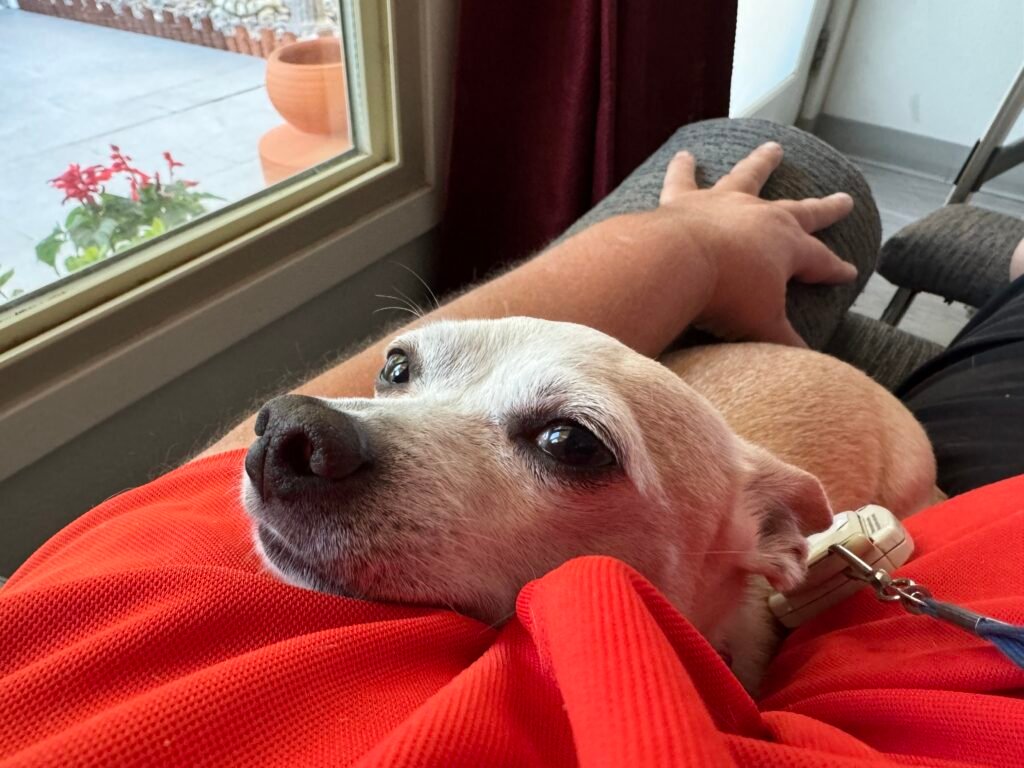
Dogs are known for their loyalty and close relationships with humans, but some dogs display a particularly intense form of attachment. These dogs are often referred to as “Velcro dogs,” a term used to describe dogs that prefer to stay extremely close to their person at all times. Like the fastening material Velcro that sticks tightly to another surface, these dogs seem to “stick” to their human companions, following them from room to room and seeking constant contact. Velcro dog behavior is the result of strong bonding instincts, breed tendencies, and social attachment to humans.
One of the most noticeable characteristics of a Velcro dog is its tendency to follow its person everywhere. Rather than remaining in one place, the dog may trail behind its person throughout the domicile, moving from the bathroom to the bed room and even waiting outside closed doors. Many Velcro dogs also prefer to stay physically close by sitting on their person’s feet, leaning against their legs, or curling up next to them on a couch or bed. This behavior is not necessarily a sign of anxiety; in many cases, it simply reflects the dog’s desire to remain near the person it trusts most.
The roots of Velcro dog behavior are closely tied to the history of domestication and breeding. Dogs are naturally social animals that evolved from wolves, which live and cooperate in packs. Because of this background, dogs are highly attuned to social relationships and often view their human families as members of their pack. Over time, certain breeds were selectively developed to work closely alongside people. Hunting dogs, herding dogs, and many companion breeds were expected to remain attentive to their handlers and respond quickly to human direction. As a result, these breeds often developed strong attachment behaviors and a natural tendency to stay near their people.
Velcro dog behavior can also be influenced by an individual dog’s personality and upbringing. Dogs that receive frequent interaction, attention, and companionship from their people may become especially attached to them. Similarly, dogs that have experienced changes in their environment, such as being adopted from shelters, may form particularly strong bonds with their new caregivers. In these situations, staying close to their person provides a sense of comfort and security.
While Velcro behavior is usually harmless and even endearing, it is important to distinguish it from separation anxiety. A Velcro dog may enjoy being near its person but can still remain calm when left alone for a period of time. In contrast, dogs with separation anxiety experience significant distress when their people leave. They may bark excessively, pace, chew on objects, cry, or wait on “high alert” by doors and windows. Understanding the difference between Velcro-ism and separation anxiety helps dog guardians determine whether their dog’s attachment is simply affectionate behavior or a sign of stress requiring training, behavioral support, or medication.
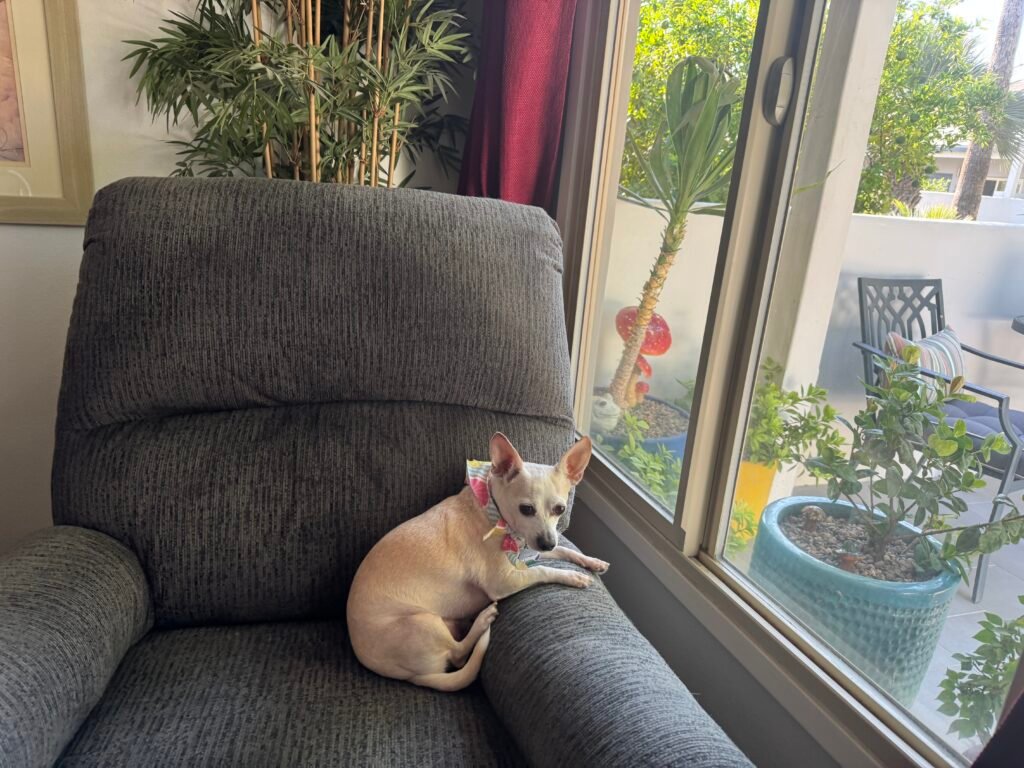
Gordon is somewhere in the middle of the spectrum. When I am around, he is always nearby; if I’m outside gardening, he takes up a position on the patio where he can keep me in his line of sight. When I am away, I’m told by our staff here that he perches like a sentinel on my recliner just inside my window (above) watching for my return, and that he cries. But beyond that he is not ill-behaved or destructive, though they tell me he vomited all over my apartment when I was away for a day last month for outpatient surgery.
And it works in reverse too. When I was hospitalized in 2024 with double pneumonia for a week, I became quite agitated and despondent being separated from Gordon. Our staff here at Stonewall took pictures and videos of him and texted them to me; I know their hearts were in the right place, but that only made it worse. Still, I didn’t bark excessively, pace, chew on objects, cry, or wait by the door or window.
That’s not entirely true – I did cry.
