People with disabilities account for 1-in-4 adults in the United States. Think about that; it’s a massive number! Though technically considered a “minority” group, there is nothing minor about it. People with disabilities are the largest and most diverse minority group in the country, representing all abilities, ages, races, ethnicities, genders, sexualities, religions, and socio-economic backgrounds.
I think many people, without malice, think “people with disabilities” are born that way, and many are. But I became disabled at 40 years old (as a result of a health crisis) and have been ever since. I have a friend who injured his knee playing catch with his son in their back yard and had to wear a brace on it for several months; while his injury healed, his mobility and ability to walk was impaired; he was, for a time, a person with a disability. I live in a residence populated by older people; some use walkers to walk, others use hearing aids to hear, a stroke survivor uses specially designed cutlery to eat given his dexterity problems. All of them are people with disabilities – mostly age-related, but disabled nonetheless.
So whether one is born with a disability – like Cerebral Palsey – injures oneself resulting in a temporary disability – like a broken knee – has an acute onset medical condition that leaves one with a disability – like a stroke – or one just grows old and experiences the disability of age – like hearing or vision loss, mobility impairment, and so on – it is important to realize that they are all disabled. The definition of a disabled person is not someone who came out of the womb impaired, nor is it limited to someone who will never overcome their impairment.
This expanded view of who is a disabled person, to my way of thinking, forms a critical component of “Disability Pride,” celebrated during the month of July in the United States to mark the passing of the landmark Americans with Disabilities Act (ADA) in July of 1990. Disability Pride Month aims to promote visibility and mainstream awareness of people with disabilities in an effort to better combat ableism.
Don’t let your eyes glaze over with a combination of fear and disinterest when I throw an “ism” at you; there seem to be a lot these days and it can be hard to keep up. And some of them, I’ll admit, can be pretty esoteric. Ableism is fairly simple. It’s just the belief that the world is designed for “normal” people without any impairments, and its up to the impaired to adapt to the world as it is; in other words, there is no societal requirement to accommodate the disabled. Let me give you an example.

Awhile back, a friend of mine invited me to see a local theater group – Dezart Performs – put on a play about the purge of homosexuals from the State Department (known as the “lavender scare”) in the McCarthy era of the 1950s. The play was to be staged in the auditorium of a private local women’s club called The Pearl McManus Theater. First we stopped for lunch at this little Vietnamese place with the most delicious phở, a Vietnamese soup consisting of broth (simmered for 14 hours with Vietnamese spices, roasted shallots, and ginger), rice noodles (bánh phở), herbs, and meat – usually beef (phở bò), or chicken (phở gà). Then it was off to the play.
When we arrived, I needed to relieve myself. This is a problem. I usually do my best to “hold it” until I get home where I live in a residence that took the time to and went to the expense of implementing the standards prescribed by the ADA to ensure disabled access. But, as I mentioned, the Pearl McManus was located inside a private club and was therefore exempted from implementing the ADA. Moreover the club was located in a building built and dedicated in the 1930s and, aside from a coat of paint and maybe some new carpeting, looked as though “modernizing” was not a priority!
My friend asked where the restrooms were located, and we were directed out into a courtyard and then down a narrow passageway, wide enough for an able-bodied man or women to walk down with ease, but challenging for me in a wheelchair being pushed by a senior citizen. I had a bad feeling about this.
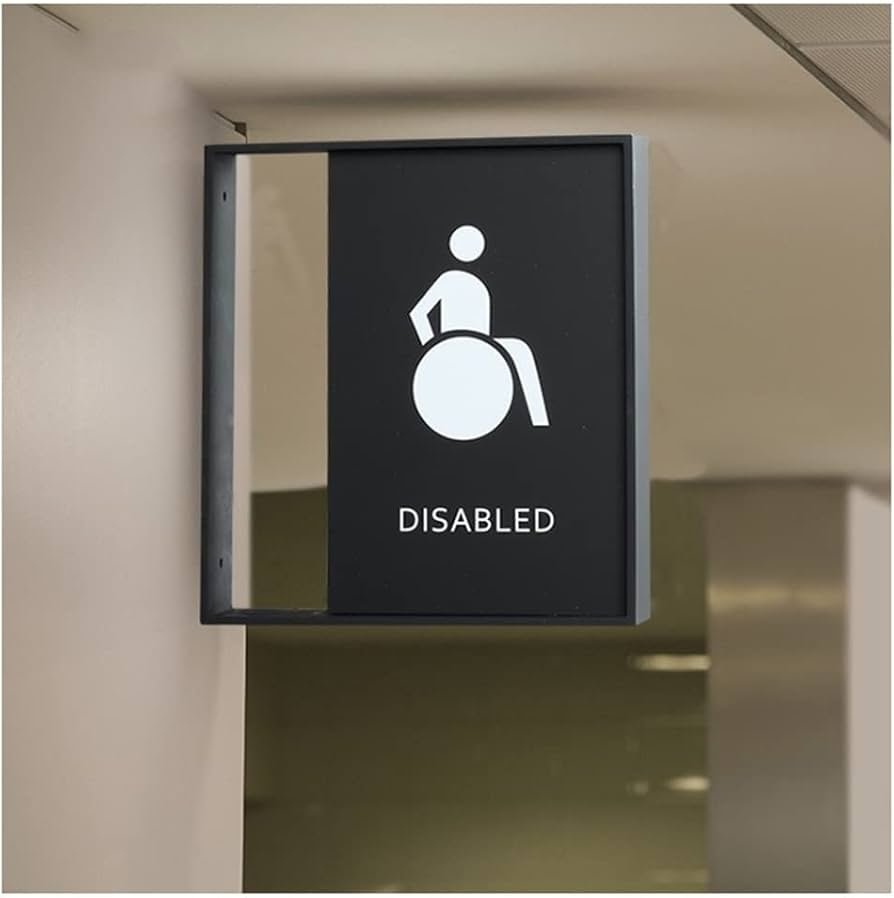
When we got to the restroom, the door was barely wide enough to squeeze my wheelchair through; in fact, I had to hold my elbows in at my ribcage to avoid banging them on the door jamb.
Things went downhill from there.
Inside, two porcelain urinals were affixed to one wall, a sink (without counter) was along another, complete with a stack of paper hand towels and an old-fashioned bar of what looked to be Palmolive soap (I didn’t even know they still made soap in bars!). Along the third wall was a stall. We’ll call it that, but it was really just some plywood built up around a commode and then painted the color of the room (which was a kind of dirty tan).
We opened the door to the “stall” and there was no way a wheelchair would fit in there, let alone maneuver into such a position I could transfer to the commode. Try this. Hold your left arm and your right arm out perpendicular to your body; the distance from the tips of your left fingers to your right is the width of that stall! To make matters worse, there were no grab rails. I looked at my friend and said, “I can’t use that.”
As three other men followed us into what was a public restroom, my friend motioned toward the urinals and said, “what about those?” I told him I might be able to stand, but I’d have to use both my hands to brace myself against the wall, meaning I’d have no hands free with which to loosen my belt, unbutton my pants, undo my zipper, and aim my penis, so he would have to do all that for me. He’s a good friend, but I would not ask him to do that – it would be awkward for him and embarrassing for me.
He went out to the lobby to ask people associated with the building if there was another restroom with disabled access. There was not. He returned with a clear plastic cocktail tumbler from the bar and said, “this is the best they can do.”

Meaning, their solution for a disabled person needing to use the facilities was to have that person (me) sit in my wheelchair in the middle of a public restroom, undo my pants and lower my underwear down around my ankles, and pee into a cup as horrified restroom-goers went about their own business. Which I did out of sheer necessity.
It was humiliating.
It is also an example of ableism. They were unprepared to have a disabled person in their building, and their “pee in a cup” solution to my problem suggested their belief that they had provided adequate facilities for everyone and anyone unable to make use of those facilities would need to adapt and come up with workarounds. But “everyone” includes people with disabilities, and they excluded them.
Stairs at the entrance to a public building with no ramp is an obvious example of ableism, but what about tables spaced too closely together in a restaurant to allow a wheelchair to pass between them without disrupting every diner in your path? Maybe you’re just old and your legs aren’t what they used to be – how about a parking lot so far away from the entrance that you have to sit down once inside the lobby for a little rest? Obviously, I’m focusing on physical disability and its limitations because that is what affects me, but the conversation must extend to issues of sight and sound (and other things) as well.
And Disability Pride Month, beyond promoting the acceptance of each person’s uniqueness, exists to foster these conversations and remind us that people with disabilities are all around us and there is no such thing as “normal.”
