
When the Civil Rights Act was passed and signed into law in 1964 by President Lyndon Johnson, it did not end discrimination, it signaled that it would be the official policy of the United States to treat all people equally under the Constitution. It acknowledged the inherent dignity of every person. Five years later, on June 28, 1969, some of those people, patrons of a bar in the Greenwich Village neighborhood of New York City, were harassed and subject to arrest while enjoying a night out.
It was nothing new. Many of them had been caught up in these “raids” of their gathering places before. They were keenly aware that by being themselves they were subject to hatred, to slander, and sometimes violence. They’d experienced it at school in the person of bullies who shouted out rude names and sometimes even threw a few punches once their “differentness” became clear. Persecution was not an imagined psychological “complex” for them, it was a reality they had lived with all of their lives.
But something took hold that June night in 1969 that spawned a movement, and LGBTQ+ people like myself commemorate and celebrate that night every year as we honor the courageous resistance of the patrons of the Stonewall Inn to mistreatment under color of authority. You can blow out a candle, but you can’t blow out a fire, and Stonewall was the conflagration.
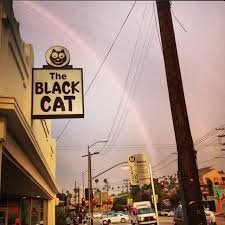
But it wasn’t the first time the match was lit. Two years earlier, in Los Angeles, on January 1, 1967, homosexuals, transvestites, probably a few “rent boys” (young male prostitutes), and some rough trade (gay men into the leather scene) had gathered at the Black Cat Tavern in the Silverlake neighborhood I called home for most of my adult life before moving to the desert. Just after midnight, eight undercover police officers from the LAPD raided the bar while those inside were ringing in the new year in the traditional way: celebratory kisses and embraces. The cops responded by beating patrons with billy clubs and night sticks, and dragging their bruised and bloodied bodies out of the bar and into the street where awaiting police vans sped them off to jail.


A month later, on February 11, 1967, hundreds gathered outside of the Black Cat to peacefully protest police brutality against the Los Angeles gay community and the discriminatory laws and procedures it was subject to. More importantly, the associated court case challenging the “lewd conduct” of bar patrons (the same-sex kissing at midnight on New Year’s Eve!) alleged by the LAPD as being the legal “reason” for the New Year’s Eve raid is significant as it marks the first time in US history that gay men were defended in a court case as equal under the Constitution.
Sadly, the courts disagreed with their definition of civil rights at the time, and equality remained the legal and aspirational law of the land, but not the reality for gay men (and lesbians, and the diverse, inclusive collection of backgrounds that make up today’s LGBTQ+ community).
“Stonewall” and “Black Cat” are not abstract names from history for me, like, say, the Bastille or Kitty Hawk. They are important moments in the history of the LGBTQ+ community to be sure, but they are immediate and present to me. Just yesterday, I had a conversation with one of the volunteers here at my residence – Stonewall Gardens – named in honor of the infamous 1969 New York City raid and subsequent protests. The volunteer had been at the Stonewall that night in 1969; chatting with him while I was weeding one of my flowerbeds was like talking with someone who had been in the audience at Ford’s Theater the night of April 14, 1865.
And though I was not even a year old when events unfolded at the Black Cat, I bellied up to that bar 30 years later, though it had gone through a number of name changes and was known as Le Barcito (“the little bar” in Spanish) when I darkened its doorstep. I could tell you about some of the nights I had (or that began) there back in the 90s, but I’d probably have to enter witness protection after. In 2008, the Black Cat was designated a Los Angeles Historic-Cultural Monument for its significant groundbreaking and trailblazing role in the history of the LGBTQ+ civil rights movement in the city of the angels, and the building was returned to its original “Black Cat” name in 2012 and reopened as a gastropub that caters to a diverse clientele. It is a “must stop” on any visit to LA. Oh my god, if those walls could talk!
And then, in 2023, I was reminded how proud I am to be a native Angeleno and Californian. Across California, hundreds of sites are designated as official state historical landmarks. They may be the homes of prominent individuals, locations of important businesses or events, and things like the California Mission Chain established by colonizing Franciscan friars; each landmark tells the story of California and Californians. A story which includes LGBTQ+ people. Bronze plaques explain the importance of the landmark, and special brown directional signage featuring the state symbol of a Grizzly Bear and the name of the landmark can be found on highways and roadways to alert drivers that a historic site is 500 feet away. And until October of 2023, none of the markers for a California Historical Landmark had to do with LGBTQ+ history.

Ray Najera, executive director of the California Landmark Foundation, had this to say announcing the installation of the Black Cat’s plaque:
It is important to teach an inclusive history of California because everyone deserves to have their history told…. The state landmark system has been in place for almost 100 years and this is the first and only registered California Historical Landmark that recognizes LGBTQ+ history; this is a step in the right direction.
Saturday, we commemorate Stonewall as part of Pride month. Today, as a transplanted Angeleno, I commemorate the Black Cat. San Francisco’s LGBTQ+ community will call your attention to the Compton’s Cafeteria riot that occurred five months before the protests at the Black Cat in response to the violent and constant police harassment of trans people, particularly trans women, and drag queens. LGBTQ+ people in other cities and towns across this nation, indeed across the world, will have their own place, their own story, to tell you about. The history of my community is steeped in activism and protests. It has had to be.
We advocate for our very lives.
I remain convinced that it was the protests at Compton’s, at Stonewall, and at the Black Cat that made the out and proud life I live today possible, and that my activism, less in the streets and more through this blog, will benefit future generations of LGBTQ+ people as I have benefited from the courage and the pride of those who have gone before me.
If I may be so bold as to steal, modify, and repurpose a quote from civil rights leader Martin Luther King, Jr.:
the arc of the rainbow is long but it bends toward justice.
