
Most people, when they learn about gravity, accept it with the same weary resignation they have about taxes, traffic, and the continued existence of Garth Brooks. Roger Babson was different. He looked at gravity and thought: this is unacceptable.
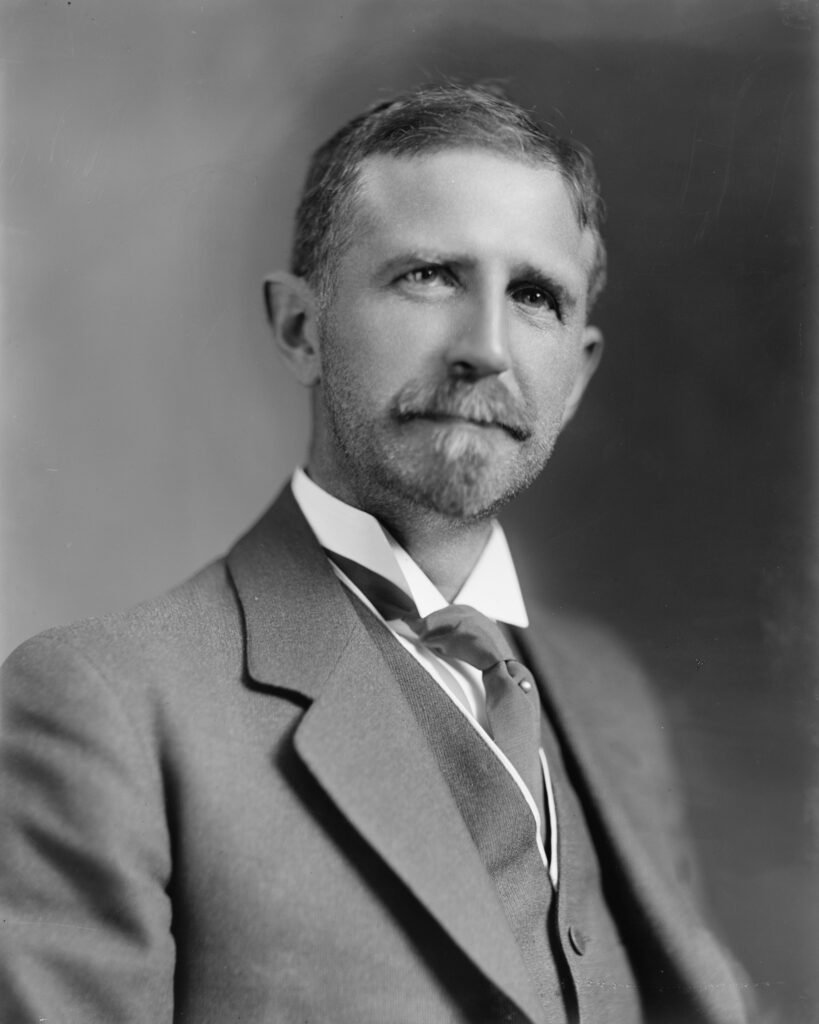
Roger Babson (left) was born in 1875; he was a wealthy American financier, statistician, businessman, and founder of what would eventually become Babson College. He made his fortune selling financial information and investment advice, which is perhaps why he developed the confidence necessary to pick a fight with one of the fundamental forces of nature. His hatred of gravity was not entirely unfounded. As a young man, Babson’s older sister drowned, and he blamed gravity for dragging her under the water. The drowning of his grandson reinforced his conviction.
To Babson, gravity was no longer merely a feature of the universe. It was an enemy. And so, having concluded that Newton had gone too far, Babson declared war.
He wrote a pamphlet called “Gravity – Our Enemy Number One” (catchy title, eh?) and began promoting the idea that humanity should find a way to defeat, neutralize, or at least inconvenience gravity. His vision was surprisingly ambitious. He imagined that science might eventually discover something like electrical insulation – some material capable of shielding objects from gravity.
Electricity could be blocked. Radio waves could be manipulated. Light could be reflected. Therefore, why not gravity?
This is the sort of reasoning that sounds wonderfully plausible right up until you remember that nature is under no obligation to make its fundamental forces behave like household appliances. Babson nevertheless put serious money behind the idea.
In 1948 he established the Gravity Research Foundation in New Hampshire, with the stated goal of encouraging research into gravitation and, initially, the possibility of defeating it. The foundation solicited ideas about gravity insulators, reflectors, absorbers, and anti-gravity devices.
Babson even erected monuments to the cause.
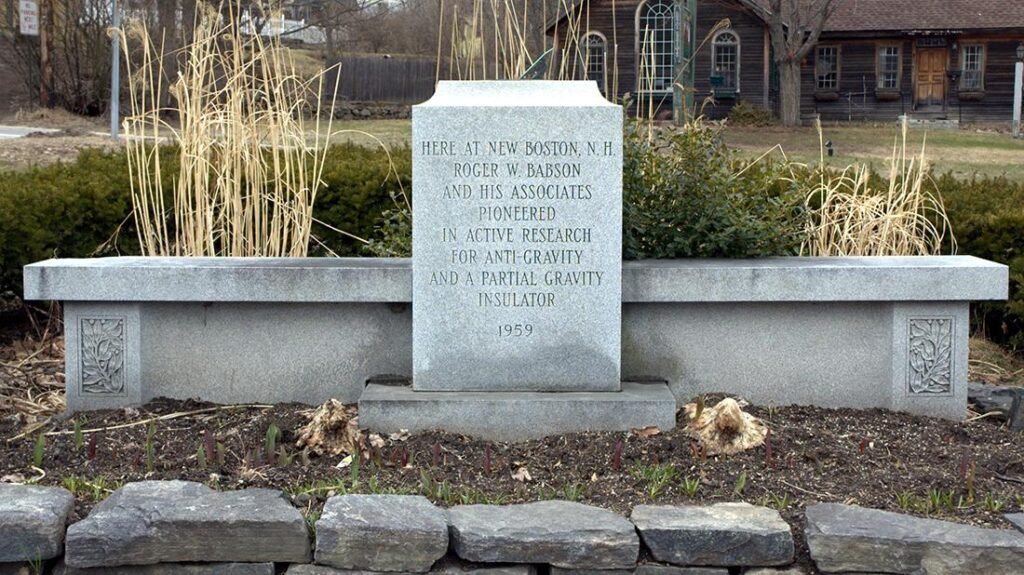
Because when your campaign against a fundamental force of nature isn’t going particularly well, the obvious next step is a granite monument.
His choice of New Hampshire was also characteristically Babsonian (to coin an adjective that no one neither needs nor asked for). He believed the area would be relatively safe from a future attack on Boston and envisioned it as a center for gravity research. Thus, in the New Hampshire countryside, one could contemplate the deeply important question of whether humanity might someday escape the gravitational prison of Earth while simultaneously being reassured that the Russians probably wouldn’t bomb the place (it was the Cold War after all).
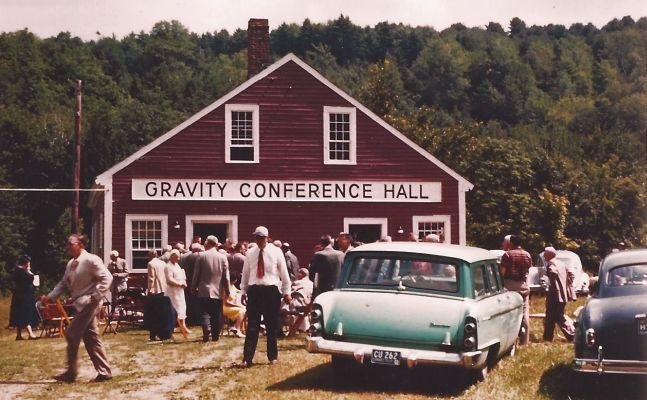
Babson’s ambitions extended beyond simply making things float. He imagined that controlling gravity might unlock new sources of energy and perhaps lead to revolutionary technologies. There was a distinctly 19th century optimism to the whole enterprise: if humans had conquered steam, electricity, flight, and disease, surely gravity was just another annoying item on the list.
Unfortunately for Babson, gravity did not cooperate.
No gravity shield appeared. No anti-gravity machine emerged from the laboratories. Newton remained undefeated. Objects continued to fall when dropped, people continued to require ladders to reach high shelves, and the universe showed no inclination whatsoever of respecting Babson’s investment portfolio.
Yet something rather wonderful happened anyway.
The Gravity Research Foundation survived Babson’s original obsession and gradually transformed into something much more scientifically respectable. Instead of trying to build a cosmic umbrella that would keep gravity from falling on your head, the foundation began supporting serious research into the nature of gravitation itself. It sponsored scientific essays, research, and academic work, and eventually became associated with legitimate advances in gravitational physics. Go figure!
In other words, Babson failed spectacularly at the thing he actually wanted to accomplish and accidentally helped create an institution that contributed to understanding the thing he wanted to destroy. There is a certain elegance to this.
The man who wanted to defeat gravity ended up funding physicists who wanted to understand it. And while Babson’s proposed gravity insulator never materialized, modern physics has since discovered phenomena that would have sounded almost as ridiculous to him as his own ideas sound to us: gravitational waves, black holes, neutron stars, and increasingly precise tests of Einstein’s general theory of relativity.
Babson’s specific belief that gravity could be shielded in the manner of an electromagnetic field was not supported by established physics, and there is still no known material that functions as a conventional “gravity insulator.” Gravity is not an electrical field that politely stops at a sheet of metal.
But dismissing Babson entirely as a lunatic would miss the more interesting part of the story.

He was certainly eccentric. He was also wealthy, stubborn, imaginative, and willing to spend his own money on an idea that most respectable scientists regarded as highly dubious. And although his proposed solution was wrong, his broader instinct – that gravity was sufficiently mysterious to deserve serious investigation – turned out to be rather less foolish than it initially appeared.
There is, finally, something deeply appropriate about the whole episode.
Roger Babson spent years campaigning against gravity because he believed it was holding humanity down. Gravity, apparently unmoved by the criticism, continued holding humanity down. Babson lost the argument. But he did manage to turn his grudge against the universe into a scientific institution. His foundation’s annual essay competition eventually attracted serious physicists, and its winners have included scientists who later became Nobel Prize winners. The Gravity Research Foundation continues to sponsor serious gravitational research.
So it just goes to show you: America has produced some serious nutjobs, and if it weren’t for crackpots like WK Kellogg trying to keep people from masturbating we wouldn’t have corn flakes. Likewise, if not for Roger Babson trying to make us all float, our understanding of the universe would not be where it is today – proving to me and I hope to you too, thoughtful reader, that nutjobs have their uses.
