
For almost a week now, I have been struggling to write about Jackie, a bald eagle that lived in a nest with a live webcam trained on it 24/7 high above Big Bear Lake, California, in the mountains just north of me. You see, she died last Monday, and I have been profoundly sad. There is something almost absurd about mourning the death of a bald eagle you never met.
And yet, in the midst of my own medical drama – tests to determine whether what they’re now calling a “cardiac event” was an indication of something more serious (it wasn’t and isn’t) – I’ve been secretly crying in my apartment, quickly wiping away the tears when a staff member comes to bring me something or get me dressed. One more observant than the others (or just more attentive and caring) noticed my eyes were red and asked, “are you okay?” Gordon has been laying his snout on my chest and staring at me, a mixture of concern and care on his face.
Jackie never knew my name. She never saw my face. She could not have cared less whether someone in Palm Springs was watching her sit on an egg, or whether a family in Ohio was holding its breath while she defended her nest. She was a wild animal living her very ordinary eagle life in a pine tree above Big Bear.
And yet, when Jackie died last Monday thousands of people around the world felt genuine grief. Local TV stations, and even those in the great metropolis of LA to the west of us, ran “breaking news” coverage, like they did when Queen Elizabeth of the United Kingdom died. Tributes started pouring in. People made retrospective videos on YouTube; one had me in tears for over 30 minutes, hyperventilating. I wrote this post several times, but each time I scrapped it because I had not captured the depth of my sorrow, the grandeur of her life, or the significance of this moment.
That is the strange and rather beautiful story of Jackie. A bird. A bird who touched me. A bird who touched me without even knowing it. A bird who is now gone.
For more than a decade now, Jackie and her mate, Shadow, were visible to the world through a livestream operated by Friends of Big Bear Valley (FOBBV). The camera did not show a wildlife documentary edited into dramatic little segments. It showed life as it actually happens: hours of sitting, sleeping, preening, and staring into the distance, interrupted by storms, territorial battles, eggs, hatchlings, ravens, and the occasional burst of unmistakable eagle drama.
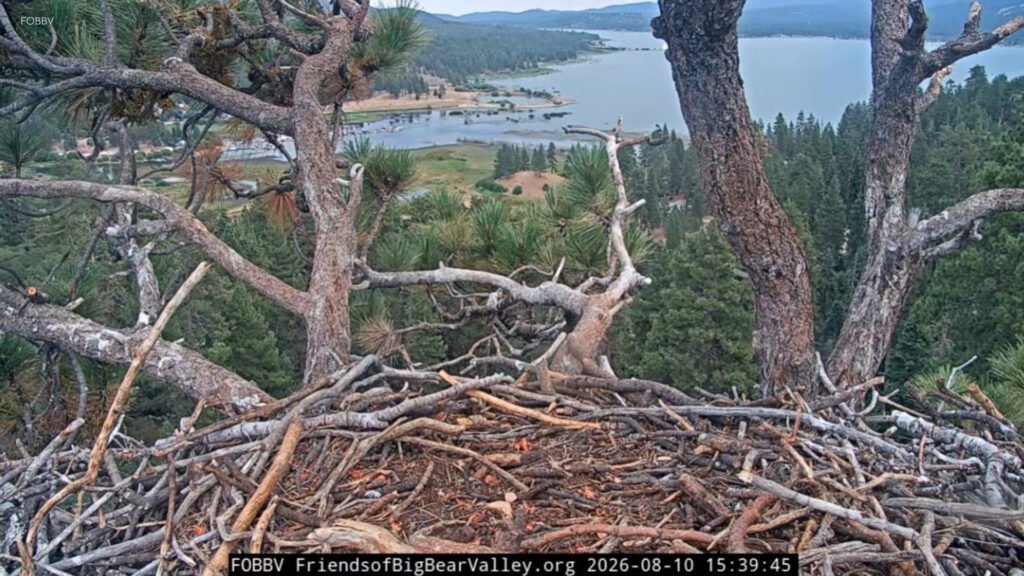
Like Jackie and Shadow’s infamous stick wars. One of them would carefully put a stick exactly where it obviously belonged in the nest, only for the other one to decide that clearly it did not belong there and move it, only for the other to move it back. Apparently, even bald eagles have strong opinions about interior decorating. But those moments were remarkably human at the same time. Who among us hasn’t argued with a partner or spouse about where to hang that picture or put that sofa?
The remarkable thing is that people kept watching.
We watched Jackie incubate eggs beneath blankets of snow, when only her eyes and her beak were visible. We watched her and Shadow build and defend their nest. We watched eaglets hatch, grow from ridiculous balls of feathers into recognizable birds, and eventually take their first flights. We watched the couple lose eggs, try again, and carry on. Just last January, ravens invaded the nest and ate their eggs. By February, a heartbroken Jackie had laid two more – a lesson for all of us about resilience in the face of setbacks, about determination, and about hope.
In short, we had a front row seat to a life.
And that may explain the extraordinary reaction to Jackie’s death better than the word celebrity does.
Jackie was not famous because she performed a trick. She wasn’t famous because someone gave her a clever voiceover or turned her into a meme. She became famous because the Internet, for once, allowed people to watch something without requiring it to entertain them every second.
She simply existed.
That turned out to be enough.
For viewers who returned to the livestream day after day, Jackie became a kind of seasonal anchor – a way to mark the passing of the year. January would mean the beginning of another nesting season. Spring meant eggs and hatchlings. Summer meant fledglings learning to become eagles. People developed rituals around checking the camera. Some watched while working. Some watched with their children. Some watched in classrooms. Some watched during lonely nights or difficult periods in their own lives. I watched daily; it was like a meditation. I looked forward to seeing what she was up to, even when it was very little.
The eagle was doing nothing extraordinary by eagle standards.
But something extraordinary was happening on the other side of the camera.
People were forming an emotional relationship with a creature they could never touch. With a creature that had no idea she was even being watched.
That phenomenon is easier to understand when we remember that humans have always attached ourselves to individual animals. We name them. We tell stories about them. We recognize their personalities. We root for them to survive. We grieve when they don’t. The Internet and webcam technology simply made it possible to do this collectively, across continents, in real time. Jackie became a communal animal.
Her death was especially painful because everyone had been following the final chapter so closely. In July, she had disappeared from the nest. Then came reports of an injured bald eagle near Big Bear Lake. Everyone waited anxiously while the rescue team determined that the bird was, in fact, Jackie, checking the chat window on the livestream or the Friends of Big Bear Valley website for updates, sometimes both, sometimes hourly. Jackie was severely ill, suffering from anemia and other problems, and despite intensive treatment – including a blood transfusion and oxygen therapy – she deteriorated. And then… Jackie died after more than three weeks of medical care.
The waiting made the grief worse.
Thousands of people had already spent days hoping she would recover. They followed updates from the rescue center. They celebrated small improvements. They worried about Shadow, who was suddenly raising their two young eaglets alone.
Then there was no next update.
No recovery.
No triumphant return to the nest.
Just Jackie, gone.
The reaction has been overwhelming. Online communities devoted to Jackie and Shadow (like the one I’m a member of) have filled with memorials and expressions of grief – people describing how they watched her through years of nesting seasons and came to regard her as part of their lives.
You, thoughtful reader, might find this strange.
After all, there are humans dying every day. There are enormous tragedies happening everywhere. Why should the death of one bird command so much emotional energy?
But grief isn’t an accounting system. We don’t mourn only according to the objective importance of the thing we’ve lost. We mourn according to attachment.
And Jackie gave people something increasingly rare: continuity.
The modern world is full of disposable information. News cycles last hours. Memes last days. Public figures rise and disappear. Algorithms constantly replace one subject of attention with another.
Jackie did the opposite. She was there year after year. The same nest. The same lake. The same mate. The same rituals. People could return to her.
That continuity made her strangely reassuring. The world changed around the camera, but Jackie kept doing Jackie things. She would sit on an egg. She would rearrange a stick. She would glare at an intruder. She would feed a chick.
There was something almost therapeutic about it. And perhaps that is why her death feels larger than the death of a particular bird. It represents the disappearance of a familiar presence.
Jackie had a personality.
She had a partner.
She had children.
She had a home.
You could watch her live there.
And Jackie did more than inspire affection. The attention surrounding the Big Bear eagles helped generate support for protecting their habitat, including a major effort to preserve land near the nest from development. Friends of Big Bear Valley launched a $10 million dollar fundraising campaign to buy land near the eagles’ nest which had been slated for development – drawing support from the local elementary school, as well as from OpenAI co-founder Greg Brockman. And I’m happy to report FOBBV will now steward 63 acres of the land. Offspring aside, that is Jackie’s greatest legacy.
As I reflected on my own relationship with Jackie these last couple of days, my sorrow at her loss gradually turned into gratitude for her life and the opportunity to watch it.
A wild animal became important to people without being captured, trained, dressed up, or forced to perform. People cared because they were allowed to observe her living her natural life.
They saw her struggle.
They saw her succeed.
They saw her raise young.
They saw her grow old.
And finally, they saw her die.
There is something profoundly human about that.
We like to pretend that our attachment to animals is just a silly nonsense, something we outgrow or set aside when faced with the “real” problems of the world. But Jackie taught me that empathy does not work that way. Caring about a bald eagle doesn’t mean caring less about people. Sometimes caring about one animal is precisely how we learn to care about the larger world that animal inhabits.
Jackie made a great wilderness feel personal.
A mountain lake in Southern California became someone’s neighborhood. A nest became someone’s familiar place – a home. An eagle became someone’s old friend.
Of course Jackie never knew any of this.
She was just being an eagle.
Maybe that’s the most moving part.
For more than ten years, while thousands of humans watched, Jackie never once performed for them. She didn’t know there was an audience. She didn’t know she had become a celebrity. She didn’t know that people were naming her offspring, worrying about her eggs, celebrating her victories and grieving her losses.
She simply lived.
And people, given the chance to watch a wild life unfold slowly and honestly, fell in love with her.
When Jackie disappeared from that nest, the world did not become objectively emptier. But for the people who had been watching her, their world did.
And that is what mourning really means. Not that the universe has lost its most important creature. Just that a particular creature had become important to you.
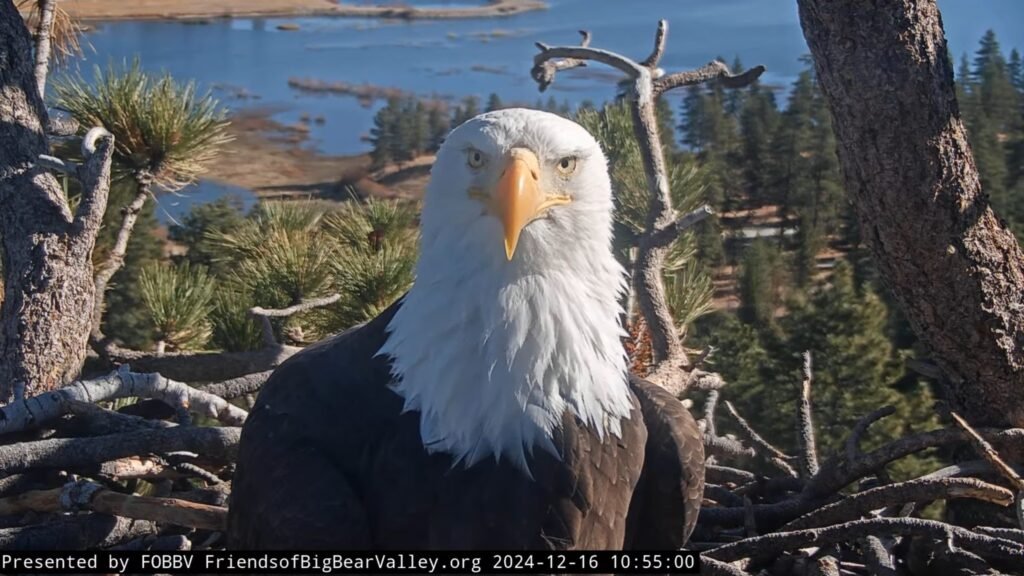
Jackie was one eagle. But for thousands of people, she was their eagle. And that was enough. She was my eagle. And I am going to miss her.
