
One of the most famous thought experiments in modern science and philosophy is Erwin Schrödinger’s cat, a paradox that captures the strange and counterintuitive nature of the microscopic world, brought to our modern consciousness by the Caltech physics nerds on the hit television sitcom The Big Bang Theory. Introduced in 1935, the idea was not meant to suggest that cats can literally exist in bizarre states, but rather to highlight the unsettling implications of Quantum Mechanics when applied beyond tiny particles. Even today, Schrödinger’s cat remains a powerful way to explore one of the deepest unresolved questions in science and its implications for philosophical inquiry: what does quantum theory actually say about reality?
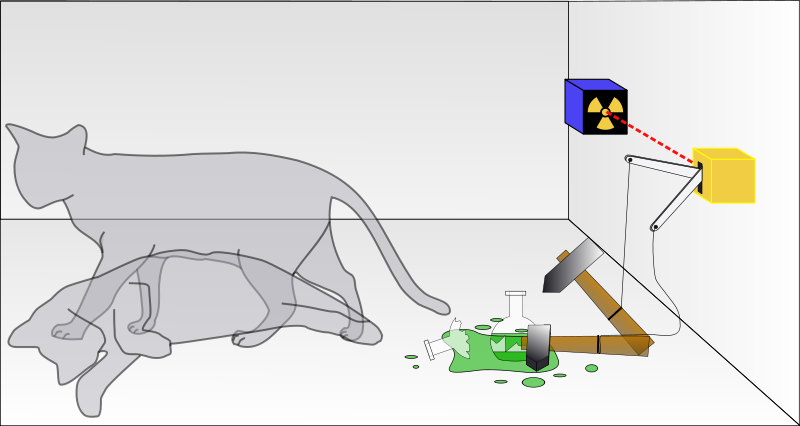
The thought experiment is simple but profound. Imagine a sealed box containing a cat, a small amount of radioactive material, a detector, and a vial of poison. If the radioactive atom decays, the detector triggers the release of poison, killing the cat. If it does not decay, the cat remains alive. According to quantum theory, however, the radioactive atom exists in a state of Quantum Superposition, meaning it is simultaneously both decayed and not decayed until it is observed. If the atom is in such a superposition, then the entire system, including the cat, must also be in a superposition. In this strange scenario, the cat is both alive and dead at the same time, at least until someone opens the box and observes the outcome.
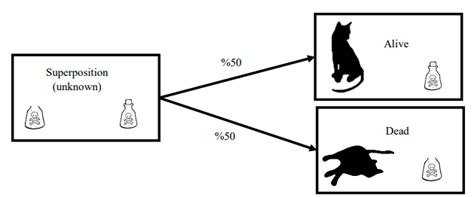
Schrödinger devised this scenario to expose what he saw as a flaw or incompleteness in the prevailing understanding of quantum mechanics. The dominant interpretation at the time, now known as the “Copenhagen Interpretation,” holds that quantum systems exist in multiple possible states simultaneously and that these possibilities collapse into a single outcome when measured. While this interpretation works extraordinarily well in predicting experimental results, it raises difficult philosophical questions. What exactly counts as a “measurement?” Why should observation play such a fundamental role in determining reality? And how can something exist in multiple states at once? Aren’t these the questions keeping you up at night thoughtful reader?

Despite these puzzles, the Copenhagen Interpretation remains the most widely taught and used framework in physics. Many scientists adopt a pragmatic stance: the theory works, so its deeper meaning is secondary. In practice, physicists can calculate probabilities and predict outcomes with remarkable accuracy without needing to fully resolve the conceptual issues. However, for those interested in the nature of reality itself, the unanswered questions remain deeply compelling.
One alternative that has gained significant attention is known as the “Many-Worlds Interpretation.” Proposed in the 1950s, this interpretation eliminates the need for wavefunction collapse altogether. Instead of a single outcome being selected when a measurement occurs, all possible outcomes happen, each in its own separate branch of the universe. In the case of Schrödinger’s cat, the universe splits into two: one in which the cat is alive and another in which it is dead. Observers in each branch perceive only their respective outcome, giving the illusion of collapse.
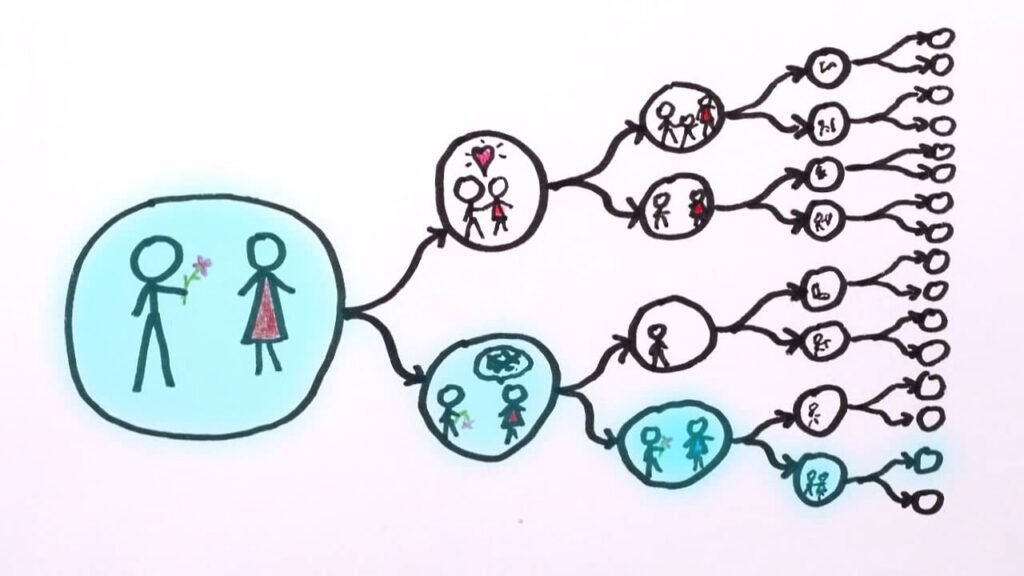
The Many-Worlds Interpretation is appealing to some physicists because it adheres closely to the mathematical formalism of quantum mechanics without introducing additional rules. However, it comes with its own conceptual challenges. The idea of countless branching universes is difficult to reconcile with everyday experience and raises questions about what it means for something to be “real.” Moreover, because these parallel worlds are not directly observable, critics argue that the interpretation may lie beyond the reach of empirical science.
A third approach is the “Pilot-Wave Theory,” which offers a more deterministic picture of the quantum world. In this framework, particles always have definite positions and properties, guided by an underlying wave. This eliminates the need for superposition in the sense of objects being in multiple states at once; instead, the apparent randomness of quantum mechanics arises from hidden variables that determine outcomes. While this interpretation restores a sense of classical realism, it introduces its own complications, particularly the idea of nonlocality, where changes in one part of a system can instantaneously affect another, regardless of distance.
A further possibility is provided by “Objective Collapse Theory,” which suggests that wavefunction collapse is a real, physical process that occurs spontaneously under certain conditions. Unlike the Copenhagen Interpretation, which ties collapse to observation, objective collapse models propose that nature itself enforces definite outcomes, especially for larger, more complex systems. These theories are particularly intriguing because they may be testable, offering the possibility of experimental evidence that could distinguish them from other interpretations.
Despite the variety of interpretations, an important point remains: they all produce the same experimental predictions. Whether one believes in collapsing wavefunctions, branching universes, hidden variables, or spontaneous collapse, the observable results are identical. This makes it extraordinarily difficult to determine which interpretation, if any, is correct. As a result, many physicists adopt an instrumentalist viewpoint, focusing on the practical use of quantum mechanics rather than its philosophical implications.
The debates surrounding Schrödinger’s cat also connect to broader questions about the role of the observer in physics. In classical science, the observer is typically seen as separate from the system being studied. In quantum mechanics, however, observation appears to play a more active role, blurring the line between subject and object. This has led to speculation about consciousness, measurement, and the nature of reality itself, though such ideas remain controversial and are not part of mainstream physics.
Ultimately, Schrödinger’s cat endures not because it provides answers, but because it vividly illustrates the mysteries at the heart of quantum theory, and indeed our understanding of reality. It forces us to confront the possibility that reality, at its most fundamental level, does not behave in ways that align with everyday intuition. Whether the universe splits into multiple branches, hides deeper deterministic laws, or operates through mechanisms we have yet to fully understand, the lesson is the same: our classical picture of reality is incomplete.
Schrödinger’s cat is more than a clever thought experiment; it is a gateway into one of the most profound scientific and philosophical debates of the modern era. While interpretations such as the Copenhagen Interpretation, the Many-Worlds Interpretation, Pilot-Wave Theory, and Objective Collapse Theory offer competing visions of quantum reality, none has yet achieved definitive confirmation.

As research continues and new experiments probe the quantum world with increasing precision, we may move closer to understanding what lies behind the mathematics. Until then, Schrödinger’s cat remains both alive and dead – not just in its box, but in the ongoing philosophical endeavor to comprehend the true nature of reality.
