
I have a complicated relationship with the holy man of Assisi, St. Francis. I no longer profess to be a Catholic, but I was a member of the Catholic religious order Francis founded in the 13th century, the Franciscans, for five years, from the time I was 19 until I was 24. Before that, I attended a Catholic high school run by a branch of the Franciscan order known as the Capuchin Friars for four years. All told, it was a formative decade of my life. During those ten years, I became well acquainted with the saint from Assisi.
Francis was very much a man of his time and place, and that was medieval Italy. But he is not bound by geography or a moment in time, or even a religious tradition. His way of understanding the world and our place in it, and how we should relate to one another – what would become Franciscan spirituality – is as relevant today, even in a non-religious context, as it was “holy” then. Perhaps that is what makes a saint a saint: that he transcends time. And perhaps that is why I still look to him for guidance in living my modern, secular, 21st century life.
The Prayer of St. Francis, sometimes known simply as the “peace prayer,” though not written by Francis, embodies his foundational idea that we must focus ourselves on reconciliation. Religious or not, who can argue with the ideas expressed?
… where there is hatred, let me sow love;
where there is injury, pardon;
where there is doubt, faith;
where there is despair, hope;
where there is darkness, light;
where there is sadness, joy…grant that I may not so much seek
to be consoled as to console,
to be understood as to understand,
to be loved as to love.
For it is in giving that we receive,
it is in pardoning that we are pardoned …
In the medieval Italian town of Gubbio, a bloodthirsty wolf was said to be devouring livestock and people alike, striking fear into everyone. Francis was sent for in nearby Assisi. But instead of approaching the terrifying beast as an enemy to be vanquished, Francis did something no one expected: he spoke to it. This remarkable encounter, that was first recorded in Latin in the early 14th century Actus beati Francisci et sociorum eius, became famous through “The Little Flowers” (I Fioretti), a later retelling translated into the Tuscan vernacular.
Written over a hundred years after Saint Francis of Assisi’s death, “The Little Flowers” is far from a reliable biography of him or history of his time. Rather, it offers an idealized portrayal of who he was and what he stood for, blending Franciscan oral tradition with the spiritual concerns of the 14th century when it was written. It is within this context that the remarkable tale of the Wolf of Gubbio appears, in chapter 21 of “The Little Flowers.”
The story is told that a “very great, terrible and fierce wolf” was ravaging the countryside around Gubbio, growing bold enough to approach the town itself. The townspeople, stricken with fear, dared not venture beyond the walls of the city, and then only when fully armed. This imagery of a city under siege is less an eyewitness account than an expression of medieval urban culture, which sharply distinguished the safety of the walled city from the dangerous wilderness beyond where outlaws held sway.
This wolf is not merely dangerous; he is portrayed as being unnatural: “he not only devoured animals but also men.” Francis makes mention of this when he addresses the wolf, admonishing him: “And not only have you killed and eaten animals, but you have also dared to kill men, who were made in the image of God – for which crime you deserve to be hanged like a thief and wicked murderer.”
Thus, the wolf is characterized as a criminal, having broken both divine and natural law. What makes the story truly extraordinary is Francis addressing the wolf as a rational creature, even humanizing him by calling him “brother wolf.” This has led some to interpret the wolf as an allegory – possibly a local nobleman who was oppressing the people of Gubbio, or a bandit preying on travelers outside the city walls. Francis calls him a “thief” and “murderer,” and the allusion is further supported by late medieval popular imagination, which associated outlaws hiding in forests with wolves or even werewolves. Around this time, the Italian expression teste di lupi or “wolf heads” began to be used to describe such criminals.
But Francis was not there as a lawman or judge, but to bring peace to the town by reconciling it with the wolf, and to do this, he first listens to the wolf’s story. The wolf tells Francis he had been left behind by his pack to fend for himself because he was injured and couldn’t keep up. He could only catch prey that didn’t run fast, like sheep and goats. He really would prefer to eat deer and rabbits, but, with his injured leg, that was out of the question as he could not catch them. He explained to Francis that he was hungry and all he wanted to do was eat.
Francis could see that the wolf was only acting out of necessity and not any evil design or motivation – he had made unfortunate choices that affected many people of whom he knew nothing. Through Francis the wolf was able to feel the pain of the people in Gubbio and he felt remorse. He was sorry for the pain he had caused, but he needed to eat – what could he do? It’s a cliché, but there are two sides to every story.
Francis then brings about the reconciliation by extracting a promise from the wolf: never again will he harm man or beast. In return, the people of Gubbio will promise to feed the wolf so that he shall no longer suffer hunger. And the pact is sealed through a solemn gesture: the wolf places his paw in Francis’ hand, as if they are shaking on it.

In the political culture of medieval city-states, where public agreement and civic consensus were essential, Francis and the wolf agreeing on a way forward is not sufficient. Thus, a second, public ritual follows: the wolf accompanies Francis back to Gubbio where they appear before the whole town, and the beast repeats his pledge before the assembled crowd. This mirrors actual recorded public reconciliations between feuding lords and urban authorities in medieval Italy that were often brokered by clerics.
The story concludes with the wolf, now fed by the townspeople, living out his days peacefully and dying of old age. No longer a predator, he has been welcomed within the walls of the city, within the order of law, and reconciled with the town.
Was the story inspired by a real, historical act of reconciliation with a bandit or a cruel lord? Perhaps. Does that make it any less compelling? No. Is it one that is relevant to us today, regardless of our background, politics, or religious affiliation. Yes.
But our story this morning does not end there.
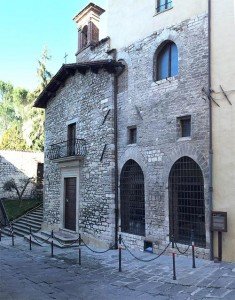
In the 17th century, a sanctuary (seen at left) was erected on the site believed to be the wolf’s burial place: the church of San Francesco della Pace, which, translated from the Italian, is simply “St. Francis of Peace.” Here, sculptures and portraits of the wolf were collected and venerated.
Fittingly, the church stands in a district of Gubbio that has been known since the 14th century as Morlupo, a name meaning “dead wolf.”
